
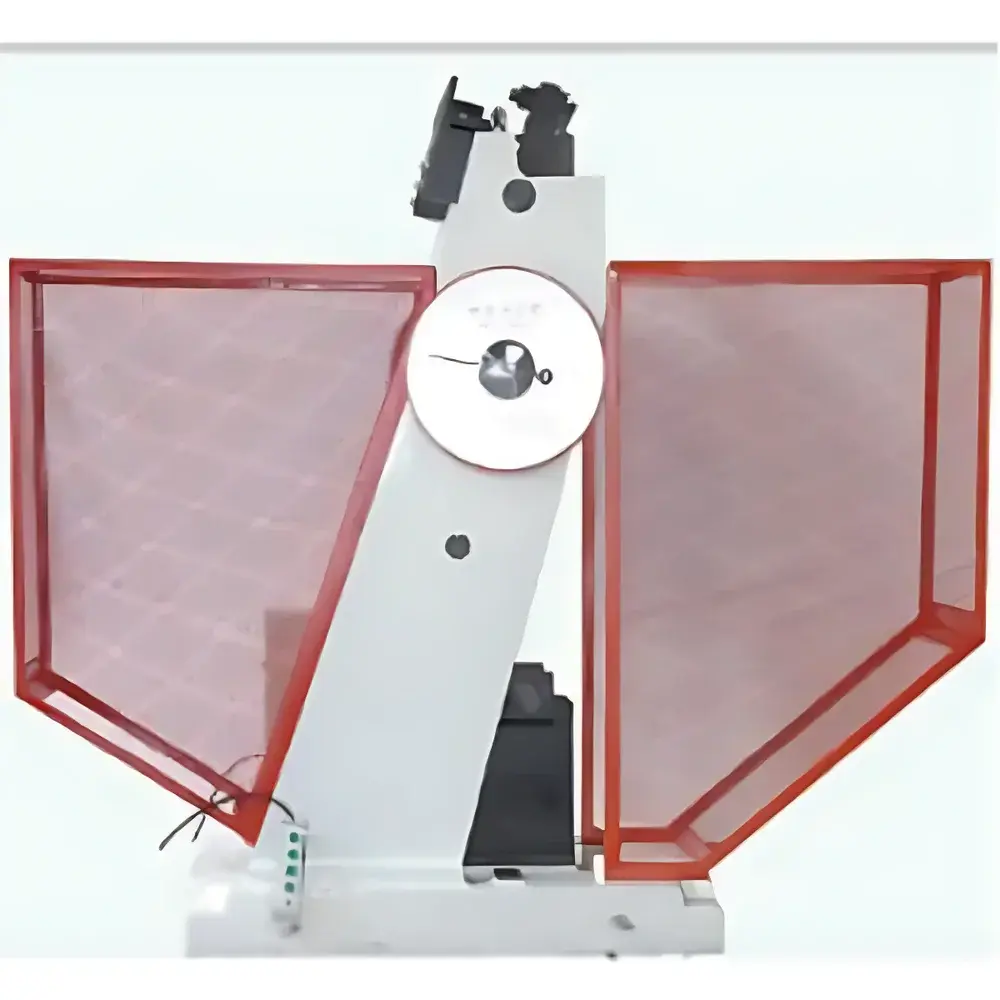
YANRUN JB-750C Semi-Automatic Pendulum Impact Testing Machine
| Brand | YANRUN |
|---|---|
| Origin | Shanghai, China |
| Manufacturer Type | Direct Manufacturer |
| Country of Origin | China |
| Model | JB-750C |
| Instrument Type | Pendulum Impact Tester |
| Nominal Impact Energies | 750 J, 600 J, 450 J, 300 J, 150 J |
| Impact Velocity | 5.5 m/s |
| Pendulum Arm Length (from pivot to impact point) | 825 mm |
| Pre-lift Angle | 150° |
| Anvil Span | 40 mm |
| Specimen Dimensions | 10 × 10 (or 7.5 or 5) × 55 mm |
| Hammer Nose Radius | R2–R2.5 mm (standard R2 mm |
| Hammer Included Angle | 30° |
| Hammer Blade Thickness | 16 mm |
| Specimen Support Surface Tilt | 0° |
| Base Plate Leveling Tolerance | ≤0.2/1000 |
| Power Supply | 3-phase AC 380 V ±10%, 50 Hz, 5 A |
| Net Weight | 2500 kg |
| Overall Dimensions | 2450 × 1200 × 2455 mm |
| Environmental Requirements | Ambient temperature 10–35 °C |
Overview
The YANRUN JB-750C Semi-Automatic Pendulum Impact Testing Machine is a precision-engineered mechanical testing system designed for standardized Charpy and Izod impact resistance evaluation of metallic, polymeric, and composite materials. Operating on the classical principle of gravitational potential energy conversion—where a calibrated pendulum is raised to a defined pre-lift angle (150°), released, and allowed to strike a notched or unnotched specimen—the JB-750C delivers repeatable kinetic energy transfer at a nominal impact velocity of 5.5 m/s. Its modular energy configuration supports five discrete impact energy levels (150 J, 300 J, 450 J, 600 J, and 750 J), enabling compliance with international test standards including ASTM E23, ISO 148-1, ISO 180, GB/T 229, and EN 10045-1. The machine’s robust cast-iron frame, precision-machined anvil and hammer assembly, and rigid 825 mm pendulum arm length ensure high mechanical stability and minimal energy loss during impact—critical for achieving measurement reproducibility within ±0.5% of full scale per ISO 148-2 requirements.
Key Features
- Multi-range pendulum system with interchangeable mass configurations to achieve five standard impact energies (150 J to 750 J) without hardware replacement
- Precision-ground hammer blade with dual-radius options (R2 mm standard; R8 mm optional) to accommodate both Charpy V-notch and U-notch specimen geometries per ASTM E23 and ISO 148-1
- Fixed 40 mm anvil span with zero-degree support surface inclination, ensuring strict adherence to standard specimen alignment criteria
- Integrated motor-driven lifting and release mechanism with electromagnetic safety lock and mechanical overtravel limiter, minimizing operator intervention while maintaining Class I safety compliance (EN ISO 13857)
- Adjustable specimen centering gauge and support alignment tool kit included for traceable setup verification prior to each test series
- Heavy-duty structural base (2500 kg net weight) mounted on ≥300 mm thick reinforced concrete foundation to suppress dynamic resonance and maintain angular repeatability within 0.2/1000 leveling tolerance
- Three-phase 380 V power interface with built-in surge suppression and thermal overload protection for continuous laboratory operation under GLP-compliant environmental conditions (10–35 °C, RH ≤85%)
Sample Compatibility & Compliance
The JB-750C accommodates standard Charpy specimens measuring 10 × 10 × 55 mm, with optional support for reduced-section variants (10 × 7.5 × 55 mm and 10 × 5 × 55 mm) using certified alignment fixtures. Notch geometry is verified using NIST-traceable depth gauges and optical profile projectors. All mechanical components—including the pendulum shaft bearing, anvil clamping surfaces, and hammer nose—are manufactured to ISO 2768-mK general tolerances and subjected to post-machining stress relief. The system meets essential requirements of ISO/IEC 17025 for testing laboratories when operated with documented calibration procedures, annual verification against certified reference pendulums (e.g., PTB or NPL traceable), and maintained logbooks for energy calibration, anvil wear inspection, and environmental monitoring.
Software & Data Management
While the JB-750C operates as a semi-automatic electromechanical platform without embedded digital control, it is fully compatible with third-party PC-based data acquisition systems via analog voltage output (0–10 V proportional to residual energy) and TTL-level trigger signals. When integrated with compliant software (e.g., LabVIEW-based modules or ISO 17025-validated LIMS interfaces), the system supports audit-trail-enabled test record generation, automatic energy calculation per ASTM E23 Annex A1, statistical reporting (mean, SD, CV%), and electronic signature workflows aligned with FDA 21 CFR Part 11 requirements. Calibration certificates, operator credentials, and environmental logs may be archived alongside raw impact traces for full GLP/GMP traceability.
Applications
This impact tester is routinely deployed in metallurgical QA/QC labs for evaluating ductile-to-brittle transition behavior in structural steels, weldments, and pressure vessel alloys; in polymer R&D for assessing notch sensitivity in thermoplastics and composites; and in academic materials science programs for comparative fracture toughness studies. Its 750 J capacity enables testing of high-toughness armor-grade steels and large-section castings, while the lower energy ranges support precise characterization of thin-sheet metals and brittle ceramics. The system serves as a primary reference instrument in accredited testing facilities performing certification tests for ASME BPVC Section IX, API RP 5L, and EN 10204 3.1 material declarations.
FAQ
What standards does the JB-750C comply with for Charpy impact testing?
ASTM E23, ISO 148-1, ISO 180, GB/T 229, EN 10045-1, and DIN 50115.
Can the machine perform both Charpy and Izod configurations?
Yes—using optional anvil and clamp assemblies, the JB-750C supports both vertical (Izod) and horizontal (Charpy) specimen orientations per standard definitions.
Is periodic calibration required—and what does it entail?
Yes. Annual verification using certified reference pendulums and quarterly checks of anvil span, hammer radius, and specimen alignment are mandatory for ISO/IEC 17025 compliance.
What electrical infrastructure is needed for safe installation?
A dedicated 3-phase 380 V ±10%, 50 Hz supply with 5 A minimum circuit rating, earth ground resistance <4 Ω, and isolation from high-frequency industrial equipment.
Does the system include safety interlocks for operator protection?
Yes—electromagnetic brake engagement, physical guard door switches, and mechanical pendulum arresters conform to EN ISO 13857 Category 1 safety architecture.



