
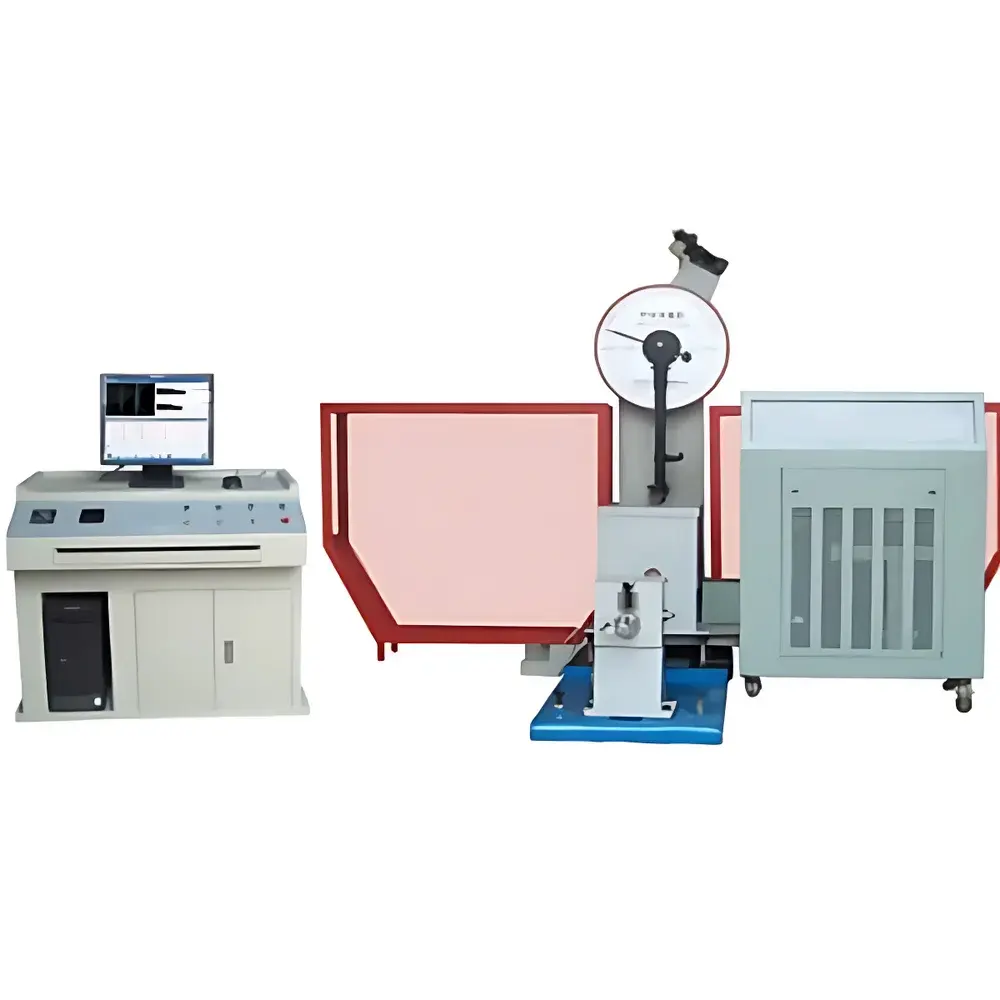
YANRUN JBN-300 Semi-Automatic Pendulum Impact Testing Machine
| Brand | YANRUN |
|---|---|
| Origin | Shanghai, China |
| Manufacturer Type | Direct Manufacturer |
| Product Category | Domestic |
| Model | JBN-300 |
| Instrument Type | Pendulum Impact Tester |
| Nominal Impact Energies | 150 J, 300 J |
| Impact Velocity | 5.2 m/s |
| Pendulum Arm Length (from axis to impact point) | 750 mm |
| Specimen Support Span | 40 mm |
| Anvil Radius (Charpy/Izod) | R1–R1.5 mm |
| Hammer Nose Radius | R2–R2.5 mm |
| Hammer Blade Thickness | 16 mm |
| Angular Accuracy | ±0.1° |
| Standard Specimen Dimensions | 10 × 10 × 55 mm |
| Machine Dimensions (L×W×H) | 2300 × 600 × 1400 mm |
| Net Weight | 550 kg |
| Power Supply | 3-phase AC 380 V ±10%, 50 Hz, 5 A |
| Environmental Requirements | Non-corrosive atmosphere, vibration-free installation site, absence of strong electromagnetic fields |
Overview
The YANRUN JBN-300 Semi-Automatic Pendulum Impact Testing Machine is a precision-engineered mechanical testing system designed for standardized Charpy and Izod impact toughness evaluation of metallic and polymeric materials in quality control, metallurgical research, and industrial certification laboratories. Based on the classical pendulum principle—where gravitational potential energy is converted into kinetic energy upon release—the instrument measures the energy absorbed by a notched specimen during fracture under controlled impact loading. Its dual-energy configuration (150 J and 300 J) enables compliance with major international standards including ISO 148-1, ASTM E23, GB/T 229, and EN 10045-1. The machine features a rigid cast-iron frame, calibrated pendulum arm with 750 mm effective length, and a precisely aligned impact axis ensuring high reproducibility across repeated tests. With an impact velocity of 5.2 m/s and angular resolution of ±0.1°, the JBN-300 delivers traceable, repeatable results suitable for material qualification, heat treatment verification, and failure analysis workflows.
Key Features
- Dual-capacity pendulum system supporting both 150 J and 300 J nominal impact energies—switchable via interchangeable hammers and calibrated damping compensation
- High-stiffness monolithic base and reinforced column structure minimizing dynamic deflection during impact event
- Integrated motor-driven lifting mechanism and automatic pendulum release system enabling semi-automated test cycles with reduced operator intervention
- Dedicated Charpy and Izod anvils and hammer blades conforming to ISO 148-2 and ASTM E23 geometry specifications (including R2–R2.5 mm hammer nose radius and R1–R1.5 mm anvil radii)
- Standardized 40 mm support span and 10 × 10 × 55 mm specimen fixture compatibility—fully compliant with reference specimen dimensions defined in ISO 148-1 and GB/T 229
- Mechanical safety interlock system with optical shielding and emergency stop circuitry meeting CE machinery directive requirements (2006/42/EC)
- Onboard angular encoder and digital position feedback for real-time pendulum trajectory monitoring and post-test energy calculation validation
Sample Compatibility & Compliance
The JBN-300 accommodates standard notched specimens per ISO 148 (Charpy V-notch and U-notch) and ASTM E23 (Izod), including metallic alloys, structural steels, aluminum extrusions, and engineering thermoplastics. Specimen alignment is facilitated by dual-purpose centering tools—one optimized for Charpy and one for Izod configurations—ensuring consistent notch positioning relative to the impact plane. All mechanical components—including the 16 mm thick impact blade, hardened steel anvils, and adjustable support blocks—are manufactured to dimensional tolerances specified in ISO 148-2 Annex A. The system supports full auditability for GLP and GMP environments through documented calibration records, traceable to national metrology institutes (e.g., NIM China or NIST-traceable reference standards). While the base configuration does not include electronic data logging, its mechanical design permits third-party integration with compliant digital acquisition systems for 21 CFR Part 11–ready reporting when paired with validated software platforms.
Software & Data Management
The JBN-300 operates as a standalone mechanical tester without embedded microprocessor control or proprietary software. Energy values are determined manually using the scale-and-pointer method or via optional external digital angle encoders interfaced through RS-232 or analog voltage output (0–10 V). For laboratories requiring automated data capture, the machine is compatible with third-party DAQ systems supporting IEEE 1451.2 transducer interface standards. When integrated with LIMS or ELN platforms, raw angular displacement data can be processed using industry-standard algorithms to compute absorbed energy (J), normalized to specimen cross-section. Calibration certificates for pendulum moment of inertia, friction loss correction, and zero-energy offset are supplied with each unit and must be retained for ISO/IEC 17025 accreditation audits. No firmware updates or cloud connectivity are implemented—ensuring long-term stability and regulatory acceptance in regulated manufacturing settings.
Applications
- Quality assurance of structural steels in pressure vessel, pipeline, and offshore construction sectors
- Toughness verification of weld metal and heat-affected zones (HAZ) per AWS D1.1 and API RP 2A
- Low-temperature impact screening of cryogenic materials (e.g., ASTM A333 Grade 6) using environmental chambers
- Metallurgical process validation—including quenching, tempering, and normalizing cycles—via comparative Charpy transition curve analysis
- R&D evaluation of polymer composites and fiber-reinforced plastics where notch sensitivity and brittle-to-ductile behavior are critical design parameters
- Third-party certification testing for CE marking, CCC (China Compulsory Certification), and ASME Section II material compliance
FAQ
What standards does the JBN-300 comply with?
The JBN-300 meets the mechanical and geometric requirements of ISO 148-1, ASTM E23, EN 10045-1, and GB/T 229 for pendulum impact testing. Calibration and verification procedures follow ISO 17025–accredited methodologies.
Can the JBN-300 perform both Charpy and Izod tests?
Yes—the system includes dedicated Charpy anvils, Izod anvils, and corresponding hammer assemblies, allowing rapid reconfiguration between test modes without tooling modification.
Is electrical safety certification provided?
The unit complies with IEC 61000-6-2 (immunity) and IEC 61000-6-4 (emission) standards and carries CE marking for machinery safety (2006/42/EC) and low-voltage directive (2014/35/EU).
What maintenance is required for long-term accuracy?
Biannual verification of pendulum axis alignment, anvil parallelism, and hammer blade wear is recommended. Friction loss correction must be recalculated annually using certified reference specimens per ISO 148-3.
Does the JBN-300 support temperature-controlled testing?
The base model is ambient-temperature only; however, it is mechanically compatible with commercially available environmental chambers (−80 °C to +200 °C) that integrate via standardized mounting interfaces and specimen transfer mechanisms.



