
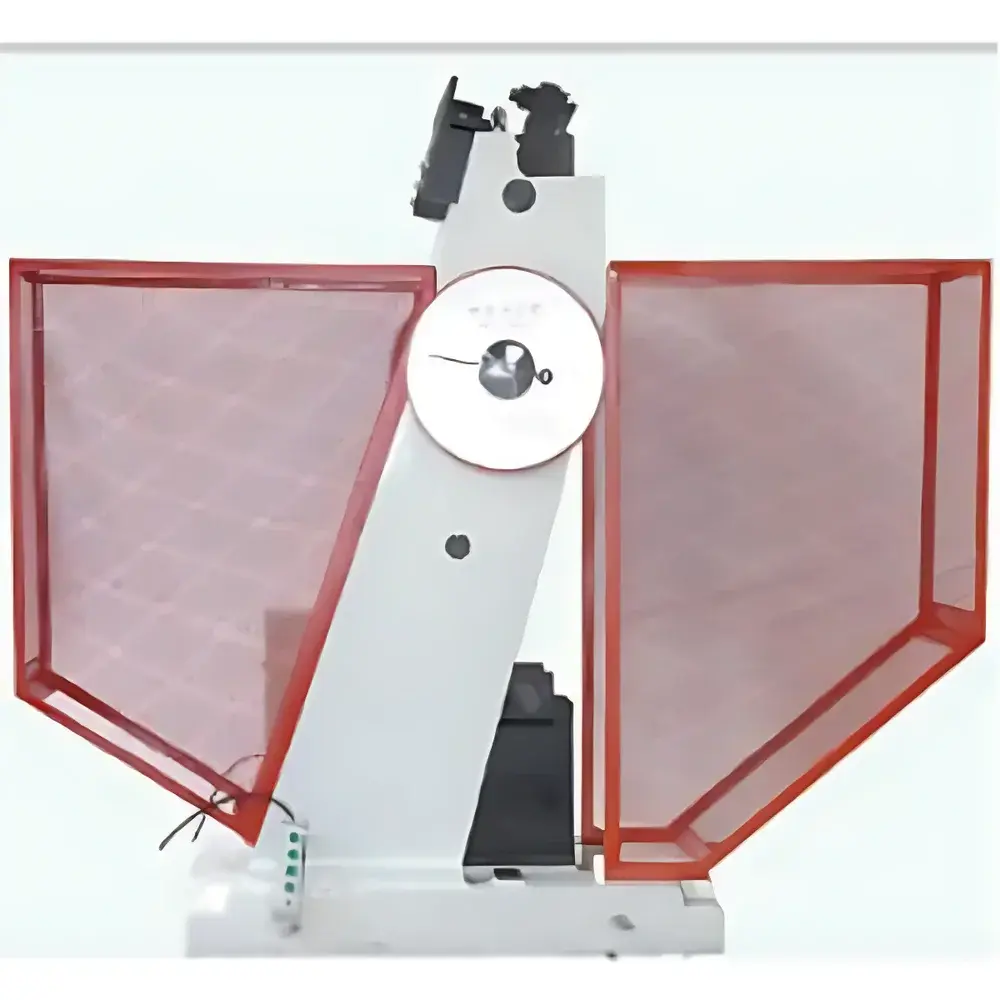
YANRUN JBW-750C Semi-Automatic Charpy/Izod Impact Testing Machine
| Brand | YANRUN |
|---|---|
| Origin | Shanghai, China |
| Manufacturer Type | Direct Manufacturer |
| Product Category | Domestic (China-Made) |
| Model | JBW-750C |
| Instrument Type | Pendulum Impact Tester |
| Nominal Impact Energies | 750 J, 600 J, 450 J, 300 J, 150 J |
| Impact Velocity | 5.5 m/s |
| Pendulum Pre-Lift Angle | 150° |
| Distance from Pendulum Axis to Impact Point | 825 mm |
| Specimen Support Span | 40 mm |
| Anvil Radius (Clamp Corner) | R1–R1.5 mm |
| Striking Edge Radius | R2–R2.5 mm (standard: R2 mm |
| optional | R8 mm) |
| Striking Edge Angle | 30° |
| Striking Edge Thickness | 16 mm |
| Specimen Support Surface Tilt | 0° |
| Specimen Dimensions | 10 × 10 (or 7.5 or 5) × 55 mm |
| Overall Dimensions | 2450 × 1200 × 2455 mm |
| Net Weight | 2500 kg |
| Power Supply | 3-phase AC 380 V ±10%, 50 Hz, 5 A |
| Operating Temperature Range | 10–35 °C |
| Relative Humidity Limit | ≤85% RH |
| Installation Requirement | Mounted on ≥300 mm thick reinforced concrete foundation or ≥1500 kg rigid base |
| Leveling Tolerance | ≤0.2 mm/m on machine base reference surface |
Overview
The YANRUN JBW-750C Semi-Automatic Charpy/Izod Impact Testing Machine is a precision-engineered pendulum impact tester designed for standardized determination of the impact toughness of metallic and polymeric materials under controlled mechanical loading conditions. Based on the principle of gravitational potential energy conversion—where a calibrated pendulum is raised to a defined angular position and released to strike a notched specimen—the system quantifies absorbed energy through direct measurement of the pendulum’s residual swing height. This method conforms to internationally recognized test standards including ISO 148-1 (Metallic Materials – Charpy Pendulum Impact Test), ASTM E23 (Standard Test Methods for Notched Bar Impact Testing of Metallic Materials), and GB/T 229 (Chinese national standard equivalent). The JBW-750C supports dual-test configurations—Charpy V-notch and Izod—and features a modular energy range (150 J to 750 J), enabling reliable evaluation across low-toughness plastics, structural steels, aerospace alloys, and cryogenically treated components.
Key Features
- Multi-range calibrated pendulum system with five selectable nominal impact energies: 150 J, 300 J, 450 J, 600 J, and 750 J—each independently verified per ISO/IEC 17025 traceable calibration protocols.
- Precision-machined striking edge with dual-radius options (R2 mm standard, R8 mm optional) compliant with ISO 148-2 and ASTM E23 geometry tolerances for notch root radius control.
- Fixed 40 mm support span anvil assembly with zero-degree horizontal alignment, adjustable within ±0.2 mm/m tolerance via integrated leveling feet and spirit level reference.
- Robust cast-iron frame and vibration-damped base structure, rated for 2500 kg net mass and requiring installation on ≥300 mm thick reinforced concrete to ensure dynamic stability during high-energy impact events.
- Motorized pre-lift mechanism with programmable 150° pendulum elevation angle and optical encoder feedback for repeatable release positioning.
- Integrated safety interlock system: automatic brake engagement upon specimen insertion, door-closed verification, and emergency stop circuit meeting IEC 60204-1 requirements.
Sample Compatibility & Compliance
The JBW-750C accommodates standard Charpy and Izod specimens per ISO 148 and ASTM E23 dimensional specifications: 10 × 10 × 55 mm (standard), with optional 10 × 7.5 × 55 mm and 10 × 5 × 55 mm cross-sections for sub-size testing. Notch geometries include U-type (3 mm depth, 1 mm root radius) and V-type (2 mm depth, 0.25 mm root radius), machined using certified tooling. All mechanical components—including anvils, clamps, and striking edges—meet hardness and surface finish requirements specified in ISO 148-2 Annex A. The instrument complies with CE marking directives (2006/42/EC Machinery Directive), and its operational envelope satisfies environmental class II per IEC 60721-3-2 (indoor industrial environments with no corrosive agents or strong electromagnetic fields).
Software & Data Management
The JBW-750C integrates with YANRUN’s proprietary IMPACT-Link™ control software, running on an embedded industrial PC with real-time acquisition of impact force profiles, energy absorption curves, and post-fracture classification (ductile/brittle transition analysis). Data output conforms to ASTM E29 and ISO/IEC 17025 reporting templates, supporting PDF report generation with digital signatures, audit trails, and user-access-level permissions. Optional 21 CFR Part 11 compliance package includes electronic signature validation, immutable data logging, and role-based authentication—enabling use in GLP/GMP-regulated laboratories performing material qualification for automotive, energy, or medical device applications.
Applications
- Quality control of structural steel plates, seamless pipes, and pressure vessel forgings per ASME BPVC Section IX and EN 10045-1.
- Evaluation of low-temperature toughness in cryogenic-grade stainless steels and aluminum alloys used in LNG infrastructure.
- Validation of heat treatment efficacy (quenching & tempering) via Charpy transition curve mapping.
- Comparative impact performance assessment of polymer composites and fiber-reinforced thermoplastics in automotive crash simulation workflows.
- Failure analysis laboratories conducting root cause investigations of brittle fracture incidents in welded joints and cast components.
FAQ
What standards does the JBW-750C comply with for Charpy testing?
It meets ISO 148-1:2016, ASTM E23-22a, and GB/T 229-2020 for specimen geometry, energy calibration, and result reporting.
Can the machine perform both Charpy and Izod tests without hardware modification?
Yes—dual-test capability is achieved via interchangeable anvil and clamp assemblies, pre-aligned to respective standard-defined support configurations.
Is calibration traceability provided with the system?
Each unit ships with a factory calibration certificate traceable to NIM (National Institute of Metrology, China) and optionally accredited to ISO/IEC 17025 by CNAS.
What electrical infrastructure is required for safe operation?
A dedicated 3-phase 380 V ±10%, 50 Hz supply with minimum 5 A capacity and proper grounding per IEC 60364-5-54 is mandatory.
Does the system support automated data export to LIMS or ERP platforms?
Yes—IMPACT-Link™ provides configurable CSV, XML, and OPC UA interfaces for seamless integration into laboratory information management systems.



