
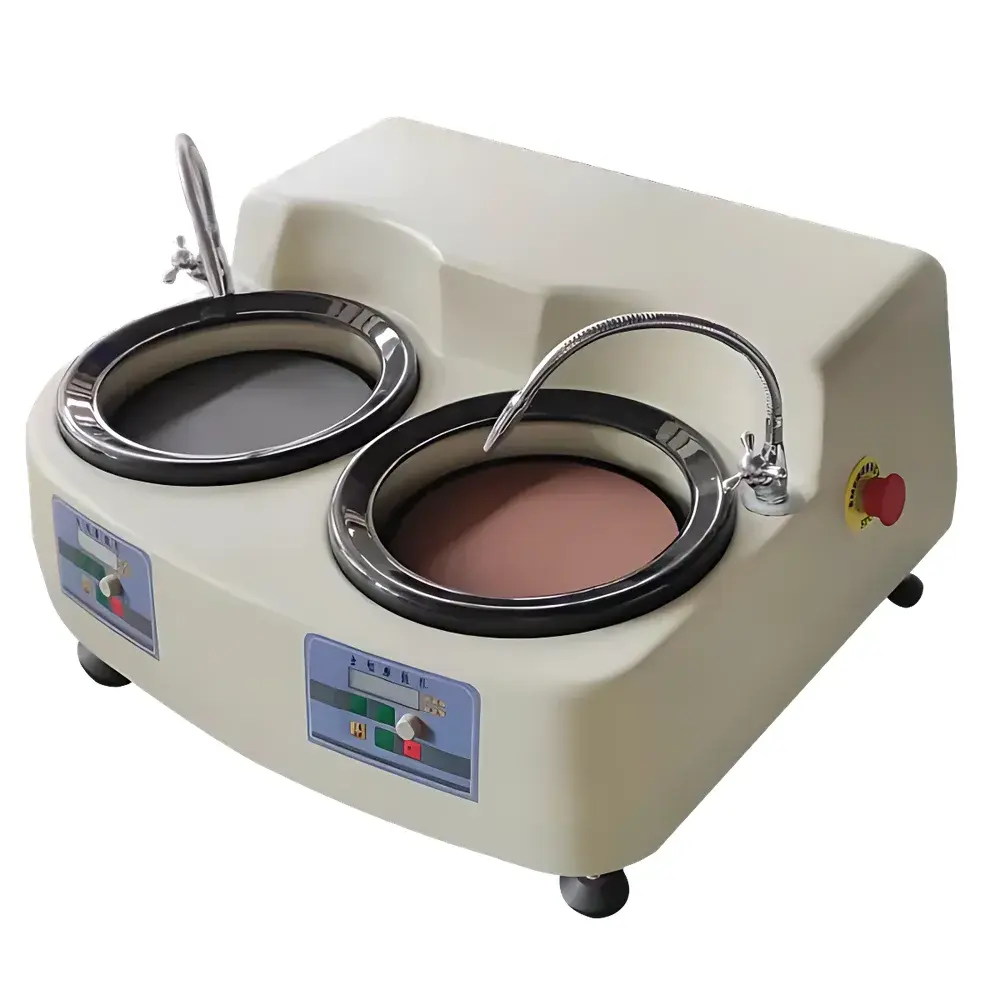
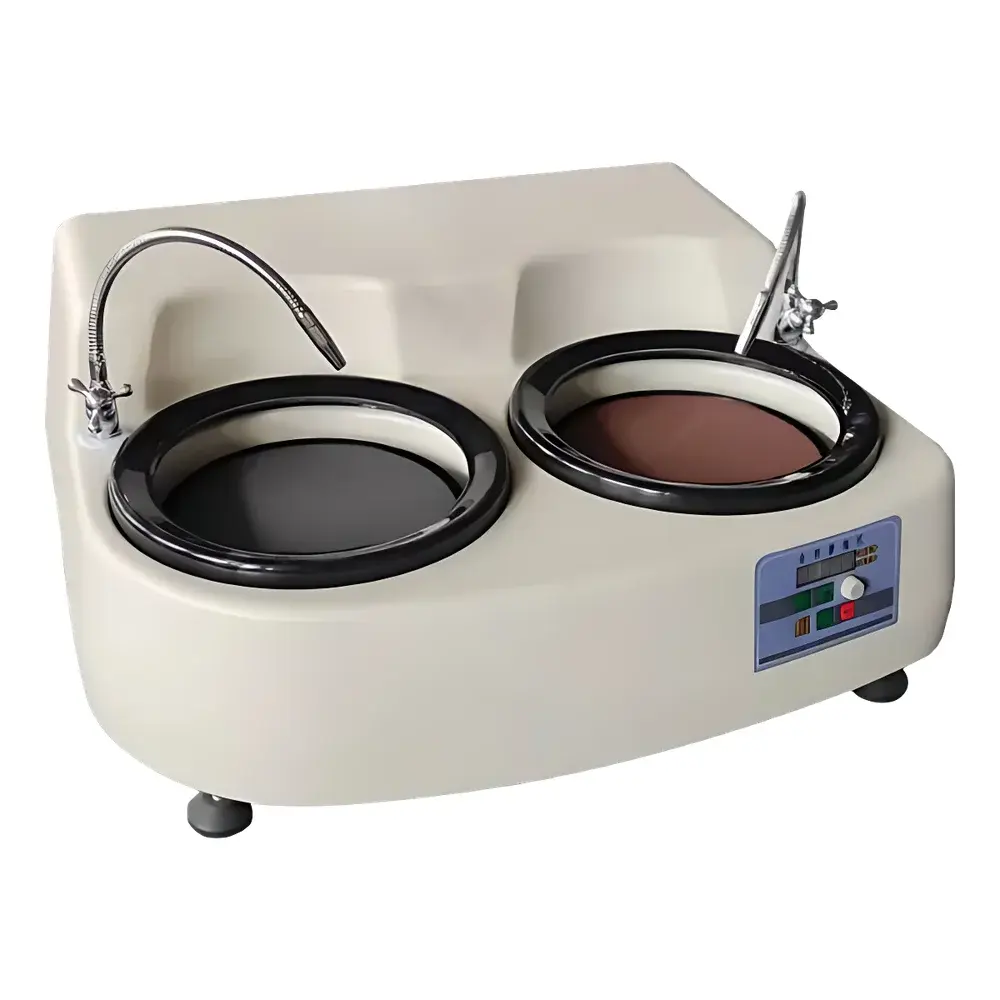
YANRUN MPD-2A Dual-Disk Precision Grinding and Polishing Machine
| Brand | YANRUN |
|---|---|
| Origin | Shanghai, China |
| Manufacturer Type | Direct Manufacturer |
| Model | MPD-2A |
| Speed Control | Infinitely Variable 50–1500 rpm + Preset Fixed-Speed Modes |
| Platen Diameter | φ230 mm (optional: φ200 / φ250 / φ300 mm) |
| Number of Platens | 2 |
| Dimensions (L×W×D) | 650 × 520 × 250 mm |
| Power Supply | 220 V AC |
| Motor Power | 550–750 W per platen |
| Drive System | Servo-Controlled Dual-Independent Drive |
| Rotation Direction | Bidirectional (Forward/Reverse selectable per platen) |
| Water Delivery | Adjustable Multi-Axis Spray Nozzle |
| Mounting Style | Benchtop |
Overview
The YANRUN MPD-2A is a dual-disk, benchtop grinding and polishing system engineered for high-reproducibility metallographic sample preparation in academic, industrial, and quality assurance laboratories. It operates on the principle of controlled abrasive removal—applying precisely regulated rotational force, pressure, and slurry delivery to progressively reduce surface topography and eliminate deformation layers induced during sectioning. Its dual-platen architecture enables simultaneous or independent operation of coarse grinding and fine polishing stages, significantly reducing total preparation time while maintaining strict inter-stage consistency. Designed for ISO/IEC 17025-compliant workflows, the MPD-2A supports standardized metallographic protocols defined in ASTM E3, ASTM E407, and ISO 13097, ensuring traceable, auditable surface conditioning prior to optical or electron microscopy.
Key Features
- Dual-independent servo-controlled drives: Each platen features isolated speed regulation (50–1500 rpm continuous range), enabling precise matching of abrasive kinetics to material hardness and stage-specific requirements (e.g., 150 rpm for final diamond polishing vs. 800 rpm for SiC paper grinding).
- Bidirectional rotation selection: Forward/reverse switching per platen minimizes directional scratch bias and improves planarity—critical for anisotropic alloys and layered composites.
- Modular platen compatibility: Standard φ230 mm platens accommodate common 8-inch consumables; optional φ200 mm, φ250 mm, and φ300 mm configurations support specialized fixtures, large-area specimens, or multi-sample carriers without tooling changes.
- Adjustable multi-axis water spray system: Fully articulating nozzles deliver consistent coolant/lubricant flow across the full platen radius, preventing localized overheating and extending abrasive disc life—particularly essential for heat-sensitive materials such as aluminum alloys and titanium grades.
- Benchtop footprint with reinforced cast-aluminum chassis: The 650 × 520 × 250 mm form factor integrates into ISO Class 5–7 cleanrooms or QC labs without requiring floor mounting; vibration-damped base ensures stable operation at high torque loads.
Sample Compatibility & Compliance
The MPD-2A accommodates metallic specimens (ferrous/non-ferrous), sintered carbides, technical ceramics (Al₂O₃, ZrO₂), and polymer-matrix composites—provided hardness falls within the 100 HV to 2500 HV range. Its dual-control interface permits independent parameter assignment per platen, supporting ASTM E3-compliant sequential preparation: rough grinding → intermediate polishing → final colloidal silica etching. All electrical components comply with IEC 61000-6-3 (EMC) and IEC 61000-6-4 (industrial emission) standards. The unit meets CE marking requirements for machinery safety (2006/42/EC) and carries factory calibration documentation aligned with ISO/IEC 17025 Clause 6.5 for measurement traceability.
Software & Data Management
While the MPD-2A operates via intuitive physical controls (rotary encoder + LED status display), it includes RS-232 and USB-B ports for optional integration with laboratory information management systems (LIMS). When paired with YANRUN’s optional PrepLog™ software module (v2.1+), users can log run parameters—including speed, duration, direction, coolant flow rate, and operator ID—with timestamped entries stored in CSV or XML format. Audit trails comply with FDA 21 CFR Part 11 requirements when deployed with electronic signature validation and role-based access control. Data export supports GLP/GMP batch record generation for metallurgical release testing.
Applications
- Failure analysis laboratories: Preparing fracture surfaces and cross-sections from failed turbine blades or automotive crankshafts for SEM-EDS phase mapping and inclusion quantification.
- Automotive R&D centers: Standardizing surface finish on Al-Si castings prior to porosity analysis per ISO 27874.
- Academic metallurgy programs: Teaching ASTM E3 specimen preparation methodology with repeatable endpoint detection via reflected-light microscopy.
- Electronics packaging QA: Polishing copper-tungsten heat spreaders to ≤0.05 µm Ra for thermal interface resistance validation.
- Ceramic component certification: Conditioning Si₃N₄ bearing races for grain boundary contrast imaging under polarized light.
FAQ
What consumables are compatible with the MPD-2A?
Standard 200 mm and 230 mm diameter abrasive discs—including silicon carbide papers (P80–P2500), diamond-impregnated pads (9–1 µm), and colloidal silica suspensions—are mechanically and dimensionally supported. Backing plates with M8 threaded inserts are recommended for optimal rigidity.
Can the MPD-2A be used for soft materials like lead or pure aluminum?
Yes—when operated at low speeds (≤200 rpm) with non-rotating specimen holders and viscous lubricants (e.g., glycerol-water mixtures), the system prevents smearing and edge rounding. A dedicated “soft-material” preset mode is available in PrepLog™ v2.3.
Is third-party calibration service available?
YANRUN-certified service engineers perform annual speed verification (±0.5% accuracy), torque linearity checks, and platen runout assessment (≤0.02 mm TIR) against NIST-traceable rotary encoders and dial indicators.
Does the unit support automated cycle programming?
Not natively—but with PrepLog™ software and optional pneumatic specimen holder actuation, up to six-step sequences (e.g., 3 min grinding @ 600 rpm → 2 min polishing @ 300 rpm → rinse → dry) can be executed unattended.
What maintenance intervals are recommended?
Lubrication of drive gearboxes every 500 operating hours; inspection of water hose integrity and nozzle alignment weekly; replacement of motor brushes every 2,000 hours or per manufacturer’s wear threshold indicators.
Related Products



