
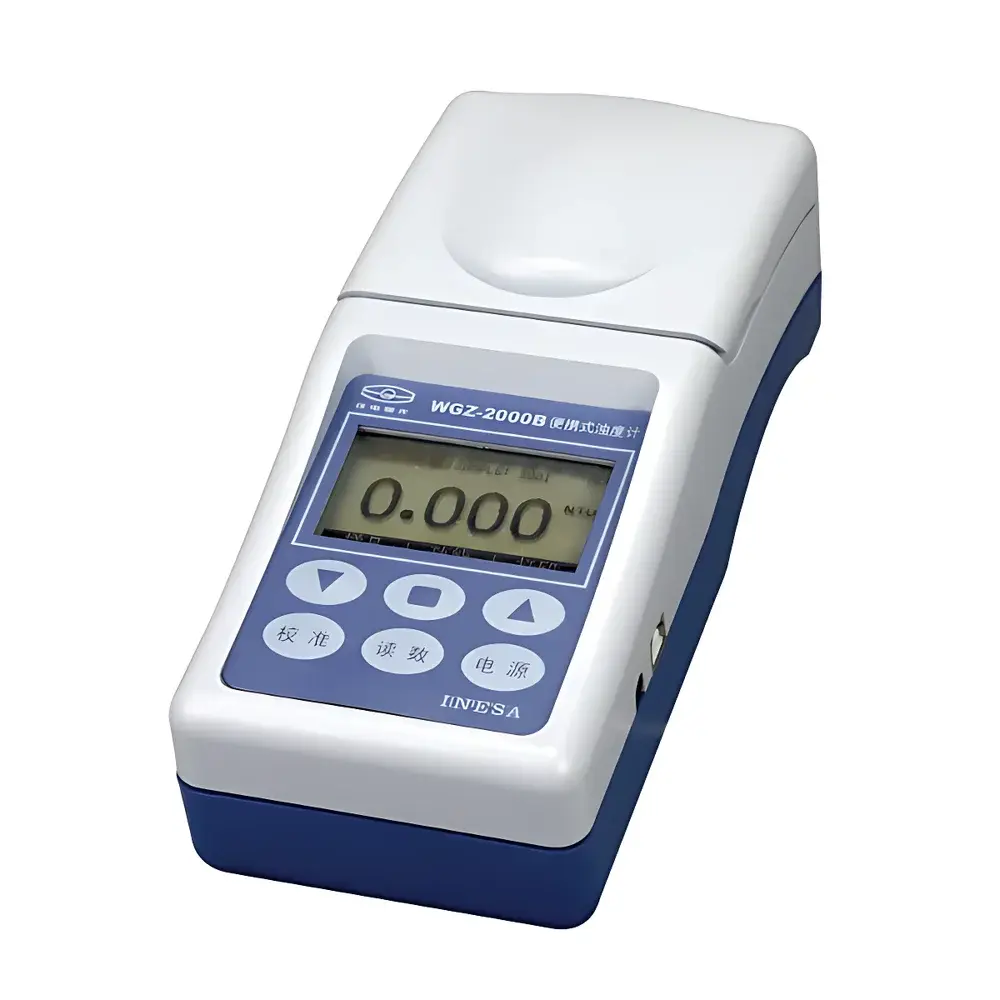
YDWG WGZ Series Portable Turbidimeter
| Brand | YDWG |
|---|---|
| Origin | Shanghai, China |
| Product Type | Portable |
| Model Range | WGZ-20B, WGZ-50B, WGZ-100B, WGZ-200B, WGZ-500B, WGZ-1000B, WGZ-2000B |
| Measurement Range | 0.000–20.00 NTU |
| Resolution | 0.1 NTU |
| Operating Temperature | Ambient |
| Accuracy | ≤ ±6% |
| Light Source | LED @ 860 nm |
| Display Units | NTU, FTU, EBC, ASBC |
| Sample Cell | Ø25 mm × 65 mm (20–30 mL capacity) |
| Data Storage | 2000 measurement records |
| Calibration Options | 2–7 point calibration |
| Interface | USB |
| Power Supply | 4× AA alkaline batteries or 5 V USB |
| Dimensions | 220 × 95 × 85 mm |
| Net Weight | 0.65 kg |
| Compliance | ISO 7027, HJ 1075–2019, GLP-ready |
Overview
The YDWG WGZ Series Portable Turbidimeter is an optical measurement instrument engineered for field-deployable and laboratory-grade turbidity assessment in aqueous and transparent liquid samples. It operates on the principle of ratio-based nephelometric measurement—simultaneously detecting scattered light (at 90°) and transmitted light intensity using a fixed-wavelength 860 nm infrared LED source. This dual-signal approach compensates for color interference and absorbance artifacts, enabling reliable turbidity quantification even in lightly colored or mildly absorbing solutions—a critical capability for applications in brewing, pharmaceutical water systems, and wastewater pre-treatment monitoring. Designed to meet the metrological requirements of ISO 7027:2016 (turbidimeters—performance requirements and calibration methods) and China’s environmental standard HJ 1075–2019 (“Determination of turbidity in water quality”), the WGZ Series delivers traceable, reproducible results across its multi-range configuration without manual range switching.
Key Features
- Ratiometric optical architecture with 860 nm LED source ensures immunity to sample coloration and minimizes drift from lamp aging or voltage fluctuation.
- Auto-ranging measurement across three overlapping NTU intervals (0.000–20.00, 20.01–200.0, and 200.1–2000 NTU), dynamically selected based on real-time signal response.
- High-contrast backlit LCD display with touch-sensitive keypad enables intuitive operation under variable ambient lighting conditions.
- Low-power design supports extended field use: up to 10,000 measurements per set of four AA alkaline batteries; optional 5 V USB bus power for benchtop continuity.
- GLP-compliant data management: each stored record includes timestamp, date, operator ID, sample ID, and calibration status flag—enabling full audit trail traceability.
- Multi-standard unit support (NTU, FTU, EBC, ASBC) allows direct reporting alignment with industry-specific regulatory frameworks, including USP , ASBC Methods of Analysis, and EU Brewery Quality Guidelines.
Sample Compatibility & Compliance
The WGZ Series accepts standard cylindrical sample cells (Ø25 mm × 65 mm), accommodating volumes between 20–30 mL. Its optical path geometry and detector sensitivity are optimized for low-volume, high-precision measurements—ideal for process water checks, effluent discharge verification, and raw material QC in beverage and biopharmaceutical manufacturing. All models comply with ISO 7027’s geometric specifications for incident beam collimation, detector solid angle, and stray light rejection. The instrument’s ≤±6% accuracy specification is validated per HJ 1075–2019 protocol using formazin and styrene divinylbenzene (SDB) reference suspensions. Zero drift (≤±0.5% FS) and repeatability (≤0.5%) are verified under controlled temperature (20–25°C) and humidity (30–70% RH) per IEC 61000-4-2 EMC guidelines.
Software & Data Management
Data export and instrument configuration are managed via native USB interface using vendor-provided PC software compatible with Windows 10/11. The application supports batch upload of up to 2000 records with CSV and PDF report generation. Audit trail functionality logs all calibration events—including date/time, standard values used, deviation from expected response, and user authentication—meeting FDA 21 CFR Part 11 requirements when deployed with system-level electronic signature controls. Raw measurement files retain embedded metadata (e.g., firmware version, sensor ID, battery level at time of acquisition), facilitating retrospective validation and method transfer documentation in GMP environments.
Applications
- Drinking water distribution network monitoring (source-to-tap turbidity profiling)
- Pharmaceutical purified water (PW) and water-for-injection (WFI) system validation per USP
- Brewery wort clarity and finished beer haze analysis (EBC units)
- Chemical process stream clarity verification prior to membrane filtration or ion exchange
- Environmental field testing of surface water, stormwater runoff, and treated effluent per EPA Method 180.1 equivalents
- QC release testing of colloidal suspensions in nanomaterial synthesis and vaccine formulation
FAQ
Does the WGZ Series support calibration with non-formazin standards?
Yes—the instrument accepts user-defined calibration curves using NIST-traceable SDB or polymer latex standards, provided their scattering properties are characterized at 860 nm and documented in accordance with ISO 7027 Annex B.
Can the device measure turbidity in viscous or high-solids slurries?
No—it is designed exclusively for low-viscosity, optically transparent liquids. Suspensions exceeding 500 cP or containing particulates >100 µm may cause flow cell fouling or signal saturation; such samples require dilution or centrifugation prior to analysis.
Is firmware upgrade supported in the field?
Yes—firmware updates are delivered via USB-connected PC and preserve all stored calibration coefficients and user configurations during installation.
What is the recommended recalibration interval?
Per GLP best practice, recalibration is advised before each analytical session or every 8 hours of continuous use; daily zero-check with deionized water is mandatory for trace-level (<1 NTU) applications.
Does the instrument include validation documentation for IQ/OQ protocols?
A complete Factory Acceptance Test (FAT) report and instrument-specific calibration certificate (NIST-traceable) are supplied with each unit; additional 3Q documentation packages are available upon request for regulated environments.







