
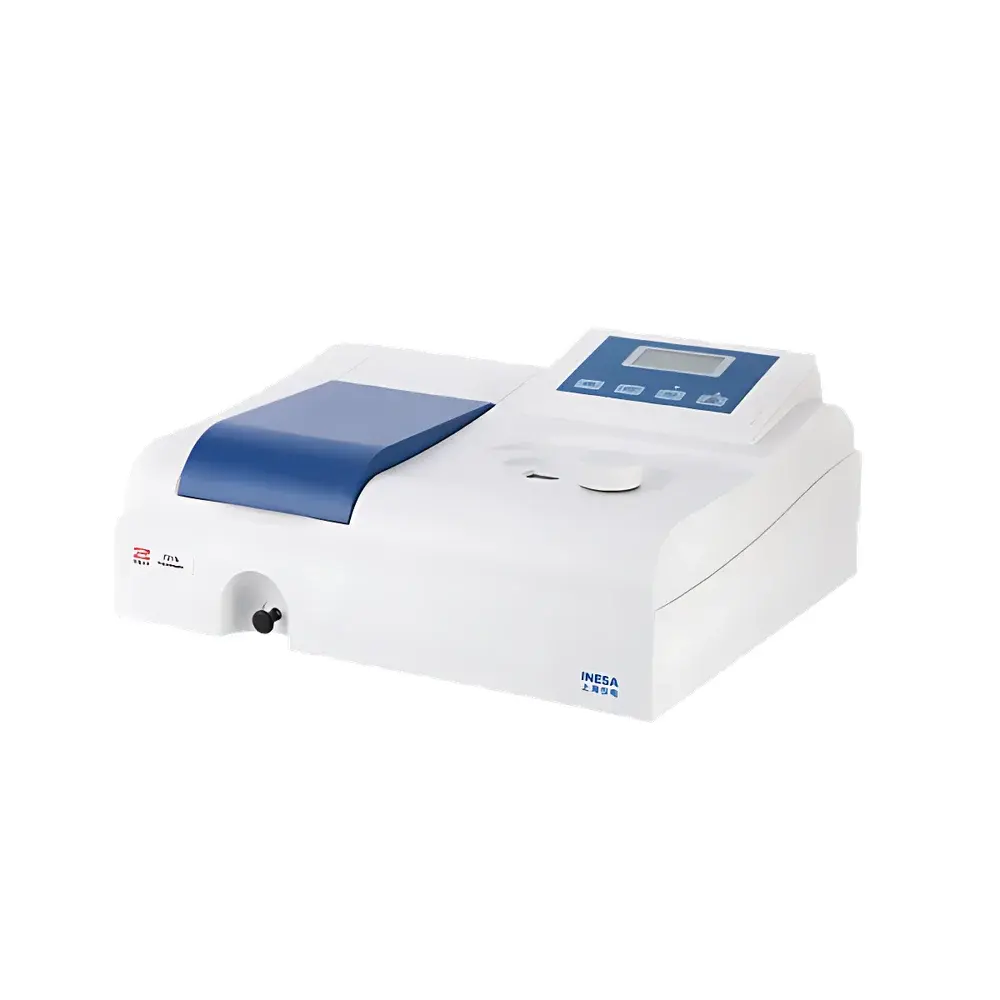
Yidian Analysis UV-Vis Spectrophotometer Series (752G to 760CRT)
| Brand | Yidian Analysis |
|---|---|
| Origin | Shanghai, China |
| Model Range | 752G, 752N, 752N (PLUS), 754N, 756N, N4, N4S, N5S, L5, L5S, L6, L6S, L7, L8, L9, 760CRT |
| Optical System | Single-beam (752/754/756/N-series) or Double-beam (L7–L9, 760CRT) |
| Wavelength Range | 190–1100 nm |
| Spectral Bandwidth | 2 nm (standard models) to 0.5 nm (high-resolution L-series & 760CRT) |
| Photometric Accuracy | ±0.3% T |
| Wavelength Accuracy | ±0.5 nm |
| Stray Light | ≤0.05% T at 220 nm and 360 nm |
| Detector | Silicon photodiode (standard) or PMT (760CRT) |
| Data Interface | RS-232, USB, optional Ethernet |
| Compliance | ISO 9001 certified manufacturing |
Overview
The Yidian Analysis UV-Vis Spectrophotometer Series represents a comprehensive family of laboratory-grade ultraviolet-visible absorption spectrometers engineered for routine quantitative analysis, method development, and quality control in academic, pharmaceutical, environmental, and industrial laboratories. Based on the fundamental principle of Beer–Lambert law, these instruments measure the attenuation of monochromatic light as it passes through a sample solution, enabling precise determination of analyte concentration, purity assessment, kinetic studies, and spectral characterization across the 190–1100 nm spectral range. The series is architecturally segmented into single-beam (752G through N5S) and double-beam configurations (L7 through 760CRT), with increasing levels of optical stability, baseline reproducibility, and photometric resolution aligned to application rigor—from teaching labs to GLP-compliant QC environments.
Key Features
- Optical architecture optimized for long-term wavelength fidelity: Czerny–Turner monochromator design with holographic grating (1200 lines/mm standard, up to 2400 lines/mm in L-series and 760CRT)
- Thermally stabilized optics and low-drift electronics ensure <±0.002 A/h baseline stability over 4-hour continuous operation (L7 and above)
- Double-beam models (L7–L9, 760CRT) incorporate real-time reference beam compensation, eliminating errors from lamp intensity drift or detector sensitivity variation
- High-sensitivity detection options: silicon photodiode for general-purpose use; side-on photomultiplier tube (PMT) in the 760CRT model for sub-nanomolar absorbance detection down to 0.0001 A
- Integrated cuvette autoloader (optional on L6S and higher) supports unattended multi-sample measurement with programmable pathlength selection (1–10 cm)
- Front-panel touchscreen interface with embedded firmware supporting absorbance, transmittance, concentration, and kinetic scan modes
Sample Compatibility & Compliance
All models accommodate standard 10-mm square quartz, glass, or plastic cuvettes; L-series and 760CRT support microvolume adapters (0.5–2 µL) and fiber-optic probes for non-contact or in-situ measurements. Instrument validation protocols align with ASTM E275 (Standard Practices for Describing and Measuring Performance of UV-Vis Spectrophotometers) and ISO 6223 (Performance Testing of Spectrophotometers). The L7 and higher models include full audit trail functionality compliant with FDA 21 CFR Part 11 requirements when paired with Yidian’s L-SpecPro software suite. Manufacturing adheres to ISO 9001:2015 quality management standards, and optical performance verification follows national standard GB/T 21186–2007 for UV-Vis spectrophotometers.
Software & Data Management
Yidian L-SpecPro software (v4.2+) provides full instrument control, spectral acquisition, quantitative analysis (single/multi-point calibration, equation-based concentration calculation), and GLP-compliant reporting. It supports data export in CSV, XML, and JCAMP-DX formats for integration with LIMS and ELN systems. Audit trails record user identity, timestamp, parameter changes, and result modifications—retained for ≥36 months with tamper-evident digital signatures. For regulatory environments, optional 21 CFR Part 11 module enables electronic signatures, role-based access control, and secure data archiving. Remote diagnostics and firmware updates are delivered via encrypted HTTPS channel.
Applications
- Pharmaceutical QC: Assay of active pharmaceutical ingredients (APIs) per USP and EP 2.2.25
- Environmental testing: Nitrate, phosphate, COD, and heavy metal quantification per EPA Methods 353.2, 365.2, and ISO 15681
- Food & beverage: Colorimetric analysis of anthocyanins, carotenoids, and preservatives (e.g., sulfites, nitrites)
- Academic research: Enzyme kinetics (e.g., NADH oxidation), protein quantification (Bradford/Lowry), DNA/RNA purity (A260/A280 ratio)
- Materials science: Bandgap estimation of semiconductors and thin-film optical density profiling
FAQ
What is the difference between single-beam and double-beam UV-Vis spectrophotometers?
Single-beam instruments (e.g., 752G, N4S) require manual reference blanking before each sample measurement and are best suited for stable, high-throughput applications. Double-beam designs (e.g., L7, 760CRT) split the light path to simultaneously monitor sample and reference, delivering superior baseline stability and reduced operator dependency—critical for long-duration scans or variable ambient conditions.
Is the 760CRT model compliant with 21 CFR Part 11?
Yes—the 760CRT, when operated with L-SpecPro software v4.2+ and configured with the Part 11 compliance module, meets all technical and procedural requirements including electronic signatures, audit trails, and system validation documentation.
Can I upgrade my L5 to L6-level functionality via firmware?
No—hardware differences (grating density, detector type, beam geometry, and thermal management) preclude functional upgrades between L-series tiers. Migration requires physical instrument replacement.
What validation documentation is provided with shipment?
Each unit ships with a Factory Acceptance Test (FAT) report, wavelength accuracy verification certificate (traceable to NIM, China), and photometric linearity certification per GB/T 21186–2007. Optional IQ/OQ/PQ protocols are available upon request.



