
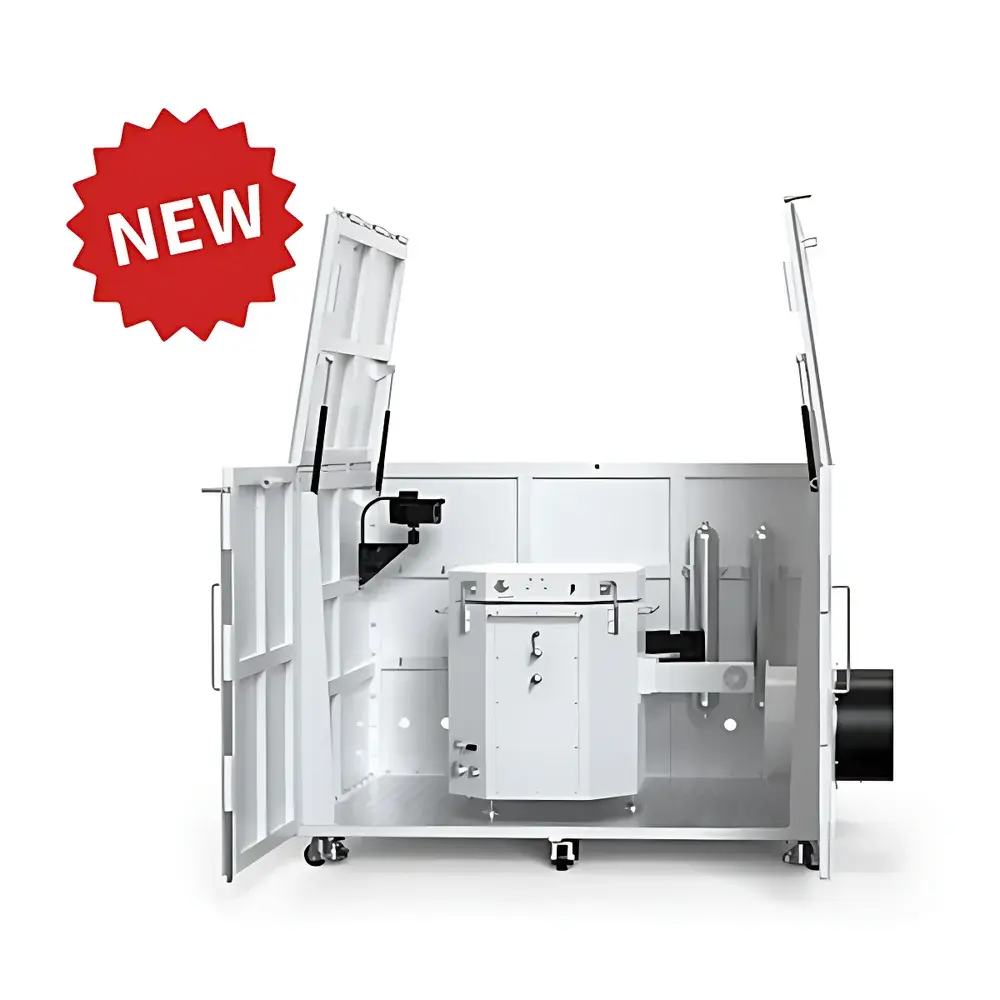
Young Instruments BAC-420B Large-Scale Battery Adiabatic Calorimeter
| Brand | Young Instruments |
|---|---|
| Origin | Zhejiang, China |
| Manufacturer Type | Manufacturer |
| Product Origin | Domestic |
| Model | BAC-420B |
| Measurement Mode | Adiabatic Calorimetry |
| Instrument Type | Accelerating Rate Calorimeter (ARC) |
| Temperature Detection Threshold | < 0.02 °C/min |
| Temperature Tracking Rate | 0.02–13 °C/min |
Overview
The Young Instruments BAC-420B is a large-scale adiabatic calorimeter engineered specifically for thermal safety evaluation of high-energy lithium-ion battery cells and small modules in compliance with GB/T 36276–2023, “Lithium-ion Batteries for Electric Energy Storage.” It operates on the principle of heat-wait-search (HWS) adiabatic calorimetry, dynamically maintaining near-zero heat exchange between sample and surroundings through real-time temperature feedback control of the furnace wall. This enables precise quantification of self-heating onset, adiabatic temperature rise rate (dT/dt)ad, time-to-thermal-runaway, maximum self-heating rate, total adiabatic temperature rise (ΔTad), specific heat capacity (Cp), and gas evolution kinetics under controlled electrochemical or mechanical abuse conditions—including charge/discharge cycling, nail penetration, and external heating.
Key Features
- High-sensitivity adiabatic detection: Self-heating detection threshold < 0.02 °C/min—exceeding the sensitivity requirement specified in GB/T 36276–2023 and ASTM E1981–98(2012)
- Optimized thermal inertia design: Adiabatic chamber with internal diameter 420 mm and depth 520 mm accommodates prismatic or pouch cells up to 600 mm in longest dimension and small modular assemblies (≤ 3 parallel cells)
- Dual-stage thermal control architecture: Integrated resistive heating elements coupled with liquid nitrogen cooling (standard configuration) enable stable operation across –25 °C to 300 °C, with wall-sample temperature differential ≤ 0.5 °C during adiabatic tracking
- Robust mechanical safety system: Dual-layer protection includes rupture disc assembly rated for 2 MPa burst pressure and spring-loaded locking mechanism; instrument is housed within a certified explosion-resistant containment cabinet meeting UL 1973 structural requirements
- Electrochemical integration: Built-in ±500 A current-rated feedthrough terminals support in situ galvanostatic cycling during calorimetric measurement, enabling simultaneous acquisition of thermal and electrical data
Sample Compatibility & Compliance
The BAC-420B supports thermal hazard assessment of large-format Li-ion cells (e.g., LFP, NMC, LCO) and module-level configurations used in stationary energy storage systems (ESS) and heavy-duty EV applications. Its test protocols align with multiple international regulatory and industry standards, including: GB/T 36276–2023 (China ESS battery safety), UL 9540A (thermal runaway propagation testing), SAE J2464–R2009 (electric vehicle battery safety), ASTM E1981–98(2012) (accelerating rate calorimetry methodology), SN/T 3078.1–2012 (chemical thermal stability evaluation), and SAND99-0497 / SAND2005-3123 (U.S. DOE battery safety guidelines). All test sequences are fully traceable and support GLP/GMP-aligned documentation workflows.
Software & Data Management
The proprietary BACControl software provides synchronized acquisition of temperature (sample, wall, ambient), pressure, voltage, current, and gas volume (when interfaced with optional mass flow meters or pressure-based gas quantification modules). Data logging resolution is configurable down to 100 ms, with built-in algorithmic identification of self-heating onset per ASTM E1981 criteria. Export formats include CSV, MATLAB (.mat), and XML-compliant reports suitable for regulatory submission. Audit trail functionality complies with FDA 21 CFR Part 11 requirements when deployed in validated environments.
Applications
- Determination of thermal runaway initiation temperature (Tonset) and critical self-heating rate thresholds under adiabatic conditions
- Quantification of specific heat capacity (Cp) across wide temperature ranges, including sub-zero operating conditions relevant to cold-climate ESS deployment
- Gas generation profiling during thermal abuse—integrated pressure transducers enable real-time calculation of evolved gas volume and molar production rates
- Electrochemically coupled thermal analysis: simultaneous measurement of Joule and reversible heat during charge/discharge cycles at variable C-rates and temperatures
- Validation of battery thermal management system (BTMS) designs by benchmarking cell-level heat generation against simulated duty cycles
FAQ
What battery dimensions can the BAC-420B accommodate?
Cells with a longest dimension between 100 mm and 600 mm—including large-format prismatic, pouch, and cylindrical cells—as well as small parallel-connected modules (up to three cells) fit within the 420 mm × 520 mm adiabatic cavity.
Does the system support automated nail penetration testing?
Yes—the instrument includes programmable actuator control for nail penetration tests, with stroke depth, speed, and dwell time fully configurable via BACControl software.
Is liquid nitrogen required for low-temperature operation?
Liquid nitrogen is supplied as standard for sub-ambient cooling down to –25 °C; alternative cryogenic options (e.g., closed-cycle refrigerators) may be integrated upon request.
Can the BAC-420B be used for UN 38.3 T.3 thermal test simulation?
While not a direct substitute for the UN 38.3 oven test, the BAC-420B’s adiabatic heating profile and temperature ramp control allow replication of worst-case thermal stress scenarios consistent with T.3 failure mode analysis.
How is data integrity ensured during long-duration tests?
All sensor inputs are continuously timestamped and stored with CRC-32 checksum validation; system logs include operator ID, method version, calibration status, and environmental metadata to support full auditability.
Related Products



