
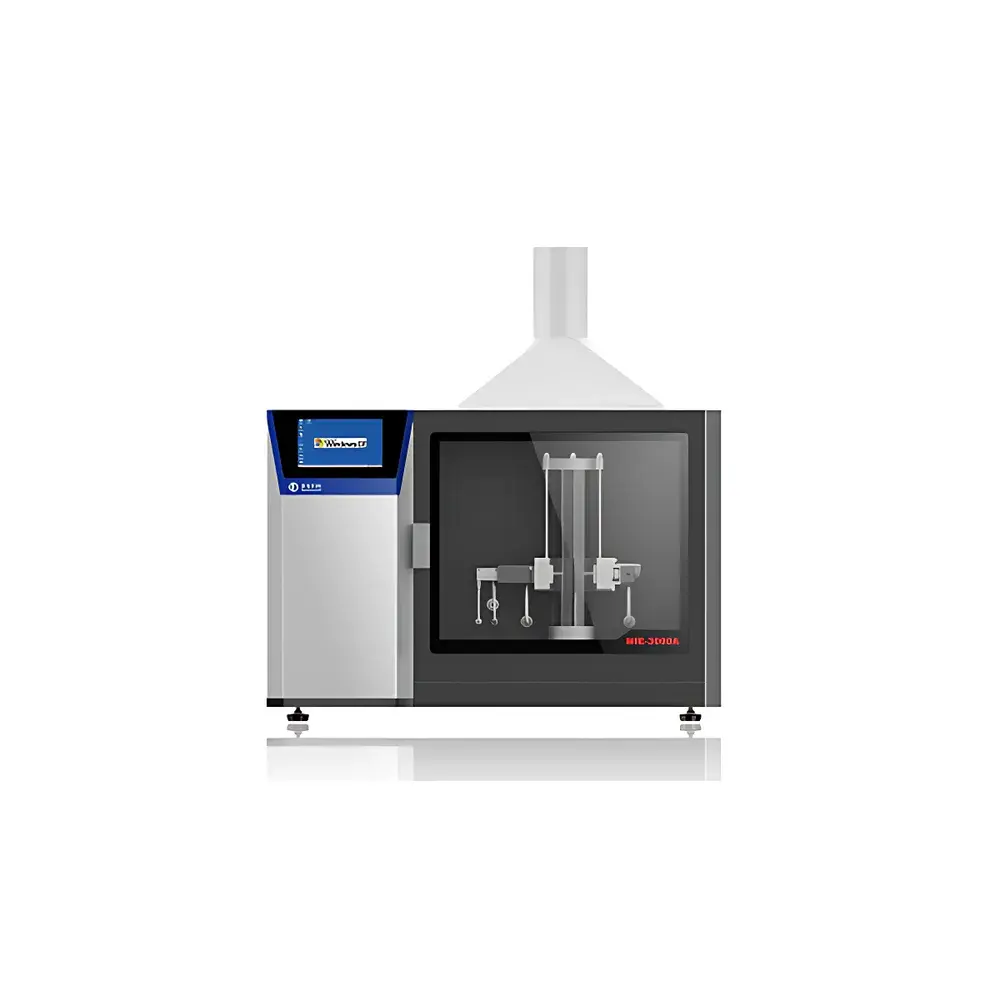
Young Instruments MIE-3000A Dust Cloud Minimum Ignition Energy (MIE) Tester
| Brand | Young Instruments |
|---|---|
| Origin | Zhejiang, China |
| Manufacturer Type | Direct Manufacturer |
| Country of Origin | China |
| Model | MIE-3000A |
| Safety Rating | Explosion-Proof |
| Resolution | 0.03% |
| Relative Error | ±2% |
| Spark Energy Range | 1–3000 mJ (8 discrete steps) |
| Charging Voltage | 0–15 kV |
| Discharge Load Options | Open-circuit or 1 mH inductive load |
| Test Vessel | Hartmann tube (1.2 L) |
| Electrode Material | Stainless steel (2 mm diameter) |
| Electrode Spacing | Adjustable from 2 mm to 10 mm |
| Electrode Triggering | High-voltage relay + movable electrode actuation |
| Ignition Delay Time | 20–200 ms (adjustable) |
| Powder Dispersion Pressure | 0.4–0.7 MPa (adjustable) |
| Operating Environment | 5–45 °C, <85% RH |
| Power Supply | 90–260 VAC, 47–63 Hz |
| Rated Power | 300 W |
| Interface | Dual USB 2.0 ports |
| Display | 7-inch color TFT touchscreen |
Overview
The Young Instruments MIE-3000A Dust Cloud Minimum Ignition Energy (MIE) Tester is a precision-engineered laboratory instrument designed for the quantitative determination of the minimum electrical spark energy required to ignite a suspended dust cloud under standardized conditions. It operates on the principle of controlled electrostatic spark ignition within a defined-volume Hartmann tube (1.2 L), where a reproducible dust dispersion is generated via compressed air-driven pneumatic injection. The system delivers calibrated high-voltage pulses across adjustable stainless-steel electrodes, enabling systematic evaluation of ignition thresholds across a wide energy range (1–3000 mJ). This measurement directly reflects the intrinsic electrostatic sensitivity of combustible particulate materials and serves as a foundational parameter in hazard classification, process safety design, and explosion protection strategy development—particularly in industries handling organic powders, metal dusts, pharmaceutical intermediates, and polymer granules.
Key Features
- Preloaded compliance with major international standards: ASTM E2019, IEC 61241-2-3, ISO/IEC 80079-20-2:2016, and GB/T 16428–1996—enabling direct traceability in regulatory submissions and third-party audits.
- Automated test sequence execution: Users input target spark energy; the instrument autonomously configures electrode spacing, dispersion pressure, and delay timing per standard-specified protocols.
- Optimized powder dispersion module ensures uniform cloud formation with minimal agglomeration, enhancing repeatability and reducing inter-test variability.
- Modular electrode assembly allows rapid replacement without tools; integrated counter logs total discharge events and prompts maintenance before performance drift occurs.
- Removable and solvent-cleanable Hartmann tube minimizes cross-contamination risk and supports high-throughput screening of multiple sample batches.
- Remote ignition activation via isolated control interface eliminates operator exposure during spark generation—critical for Class 1 Div 1 or ATEX Zone 20 environments.
- Optional high-bandwidth voltage and current probes enable real-time oscilloscopic validation of delivered spark energy, supporting ISO/IEC 17025-compliant uncertainty budgets.
- Role-based user management (administrator, technician, viewer) enforces data integrity and aligns with GLP/GMP documentation requirements.
- Dual USB 2.0 ports support direct export of raw test logs (.csv), metadata-rich reports (.pdf), and firmware updates without network dependency.
- Industrial-grade enclosure rated IP54 with intrinsically safe circuitry and reinforced grounding meets EN 60079-0 and EN 60079-11 for use in hazardous locations.
Sample Compatibility & Compliance
The MIE-3000A accommodates dry, non-agglomerating powders with particle sizes typically ranging from 10 µm to 250 µm and bulk densities between 0.1 g/cm³ and 2.5 g/cm³. It has been validated for use with carbon black, aluminum, corn starch, lactose, polyethylene, and sulfur—materials representative of chemical, food, pharmaceutical, and metallurgical sectors. All operational parameters adhere strictly to the test matrix defined in ASTM E2019 Section 7 and IEC 61241-2-3 Annex A. Calibration verification is performed using certified reference sparks traceable to NIST SRM 2811 (electrostatic discharge simulator), and full system verification includes periodic checks of dispersion consistency (via laser diffraction particle sizing pre- and post-cloud formation) and spark energy fidelity (using calibrated high-voltage dividers).
Software & Data Management
Embedded firmware provides real-time visualization of cloud formation dynamics, spark waveform capture (when optional probes are installed), and pass/fail status per ignition attempt. Test records include timestamped environmental readings (ambient T/RH), operator ID, sample lot number, dispersion pressure, electrode gap, charging voltage, measured energy, and observed ignition outcome (flame propagation vs. no ignition). Exported datasets comply with FDA 21 CFR Part 11 requirements through electronic signatures, audit trails, and immutable record locking. Data structure follows ASTM E2019 Annex B formatting conventions, facilitating direct import into PHA (Process Hazard Analysis) software such as DNV PHAST or BakerRisk EXPLOSION.
Applications
This instrument supports critical safety functions across R&D, QA/QC, and process engineering workflows—including but not limited to: classification of dust explosibility per NFPA 652 and EU ATEX Directive 2014/34/EU; selection of appropriate explosion venting area per EN 14491; validation of inerting gas concentration targets; assessment of antistatic additive efficacy; and generation of technical dossiers for REACH SVHC registration. It is routinely deployed in contract testing laboratories accredited to ISO/IEC 17025 and by corporate EHS departments maintaining OSHA PSM or CCPS RBPS compliance.
FAQ
What standards does the MIE-3000A natively support?
It implements test procedures and acceptance criteria from ASTM E2019, IEC 61241-2-3, ISO/IEC 80079-20-2:2016, and GB/T 16428–1996 without modification.
Can the instrument verify actual delivered spark energy?
Yes—when equipped with optional high-voltage and current probes, it captures full transient waveforms and calculates true energy per IEEE Std 1313.1-2020 Annex C methodology.
Is remote operation possible beyond the local touchscreen?
The device supports RS-232 and Ethernet (optional) interfaces for integration into centralized lab automation systems or SCADA networks.
How often must electrodes be replaced?
Electrode lifetime averages 2,500–3,000 discharges at ≤100 mJ; the system logs cumulative counts and recommends replacement at 90% of nominal service life.
Does the Hartmann tube require special cleaning solvents?
No—standard laboratory-grade isopropanol or acetone suffices; residue-free drying is verified by visual inspection and baseline spark consistency testing.
Related Products







