
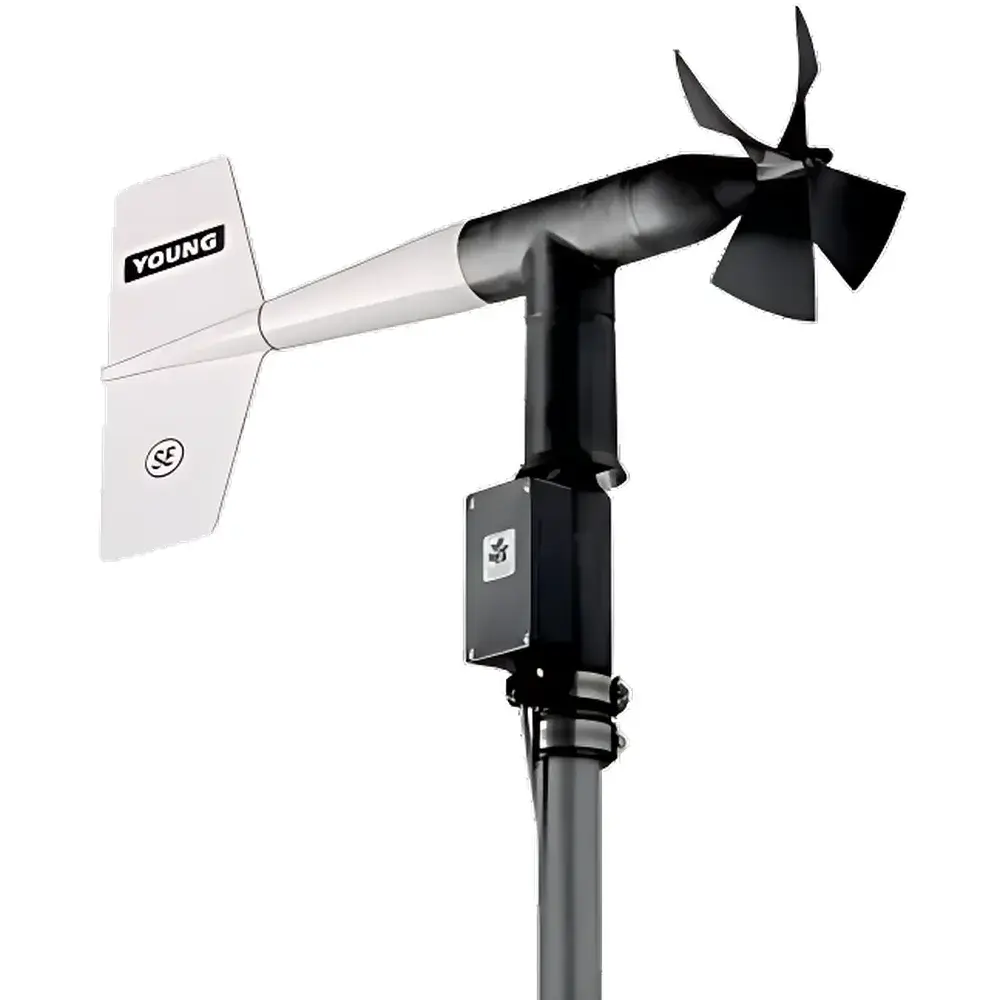
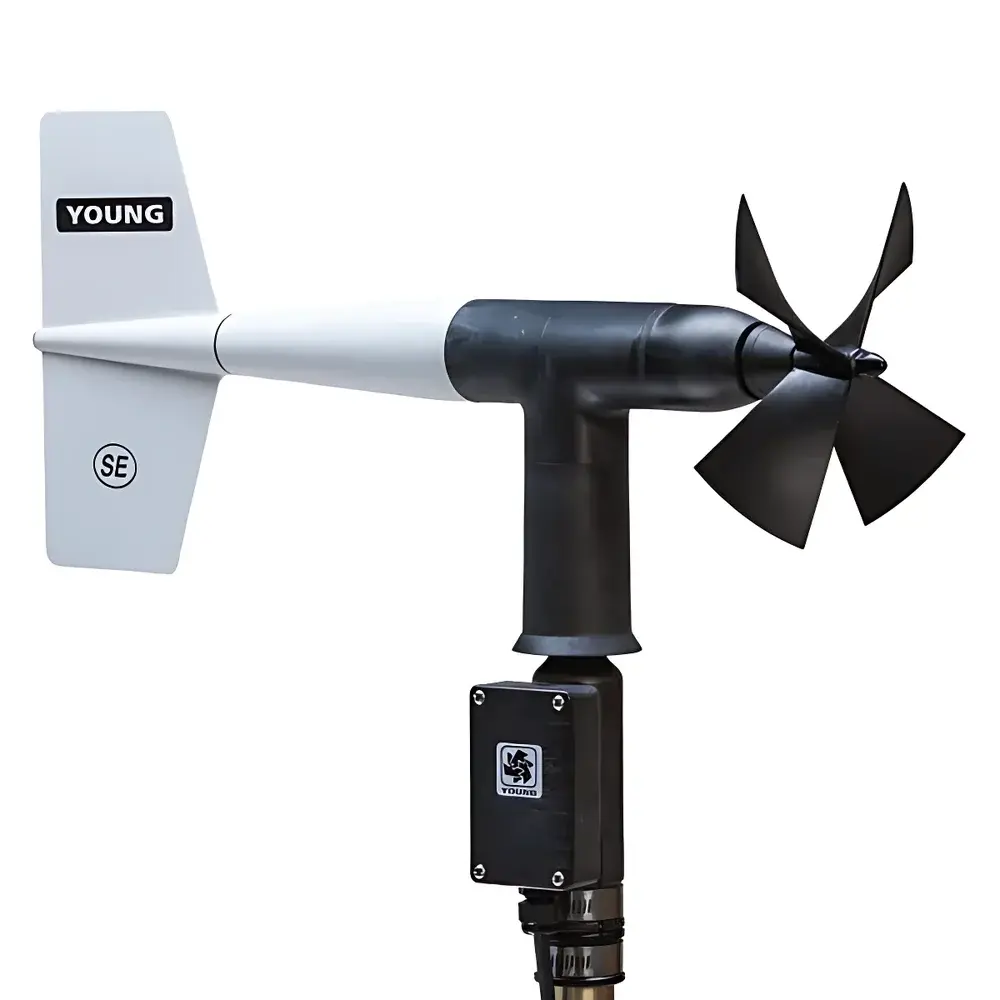

R.M. Young Model 09106 Serial Output Cup Anemometer with Ceramic Bearing
| Brand | R.M. Young |
|---|---|
| Origin | USA |
| Model | 09106 |
| Instrument Type | Propeller Anemometer |
| Resolution | 0.1 m/s |
| Measurement Range | 0–100 m/s |
| Accuracy | ±2% of reading or ±0.3 m/s (whichever is greater) |
| Operating Temperature | −50°C to +50°C |
| Relative Humidity Range | 0–100% RH |
| Wind Direction Range | 0–360° |
| Wind Direction Resolution | 1° |
| Wind Direction Accuracy | ±2° |
| Startup Wind Speed (Propeller) | 1.0 m/s |
| Output Interface | RS-485 serial (RMY, NCAR, or NMEA protocol), configurable for polled or continuous mode |
| Power Supply | 11–24 VDC, 20 mA |
| Dimensions (H × L) | 37 cm × 55 cm |
| Propeller Diameter | 18 cm |
| Mounting Tube Diameter | 34 mm (1-inch standard pipe) |
| Sensor Weight | 1.0 kg |
| Shipping Weight | 2.3 kg |
Overview
The R.M. Young Model 09106 is a high-reliability, marine-grade propeller anemometer engineered for long-term, unattended operation in demanding environmental monitoring applications. Unlike conventional cup or vane anemometers relying on potentiometric sensing, the 09106 employs a precision optical encoder for both wind speed and direction measurement—eliminating mechanical hysteresis, dead zones, and wear-related drift associated with analog wiper-based systems. Its four-blade stainless-steel propeller rotates around a ceramic-bearing shaft, inducing a variable-frequency signal in a stationary coil via a rotating multi-pole magnet assembly—fully eliminating slip rings and carbon brushes. This contactless transduction architecture ensures stable zero-point calibration and consistent linearity across its full 0–100 m/s dynamic range. The sensor’s digital signal path includes an onboard microprocessor that converts raw frequency data into calibrated, temperature-compensated digital output—supporting industry-standard RS-485 serial communication with selectable protocols (RMY, NCAR, or NMEA 0183). Designed for compatibility with SCADA, meteorological data loggers, and automated weather stations, the 09106 delivers traceable, audit-ready measurements under IEC 61000-4 electromagnetic immunity standards and meets IP65 ingress protection requirements.
Key Features
- Ceramic bearing assembly—resistant to salt corrosion, thermal expansion mismatch, and abrasive particulate wear; extends service life in coastal, offshore, and polar deployments.
- Optical absolute encoder for wind direction—retains angular position during power interruption, enabling seamless restart without recalibration.
- Dual-output flexibility: RS-485 serial interface (default) with jumper-selectable 0–5 V analog output for wind speed and direction—enabling integration with legacy analog DAQ systems.
- UV-stabilized thermoplastic housing and marine-grade stainless-steel/anodized aluminum hardware—validated for continuous exposure from −50°C to +50°C ambient.
- Low startup threshold (1.0 m/s for propeller, 1.1 m/s for tail vane) and optimized aerodynamic damping (damped natural wavelength: 7.4 m) for accurate low-wind response and minimal overshoot in turbulent flow.
- Configurable serial protocol modes: continuous streaming or polled interrogation—supports time-synchronized multi-sensor networks in distributed environmental observatories.
Sample Compatibility & Compliance
The Model 09106 is certified for outdoor, permanent-installation use in Class I, Division 2 hazardous locations per UL 1604. It complies with WMO Guide to Meteorological Instruments and Methods of Observation (CIMO Guide, Chapter 6) for wind measurement performance criteria. Its mechanical design adheres to ISO 24800-2:2021 (Wind sensors — Part 2: Performance testing of propeller anemometers) and supports traceable calibration per ISO/IEC 17025-accredited laboratories. The RS-485 interface meets ANSI/TIA/EIA-485-A electrical specifications and is compatible with Modbus RTU over RS-485 when configured in RMY mode. No internal battery or volatile memory is used—ensuring data integrity during extended power outages.
Software & Data Management
Raw serial output is ASCII-formatted and human-readable, facilitating direct parsing by Python, LabVIEW, or MATLAB scripts. R.M. Young provides open-specification command sets and protocol documentation—no proprietary drivers required. When integrated with compliant data acquisition platforms (e.g., Campbell Scientific CR6, Onset HOBO RX3000), the 09106 supports automatic metadata tagging, timestamped logging, and CRC-verified transmission. Audit trails—including firmware version, configuration state, and last calibration date—are accessible via query commands. For regulated environments (e.g., EPA air quality monitoring networks), the sensor supports optional firmware upgrades enabling NIST-traceable timestamping and 21 CFR Part 11-compliant electronic record generation when paired with validated host software.
Applications
- Long-term climate monitoring networks (NOAA, GCOS, GAW)
- Oceanographic buoys and offshore platform wind profiling
- Air quality compliance stations requiring simultaneous wind vector and pollutant dispersion modeling
- Wind resource assessment for utility-scale turbine siting (IEC 61400-12-1 pre-construction campaigns)
- Aviation weather systems (AWOS/ASOS) meeting FAA AC 150/5220-16B requirements
- Glaciological and polar research stations operating under extreme thermal cycling conditions
FAQ
What is the difference between the 09101 and 09106 models?
The 09106 replaces the stainless-steel ball bearings in the 09101 with ceramic hybrid bearings and features a larger-diameter stainless-steel propeller shaft—improving corrosion resistance and reducing rotational friction in high-salinity environments.
Can the 09106 be powered by solar-charged batteries?
Yes—the 11–24 VDC input range and 20 mA quiescent current make it compatible with typical solar-powered remote telemetry systems using charge controllers and deep-cycle LiFePO₄ or AGM batteries.
Is firmware update capability available in the field?
Yes—firmware updates are performed via serial command sequence using standard terminal emulation software; no hardware rework or factory return is required.
Does the optical encoder require periodic recalibration?
No—absolute optical encoding has no mechanical wear mechanism; calibration is retained indefinitely unless physically disturbed. Annual verification against a reference standard is recommended per ISO/IEC 17025 quality management protocols.
How is temperature compensation implemented?
An onboard thermistor monitors housing temperature in real time; compensation coefficients—derived from factory thermal soak testing across −50°C to +50°C—are applied algorithmically to both wind speed and direction outputs.







