
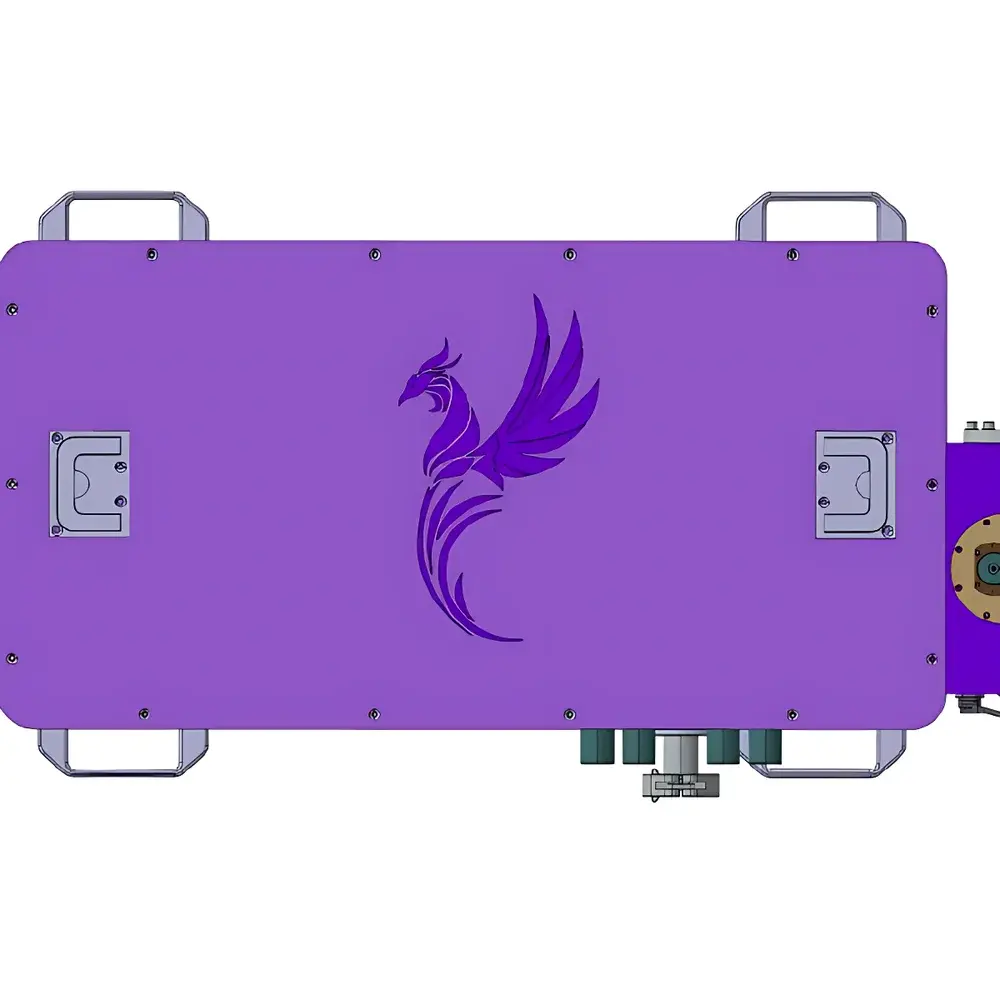
Yue Zhuo HHG EUV Light Source System (Lumi-Universe Model Yue Zhuo)
| Brand | Lumi-Universe |
|---|---|
| Origin | Anhui, China |
| Manufacturer Type | Authorized Distributor |
| Product Category | Domestic |
| Model | Yue Zhuo |
| Light Source Type | High-Harmonic Generation (HHG) EUV Source |
| Illumination Mode | Internal Illumination |
| Wavelength Range | 10–100 nm |
| Output Harmonic Power | 1 mW – 1 W |
| Pulse Duration | < 50 fs |
| Repetition Rate | 1–10 MHz |
| Dimensions | 885 × 420 × 233 mm |
| Weight | 55 kg |
Overview
The Yue Zhuo HHG EUV Light Source System is a compact, high-repetition-rate, table-top extreme ultraviolet (EUV) light source engineered for advanced ultrafast science and precision metrology. It operates on the physical principle of high-order harmonic generation (HHG), wherein intense femtosecond near-infrared (NIR) laser pulses are focused into a noble gas medium (e.g., Ar, Ne, or He), inducing non-perturbative nonlinear optical response and generating coherent radiation through quantum recollision dynamics. This process yields discrete, phase-locked harmonics spanning the 10–100 nm spectral range (12.4–124 eV photon energy), corresponding to the EUV regime—critical for probing core-level electronic transitions, valence band structures, and ultrafast electron dynamics with combined attosecond temporal and nanometer spatial resolution.
Unlike synchrotron or free-electron laser (FEL) facilities, the Yue Zhuo system delivers laboratory-scale access to EUV photons without requiring megawatt-class drivers or kilometer-scale infrastructure. Its design prioritizes stability, reproducibility, and integration readiness—making it suitable for both university ultrafast labs and industrial R&D environments engaged in next-generation semiconductor metrology, quantum device characterization, and coherent imaging.
Key Features
- Compact footprint: 885 × 420 × 233 mm — optimized for standard optical tables and cleanroom-compatible integration.
- High spectral brightness: Harmonic output power ranging from 1 mW to 1 W per selected order, scalable via input pulse energy and gas jet optimization.
- Narrow intrinsic linewidth: Δλ/λ < 1% for individual harmonic orders, enabling high-resolution spectroscopic applications such as time-resolved photoemission (tr-ARPES) and resonant inelastic scattering.
- Femtosecond temporal coherence: Pulse duration < 50 fs, supporting pump-probe experiments with sub-100 fs time resolution.
- Flexible driver compatibility: Designed to interface with commercial Ti:sapphire, Yb-based, or OPCPA femtosecond laser systems (center wavelength 780–1030 nm; pulse energy 0.1–5 mJ; repetition rate 1–10 MHz).
- Integrated gas handling: Low-consumption pulsed gas nozzle system minimizes operational cost and enables long-term unattended operation.
- Full electro-opto-mechanical integration: Synchronized control of harmonic generation chamber, vacuum interlocks, beam steering, and spectral selection modules via unified software interface.
Sample Compatibility & Compliance
The Yue Zhuo system is compatible with standard UHV-compatible sample stages (≤10⁻⁸ mbar base pressure), including 6-axis manipulators, cryogenic coolers (4–300 K), and spin-polarized electron analyzers. Its EUV output meets spectral purity and pointing stability requirements defined in ISO 10110-7 (optical component testing) and ASTM F3219 (EUV lithography source metrology). All vacuum components conform to ISO-KF and CF flange standards. The system supports GLP-compliant operation through audit-trail-enabled software logging and hardware interlock monitoring per IEC 61000-6-2 (EMC immunity) and IEC 61000-6-4 (EMC emission) standards.
Software & Data Management
Control is managed via a modular LabVIEW-based platform with Python API extension support. Key functionalities include automated harmonic order selection via motorized grating rotation, real-time beam pointing stabilization using quadrant photodiode feedback, and synchronized data acquisition with external detectors (e.g., MCPs, CCDs, TOF spectrometers). All experimental parameters—including gas pressure, laser energy, delay stage position, and harmonic center wavelength—are timestamped and exported in HDF5 format. The software architecture supports 21 CFR Part 11 compliance when configured with user role management, electronic signatures, and immutable audit trails—essential for semiconductor process development labs operating under FDA or ISO 13485 frameworks.
Applications
- Angle-resolved photoemission spectroscopy (ARPES) and time-resolved ARPES (tr-ARPES) for topological materials and 2D heterostructures.
- Coherent diffractive imaging (CDI) and ptychography of nanoscale biological specimens and catalytic nanoparticles.
- EUV interferometry and holography for mask inspection and multilayer mirror characterization in EUV lithography tool development.
- Ultrafast transient absorption and stimulated emission spectroscopy in molecular and condensed-phase systems.
- Atomic and molecular physics experiments requiring isolated attosecond pulses or attosecond pulse trains.
- In-line EUV reflectometry and scatterometry for high-NA EUV scanner optics qualification and defect metrology.
FAQ
What vacuum level is required for stable HHG operation?
A base pressure ≤ 5 × 10⁻⁷ mbar is recommended in the interaction chamber; the system includes integrated turbomolecular pumping and active pressure regulation.
Can the output be spectrally filtered to isolate a single harmonic order?
Yes—the system integrates a flat-field EUV spectrometer with motorized slit and variable-line-spacing grating, enabling automated selection of individual harmonics with < 0.1 nm bandwidth.
Is the source compatible with existing beamlines or endstations?
It features standard 2.75″ CF vacuum interfaces and kinematic optical mounts, allowing direct coupling to pre-aligned EUV beamlines or integration into custom UHV chambers.
Does the system support synchronization with external pump lasers?
Yes—via programmable TTL/USB-triggered delay generators with < 1 ps jitter, fully integrated into the control software stack.
What maintenance intervals are recommended?
Gas nozzle inspection every 500 hours; optic cleaning and alignment verification every 2000 hours; no consumables beyond noble gas supply.




