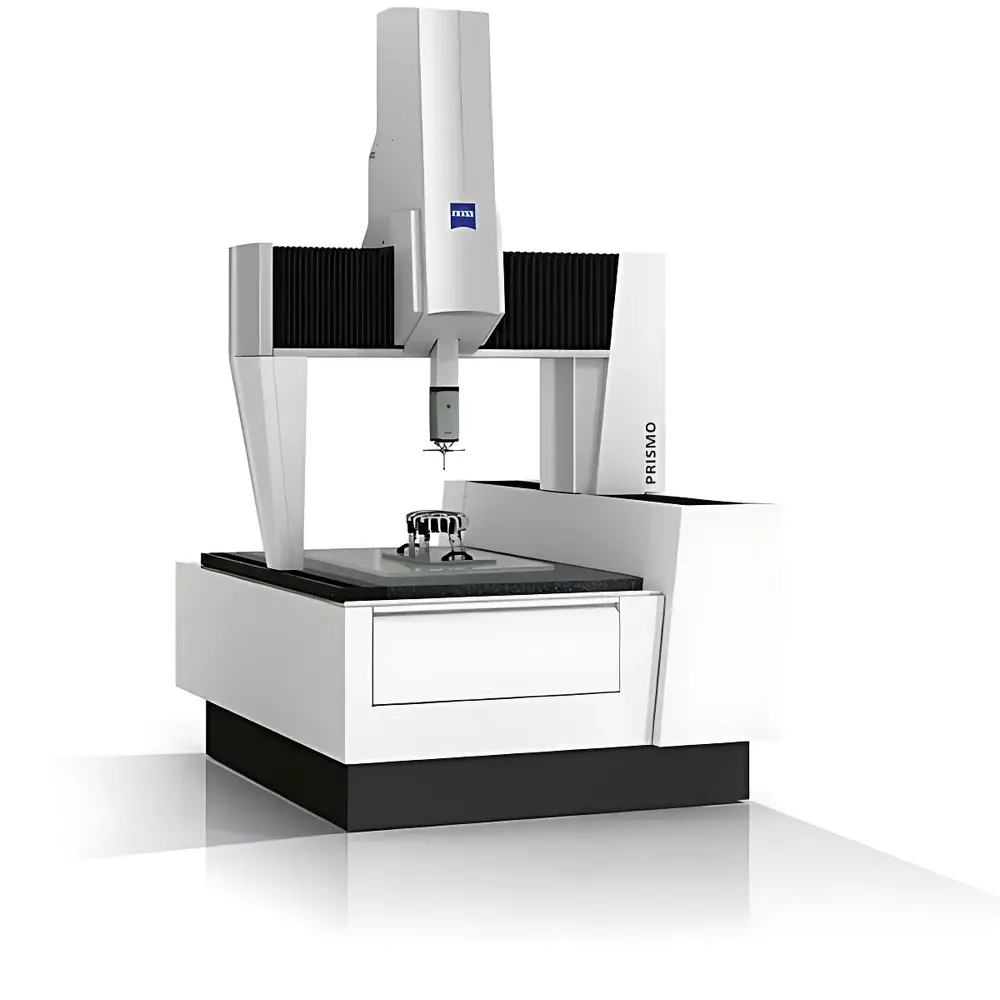
ZEISS PRISMO Series Bridge Coordinate Measuring Machine
| Brand | ZEISS |
|---|---|
| Origin | Germany |
| Model | PRISMO Series |
| Configuration | Bridge-type |
| Operation Mode | Automatic |
| Application Class | Shop-floor & Laboratory |
| Measurement Range | 700 × 1000 × 500 mm to 1600 × 4200 × 1000 mm |
| Volumetric Accuracy | (0.5 + L/500) µm |
| Maximum Scanning Speed | 1 m/s |
| Standard Operating Temperature | 18–20 °C |
| Thermal Stability | Glass-ceramic scale encoders |
| Structural Material | Industrial ceramic bridge and Z-axis |
| Bearing System | ZEISS Quadrapod air-bearing guidance on all axes |
| Dynamic Compensation | Computer-Aided Accuracy (CAA) real-time error correction |
| Compliance | ISO 10360, VDI/VDE 2627 Class 3 (for PRISMO verity), GLP/GMP-ready software architecture |
Overview
The ZEISS PRISMO Series Bridge Coordinate Measuring Machine (CMM) is a high-precision metrology platform engineered for demanding dimensional inspection in both controlled laboratory environments and near-production shop-floor settings. Based on the proven bridge architecture, the PRISMO leverages fundamental principles of geometric metrology—namely, orthogonal Cartesian coordinate measurement using tactile probing systems referenced to calibrated linear encoders—and integrates them with advanced dynamic compensation methodologies. Its core design philosophy centers on minimizing thermal drift, mechanical hysteresis, and kinematic uncertainty across the full operational envelope. The machine’s structural backbone—comprising industrial ceramic for the bridge and Z-axis—delivers exceptional stiffness-to-mass ratio and near-zero thermal expansion. Coupled with glass-ceramic linear scales and ZEISS Quadrapod air-bearing guidance on all three axes, the PRISMO achieves sub-micron volumetric performance even at elevated scanning velocities. Computer-Aided Accuracy (CAA) continuously models and corrects for dynamic errors—including Abbe offset, elastic deformation, and thermal gradients—ensuring traceable, reproducible results compliant with ISO 10360-2 and ISO 10360-4 standards.
Key Features
- Industrial ceramic bridge and Z-axis structure for superior torsional rigidity and minimal thermal sensitivity
- Glass-ceramic linear encoders with sub-micron resolution and long-term stability under ambient fluctuations
- ZEISS Quadrapod air-bearing guidance system providing frictionless motion, uniform load distribution, and high repeatability
- VAST Navigator technology enabling high-speed continuous scanning with adaptive path optimization and real-time probe compensation
- CALYPSO VAST Probing module reducing single-point measurement time by up to 25% while maintaining traceable uncertainty budgets
- REACH probing system with fully articulating VAST gold sensor head supporting continuous angular reorientation (±180° A, ±90° B) for complex geometry access
- CALYPSO Tray Optimizer enabling feature-based batch measurement across multiple parts on a single fixture—eliminating sequential probe reconfiguration
- CAA real-time dynamic error correction applied during scanning, compensating for velocity-dependent deviations, thermal drift, and mechanical compliance
Sample Compatibility & Compliance
The ZEISS PRISMO accommodates workpieces ranging from small precision components (e.g., medical implants, aerospace turbine blades) to large-scale assemblies (e.g., automotive body panels, wind turbine housings), within its scalable volume envelope (700 × 1000 × 500 mm up to 1600 × 4200 × 1000 mm). It supports standard tactile probes (including analog and digital scanning heads), optical line scanners, and optional vision modules for hybrid measurement strategies. All configurations comply with ISO 9001-certified manufacturing processes and support audit-ready documentation per FDA 21 CFR Part 11 when deployed with CALYPSO’s electronic signature and audit trail functionality. For applications requiring highest metrological confidence—such as calibration lab reference measurements or R&D validation—the PRISMO verity variant meets VDI/VDE 2627 Class 3 environmental specifications (temperature stability ±0.5 °C over 24 h, 19–22 °C ambient), while the PRISMO ultra achieves enhanced volumetric uncertainty through upgraded air-bearing tuning, ZERODUR® scale integration, and extended CAA modeling depth.
Software & Data Management
CALYPSO serves as the native metrology software platform, offering full ISO 15530-3-compliant uncertainty evaluation, GD&T analysis per ASME Y14.5 and ISO 1101, and automated report generation with embedded traceability metadata. The software architecture supports multi-user collaboration, role-based access control, and secure data export in neutral formats (XML, STEP AP242, QIF). Audit trails record every measurement parameter change, probe calibration event, and operator action—fully aligned with GLP and GMP requirements. Integration with enterprise quality management systems (QMS) is enabled via RESTful API and OPC UA interfaces. Optional CALYPSO SPC modules provide real-time process capability monitoring (Cp/Cpk, Pp/Ppk), trend analysis, and statistical alarm thresholds linked directly to measured features.
Applications
The ZEISS PRISMO is routinely deployed in Tier-1 automotive powertrain facilities for cylinder head and transmission case verification; in aerospace MRO centers for turbine disk profile certification; in medical device manufacturing for ISO 13485-compliant implant dimensional release testing; and in national metrology institutes for inter-laboratory comparison studies. Its dual suitability for temperature-controlled labs and conditioned shop-floor zones enables seamless transition from first-article inspection to in-process SPC sampling—reducing part transport delays and mitigating handling-induced variability. Typical use cases include form analysis (flatness, cylindricity, sphericity), position tolerancing (true position, concentricity), surface texture correlation, and multi-sensor alignment verification between CMM, CT, and optical measurement data.
FAQ
What environmental conditions are required for optimal PRISMO performance?
The base PRISMO model operates within a stabilized environment of 18–20 °C ±1 °C. For PRISMO verity, VDI/VDE 2627 Class 3 compliance requires 19–22 °C with ≤0.5 °C/h drift and ≤1 °C/24 h variation.
Does the PRISMO support automated calibration routines?
Yes—CALYPSO includes fully automated probe qualification, master ball calibration, and artifact-based volumetric error mapping per ISO 10360-6, with scheduled recalibration reminders and certificate generation.
Can the PRISMO interface with factory automation systems?
It supports direct integration via Ethernet/IP, PROFINET, and OPC UA for MES and SCADA connectivity, including part ID-triggered measurement program execution and pass/fail feedback to PLCs.
Is CAA correction applied during both single-point and scanning measurements?
Yes—CAA operates in real time across all measurement modes, dynamically adjusting for velocity, acceleration, thermal state, and probe deflection effects without user intervention.
What level of traceability does the PRISMO provide for ISO/IEC 17025 accreditation?
All hardware components carry individual calibration certificates traceable to PTB or NIST; software uncertainty budgets comply with GUM (JCGM 100) and are documented in CALYPSO’s integrated uncertainty engine.