
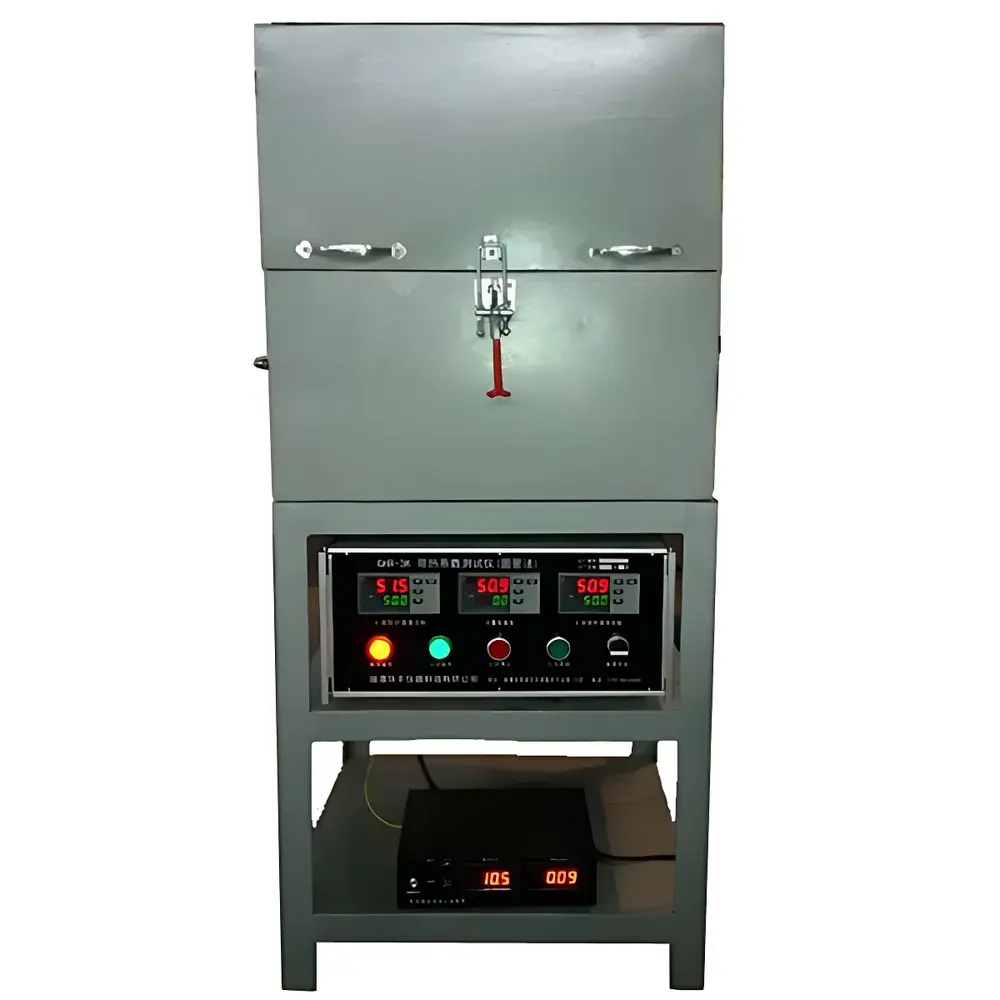
ZHENHUAFENXI GHR-3K Cylindrical Pipe Method Thermal Conductivity Analyzer
| Brand | ZHENHUAFENXI |
|---|---|
| Origin | Hunan, China |
| Model | GHR-3K |
| Measurement Principle | Steady-State Cylindrical Guarded Hot Pipe Method (per GB/T 10296–2008 & ISO 8497:1994) |
| Thermal Conductivity Range | 0.05–80 W/(m·K) |
| Accuracy | ±3% |
| Repeatability | ±2% |
| Test Temperature Range | Ambient to 350 °C |
| Sample Form | Cylindrical tubular insulation shells (e.g., rubber-plastic, fiberglass, rock wool, glass wool pipes) |
| Specimen Dimensions | Outer diameter up to 25 mm, length 500 mm, metering section 200 mm, guard sections 150 mm each |
| Heating Power | 0–500 W (adjustable constant-current source, ±0.5% stability) |
| Environmental Control Precision | ±1 °C |
| Guard Zone Temperature Control Precision | ±1 °C |
| Data Acquisition | 16-bit multi-channel thermocouple input card |
| Software Interface | Windows-based control, real-time monitoring, automated calculation of thermal conductivity (λ), surface thermal resistance (Rₛ), and heat transfer coefficient (h) |
| Compliance | Fully aligned with GB/T 10296–2008 and ISO 8497:1994 requirements for steady-state thermal transmission characterization of cylindrical insulation systems |
Overview
The ZHENHUAFENXI GHR-3K Cylindrical Pipe Method Thermal Conductivity Analyzer is a precision-engineered instrument designed for the standardized determination of thermal transport properties in tubular insulating materials under steady-state conditions. It implements the guarded hot pipe method—specifically configured for cylindrical geometry—as defined in GB/T 10296–2008 and ISO 8497:1994. Unlike planar or needle-probe techniques, this system models real-world installation conditions where insulation is applied as concentric shells around pipes, enabling direct quantification of radial heat flow through curved geometries. The apparatus features a central heated pipe (metering section) surrounded by two axially symmetric guard zones maintained at identical temperatures to eliminate axial conduction losses. Heat flux is measured via calibrated power input and high-resolution surface temperature gradients across the insulation layer. This architecture ensures traceable, geometry-specific thermal property data required for HVAC design validation, energy code compliance, and material certification.
Key Features
- Steady-state cylindrical configuration compliant with GB/T 10296–2008 and ISO 8497:1994, supporting metrologically rigorous λ-measurement for pipe insulation
- Adjustable constant-current heating source (0–500 W) with ±0.5% power stability and low-thermal-mass custom heater elements
- Dual-zone active temperature control: metering section and independently regulated guard zones, both stabilized to ±1 °C
- 16-bit multi-channel thermocouple data acquisition system capturing radial and axial temperature profiles with sub-millikelvin resolution
- Modular test fixture accommodating standard tubular specimens: outer diameter ≤25 mm, total length 500 mm, metering zone 200 mm
- Integrated environmental chamber with ambient-to-350 °C operational range and uniform thermal boundary control
- Computer-controlled automation including real-time convergence monitoring, automatic equilibrium detection, and iterative λ-calculation
Sample Compatibility & Compliance
The GHR-3K is optimized for rigid and semi-rigid cylindrical insulation shells commonly used in industrial piping and building services applications. Validated sample types include rubber-plastic foam tubes, extruded polyethylene (PE) pipes, mineral wool (rock wool, slag wool), glass fiber sleeves, and ceramic fiber pipe covers. All measurements adhere strictly to the geometric constraints, boundary condition specifications, and uncertainty budgeting procedures outlined in GB/T 10296–2008 and ISO 8497:1994. The system supports full audit trails for GLP-compliant reporting and may be integrated into quality management systems requiring ISO/IEC 17025 documentation. No inert gas purging or vacuum enclosure is required; testing occurs under ambient atmospheric conditions unless otherwise specified per material safety protocols.
Software & Data Management
The proprietary Windows-based software provides closed-loop instrument control, real-time visualization of temperature gradients, and automated derivation of thermal conductivity (λ), surface thermal resistance (Rs), and convective heat transfer coefficient (h). All raw sensor data—including voltage outputs, calibration coefficients, and time-stamped equilibrium states—are stored in open-format CSV and binary archives. The software includes built-in uncertainty propagation modules that compute combined standard uncertainty per ISO/IEC Guide 98-3 (GUM), incorporating contributions from power measurement, thermocouple drift, dimensional tolerances, and spatial averaging effects. Audit logs record user actions, parameter changes, and calibration events to satisfy FDA 21 CFR Part 11 requirements when operated in validated environments. Export options include PDF test reports with embedded metadata, Excel-compatible summaries, and XML for LIMS integration.
Applications
- Quality assurance of pre-fabricated pipe insulation for HVAC, district heating, and chilled water distribution systems
- Thermal performance verification of fire-rated pipe wraps and acoustic-thermal composite shells
- R&D evaluation of novel aerogel-enhanced or phase-change material (PCM)-integrated tubular insulators
- Third-party certification testing for compliance with EN 14320, ASTM C687, and ASHRAE Standard 90.1
- Material substitution studies comparing traditional mineral wool against bio-based or recycled-content alternatives
- Validation of computational fluid dynamics (CFD) and finite element analysis (FEA) models of radial conduction-convection coupling
FAQ
What standards does the GHR-3K comply with?
The instrument fully implements the test methodology and reporting requirements of GB/T 10296–2008 and ISO 8497:1994 for steady-state thermal transmission measurements on cylindrical insulation.
Can it test non-metallic or flexible pipe insulation?
Yes—it accommodates elastomeric foam, polyolefin, fiberglass, and mineral wool shells, provided they maintain structural integrity during mounting and thermal cycling.
Is vacuum or controlled atmosphere capability available?
No; the base configuration operates under ambient air. Optional environmental enclosures with nitrogen purge or low-pressure capability can be integrated upon request.
How is calibration traceability established?
Temperature sensors are calibrated against NIST-traceable reference thermometers; power measurement is verified using certified shunt resistors and precision multimeters accredited to ISO/IEC 17025.
What is the minimum specimen wall thickness supported?
The system achieves reliable measurement down to 5 mm nominal wall thickness, assuming uniform density and absence of interfacial voids or delamination.



