
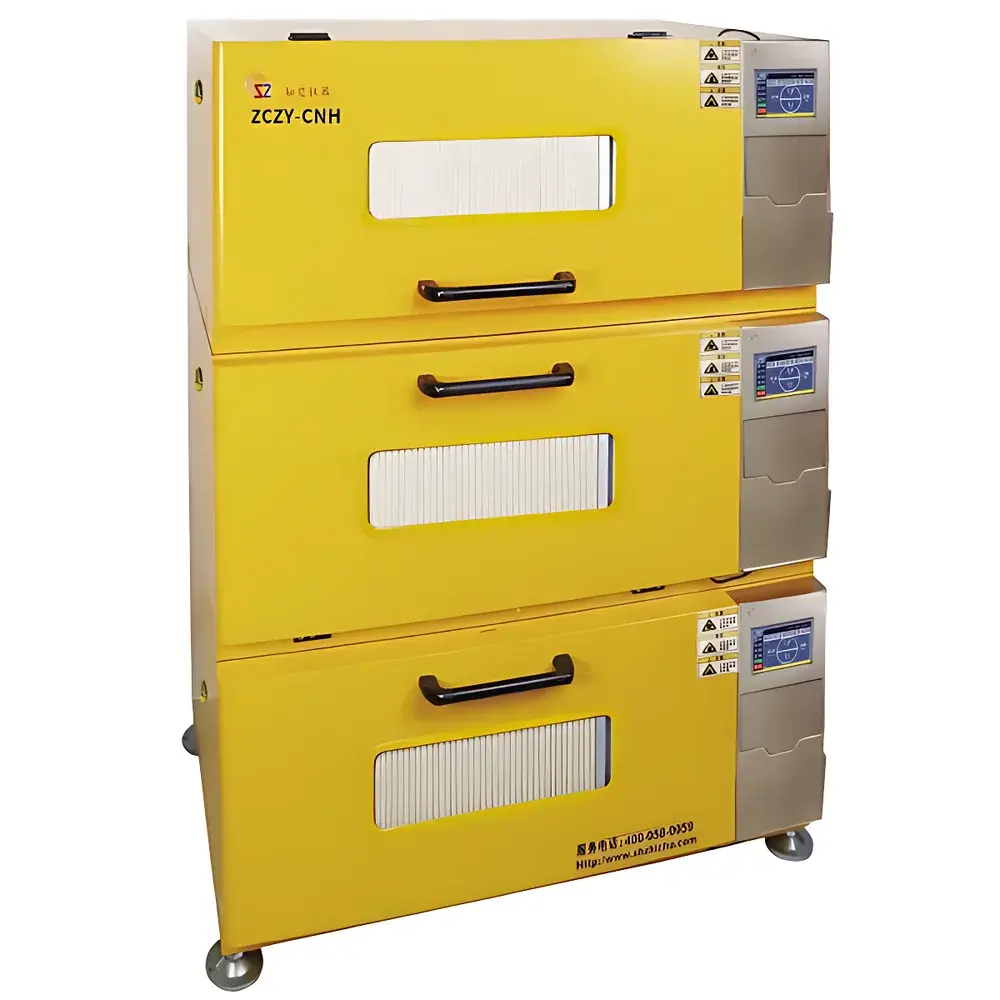
ZhiChu ZCZY-CNH High-Speed Dual-Motor CO₂ Orbital Shaker Incubator
| Brand | ZhiChu |
|---|---|
| Origin | Guangdong, China |
| Model | ZCZY-CNH |
| Instrument Type | CO₂-Regulated Temperature-Controlled Orbital Shaker Incubator |
| Timer Range | 0–999.9 h |
| Oscillation Frequency | 10–1000 rpm (±1 rpm accuracy) |
| Oscillation Amplitude | Φ3 mm |
| Temperature Range | 4–60 °C (ambient 23–25 °C) |
| Number of Shaking Decks | 3 |
| CO₂ Control Range | 0–20 % |
| CO₂ Control Accuracy | ±0.1 % |
| Temperature Uniformity | ±0.5 °C (at 37 °C) |
| Temperature Resolution | ±0.1 °C |
| Deck Dimensions (L×W) | 435 × 298 mm per deck (dual-motor per deck) |
| Power Supply | AC 220 V ±10 %, 50–60 Hz |
| Noise Level | <55 dB(A) |
| Internal Chamber | R-cornered 304 stainless steel |
| CO₂ Leak Rate | 5 % → 4.5 % in 30 min |
| Humidity Range (optional) | Ambient to 90 % RH (at 37 °C) |
| Data Logging | 5-year internal storage with temperature, RPM, and CO₂ concentration trend curves |
| Interface | Touchscreen LCD with USB data export |
| Compliance | Designed for GLP-compliant cell culture workflows |
Overview
The ZhiChu ZCZY-CNH is a tri-deck, high-speed dual-motor CO₂ orbital shaker incubator engineered for precision-controlled mammalian cell culture, microbial suspension growth, and biochemical assay development under physiologically relevant gaseous and thermal conditions. Unlike conventional single-motor shakers, each deck integrates two independent brushless DC motors—enabling simultaneous or differential control of rotational speed (10–1000 rpm) and direction (forward/reverse), with ±1 rpm frequency stability across the full range. The system employs PID-driven microprocessor regulation for temperature (4–60 °C), CO₂ (0–20 %, ±0.1 % accuracy via imported infrared NDIR sensor), and optional humidity (up to 90 % RH at 37 °C). Its forced-air convection architecture ensures ±0.5 °C uniformity at 37 °C, while the R-cornered 304 stainless-steel chamber—treated for >99 % bacterial inhibition—supports rigorous cleaning protocols required in QC/QA and bioprocess labs.
Key Features
- Dual-motor per deck architecture enables independent speed/direction control on all three decks—ideal for parallel optimization of culture conditions across cell lines or media formulations.
- Integrated infrared CO₂ sensing with real-time feedback loop delivers stable gas concentration control; CO₂ decay from 5 % to 4.5 % requires ≥30 minutes, confirming superior chamber seal integrity.
- Two-stage humidification system—including bottom-mounted evaporation tray and heated door—maintains >90 % RH at 37 °C without condensation, even during prolonged low-temperature operation.
- Intelligent refrigeration subsystem features adjustable cooling capacity, programmable defrost cycles (1–250 s duration, 30–600 min interval), and eco-friendly refrigerant—ensuring stable sub-ambient operation down to 4 °C.
- UV-C germicidal lamp (254 nm) integrated into ceiling panel enables routine sterilization between runs; optional retractable blackout curtain provides complete light exclusion for photophobic cultures.
- Full-touch LCD interface displays setpoints and real-time values (temperature, RPM, CO₂, remaining time) on one screen; password-protected operation prevents unauthorized parameter changes.
Sample Compatibility & Compliance
The ZCZY-CNH accommodates standard microplate formats (96-/384-well), deep-well plates (16 per deck using included columnar clamps), Erlenmeyer flasks (up to 2 L), and custom bioreactor vessels via adaptable deck fixtures. Its 304 stainless-steel interior meets USP requirements for non-porous, corrosion-resistant surfaces in biological manufacturing environments. The unit is designed to support GLP-compliant documentation workflows: onboard logging captures five years of timestamped temperature, shaking speed, and CO₂ concentration data with curve visualization; USB export enables traceable transfer to LIMS or ELN systems. While not FDA-cleared as a medical device, its construction and control architecture align with ISO 13485 principles for equipment used in preclinical biologics development.
Software & Data Management
No external PC software is required for basic operation—the embedded firmware handles all regulation, alarm logic, and data retention. Real-time operational parameters and historical trends are viewable directly on the 7-inch capacitive touchscreen. Logged data includes minimum/maximum/average values per session, with automatic timestamping compliant with ALCOA+ data integrity principles. USB 2.0 port supports CSV export of raw time-series datasets (sampled at 10-s intervals) for post-hoc statistical analysis in MATLAB, Python, or JMP. Optional Wi-Fi-enabled remote monitoring (via ZhiChu’s secure cloud portal) provides email/SMS alerts for out-of-spec events—fully configurable per deck—and supports role-based access control for multi-user facilities.
Applications
- High-density suspension culture of CHO, HEK293, and hybridoma cells under controlled CO₂ and pH-stabilized conditions.
- Time-resolved metabolic profiling requiring synchronized agitation and gas exchange (e.g., lactate/glucose monitoring in fed-batch studies).
- Antibiotic susceptibility testing (AST) with automated rocking to enhance drug–bacteria contact kinetics.
- Enzyme kinetics assays where oxygen transfer rate (OTR) and mixing homogeneity critically influence reaction velocity.
- Stem cell expansion protocols demanding strict avoidance of thermal gradients and shear-induced differentiation.
- Biopolymer synthesis (e.g., alginate, chitosan) under oscillatory shear to modulate molecular weight distribution.
FAQ
Does the ZCZY-CNH support GMP-compliant electronic records?
Yes—the built-in data logger maintains tamper-evident timestamps and retains full operational history for ≥5 years. Exported CSV files contain uneditable metadata (firmware version, serial number, operator ID if configured), satisfying FDA 21 CFR Part 11 predicate rule expectations for non-validated environments.
Can individual decks operate at different temperatures and CO₂ levels?
Temperature and CO₂ are regulated at the chamber level—not per deck—so all three decks share identical gas and thermal setpoints. However, each deck operates independently in speed, direction, and timing, enabling heterogeneous agitation protocols within a unified environmental envelope.
What maintenance is required for the CO₂ sensor?
The NDIR sensor is factory-calibrated and requires no routine recalibration. Annual verification against a certified gas standard (e.g., 5.00 % CO₂ in N₂) is recommended for labs operating under ISO/IEC 17025 quality systems.
Is the unit compatible with sterile tubing connectors for external gas supply?
Yes—standard 6 mm OD barbed inlet/outlet ports accept silicone or fluoropolymer tubing; optional stainless-steel gas manifold kit available for integration with central lab CO₂ lines.
How is condensation prevented on the observation window?
The double-glazed, tempered front door incorporates resistive heating elements synchronized with chamber humidity and temperature—eliminating fogging across the full operational range, including 4 °C/90 % RH conditions.




