
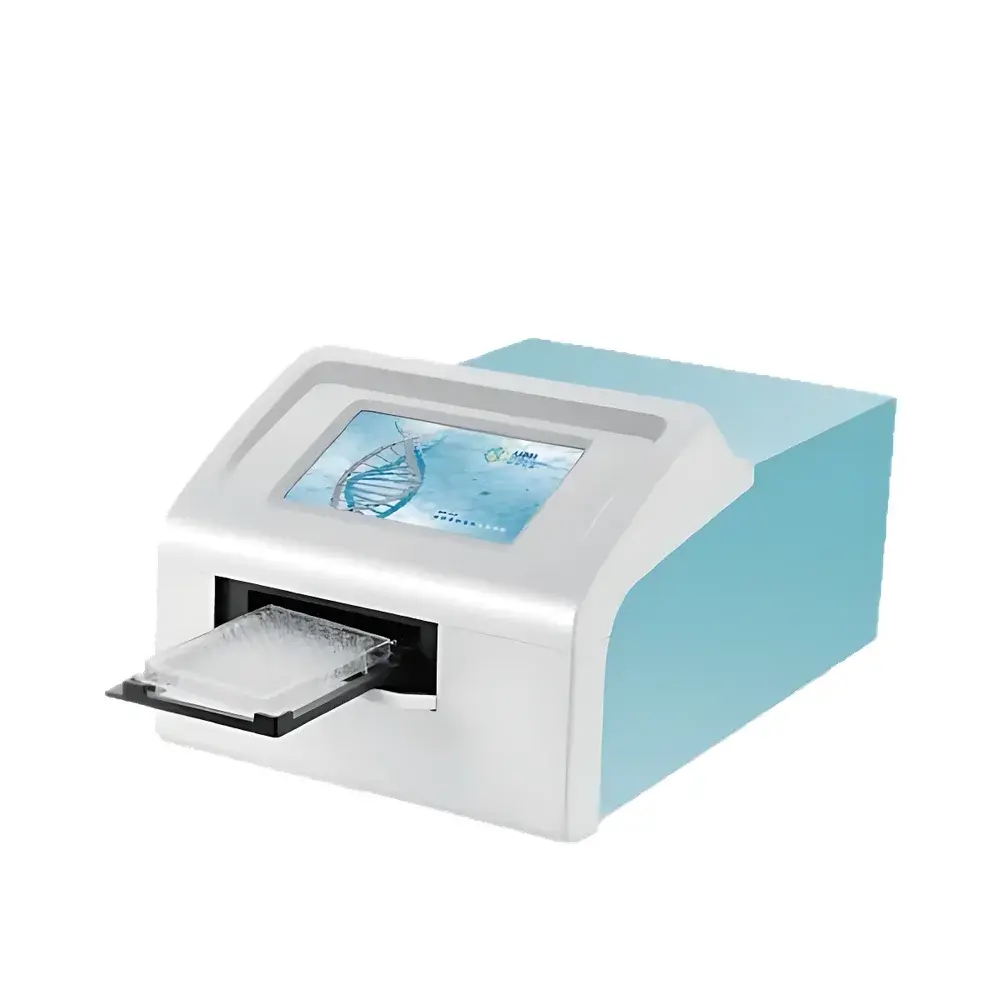
Zuofei ZMR-100 Automated Full-Spectrum Microplate Reader
| Brand | Zuofei |
|---|---|
| Origin | Shanghai, China |
| Manufacturer Type | Direct Manufacturer |
| Product Category | Domestic |
| Model | ZMR-100 |
| Detection Method | Absorbance (Photometric) |
| Functionality | Multifunctional |
| Automation Level | Fully Automated |
| Measurement Mode | Scanning |
| Curve Fitting Options | Linear, Point-to-Point, Quadratic, Cubic, Four-Parameter Logistic (4PL), Cubic Spline, Two-Parameter Logarithmic |
| Detector Light Source | 6 V / 10 W Halogen Lamp |
| Wavelength Range | 340–750 nm (Full Visible Spectrum) |
| Absorbance Range | 0–4.000 Abs |
| Absorbance Linearity | ≤ ±1% (0–2.0 Abs) |
| Read Time | <10 s per 96-well plate (single wavelength), <16 s (dual wavelength, standard mode) |
| Absorbance Resolution | 0.001 Abs |
Overview
The Zuofei ZMR-100 Automated Full-Spectrum Microplate Reader is a dedicated photometric microplate detection system engineered for high-throughput, quantitative analysis of enzyme-linked immunosorbent assays (ELISA), colorimetric enzymatic reactions, and other absorbance-based biochemical assays. Operating on the principle of monochromatic light absorption through sample wells in standard 96-well or 384-well microplates, the ZMR-100 employs a stable 6 V / 10 W halogen lamp coupled with an 8-position filter wheel to deliver precise, reproducible optical measurements across the full visible spectrum (340–750 nm). Its vertical 9-channel optical path ensures consistent beam alignment with well centers, minimizing positional error and enhancing inter-plate and intra-plate repeatability. Designed for routine use in core laboratories, QC environments, and academic research settings, the instrument supports both endpoint and kinetic read modes—enabling dynamic monitoring of enzymatic activity, cell viability, and ligand-binding kinetics without external software dependencies.
Key Features
- Fully automated operation with integrated plate handling logic—no manual intervention required for plate loading, wavelength selection, or data acquisition.
- 7-inch high-resolution capacitive touchscreen interface—intuitive graphical navigation, no external keyboard or mouse necessary; optional peripheral support available.
- 8-position filter wheel with 4 standard filters pre-installed (405 nm, 450 nm, 492 nm, 630 nm); additional narrow-band interference filters (340–750 nm) are field-replaceable without opening the instrument chassis.
- Optimized optical architecture: 9-channel vertical light path with automatic well-centering algorithm ensures uniform illumination and minimal cross-talk between adjacent wells.
- High-speed photometric reading: completes single-wavelength measurement of a full 96-well plate in under 10 seconds; dual-wavelength mode completes in under 16 seconds (standard mode).
- Onboard vibration function with adjustable amplitude and duration—enhances mixing homogeneity prior to measurement, critical for heterogeneous assays.
- Self-diagnostic routines covering optical path integrity, motor positioning accuracy, lamp intensity stability, and filter wheel calibration—accessible via service menu with timestamped logs.
- Energy-efficient halogen illumination system with extended service life (>2,000 hours), reducing long-term maintenance frequency and operational cost.
Sample Compatibility & Compliance
The ZMR-100 accommodates ANSI/SLAS-compliant microplates including flat-bottom, U-bottom, and V-bottom formats (96-well and 384-well). It supports common assay chemistries such as ELISA, BCA, Lowry, Bradford, MTT, XTT, and LDH-based cytotoxicity assays. The instrument meets general laboratory safety standards (IEC 61010-1) and incorporates design features aligned with Good Laboratory Practice (GLP) workflows—including audit-trail-capable event logging, user-access control tiers, and immutable result timestamps. While not FDA 21 CFR Part 11–certified out-of-the-box, its data export architecture (CSV, Excel-compatible .xls) enables integration into validated LIMS or electronic lab notebook (ELN) systems compliant with ISO/IEC 17025 and CLIA requirements.
Software & Data Management
The embedded firmware provides native support for endpoint quantitation, kinetic profiling, qualitative thresholding, and statistical quality control (Levey-Jennings, Westgard rules). Curve-fitting algorithms include linear regression, quadratic/cubic polynomial, point-to-point interpolation, and four-parameter logistic (4PL) modeling—essential for immunoassay standard curve generation. All protocols—including wavelength pairs, incubation parameters (ZMR-100T variant only), shaking profiles, and curve-fit configurations—are saved internally with versioned naming. Raw absorbance values and derived concentrations are stored with metadata (date/time, operator ID, plate ID, filter set) and exportable in comma-separated values (CSV) or Microsoft Excel (.xls) format. No proprietary software installation is required for basic operation; advanced reporting or batch analysis may be performed using third-party tools compatible with standard spreadsheet formats.
Applications
- Quantitative ELISA and competitive immunoassays requiring high linearity over broad dynamic ranges (0–4.000 Abs).
- Protein concentration determination via colorimetric methods (BCA, Bradford, Lowry) with trace-level sensitivity enabled by low-noise photometry.
- Cell proliferation and cytotoxicity assessment using metabolic dyes (e.g., MTT, WST-1) measured at 450 nm or 492 nm with reference correction at 630 nm.
- Enzyme kinetic studies (e.g., β-galactosidase, alkaline phosphatase, horseradish peroxidase) leveraging onboard time-resolved scanning capability.
- Environmental and food safety testing—e.g., pesticide residue screening (ELISA-based), mycotoxin detection, and allergen quantification.
- Agricultural research applications including plant stress biomarker analysis and phytohormone quantification via enzymatic amplification.
FAQ
What microplate formats does the ZMR-100 support?
Standard 96-well and 384-well plates conforming to ANSI/SLAS dimensional specifications; compatible with clear, white, and black polystyrene plates.
Can the ZMR-100 perform temperature-controlled assays?
The base ZMR-100 model operates at ambient temperature; the ZMR-100T variant includes an integrated Peltier-based incubation module (range: +4 °C to 50 °C) with ±0.5 °C uniformity across the plate surface.
Is wavelength calibration traceable to NIST standards?
Factory calibration uses certified reference filters; users may perform periodic verification using optional NIST-traceable absorbance standards (e.g., potassium dichromate solutions).
How is data security handled during export?
Exported files contain no embedded executable code; all outputs are plain-text CSV or binary Excel formats compliant with institutional IT policies for data transfer and archival.
What maintenance is required for the optical system?
No routine optical alignment is needed; lamp replacement and filter changes are tool-free and accessible via front-panel service ports—designed for field servicing without disassembly.




