
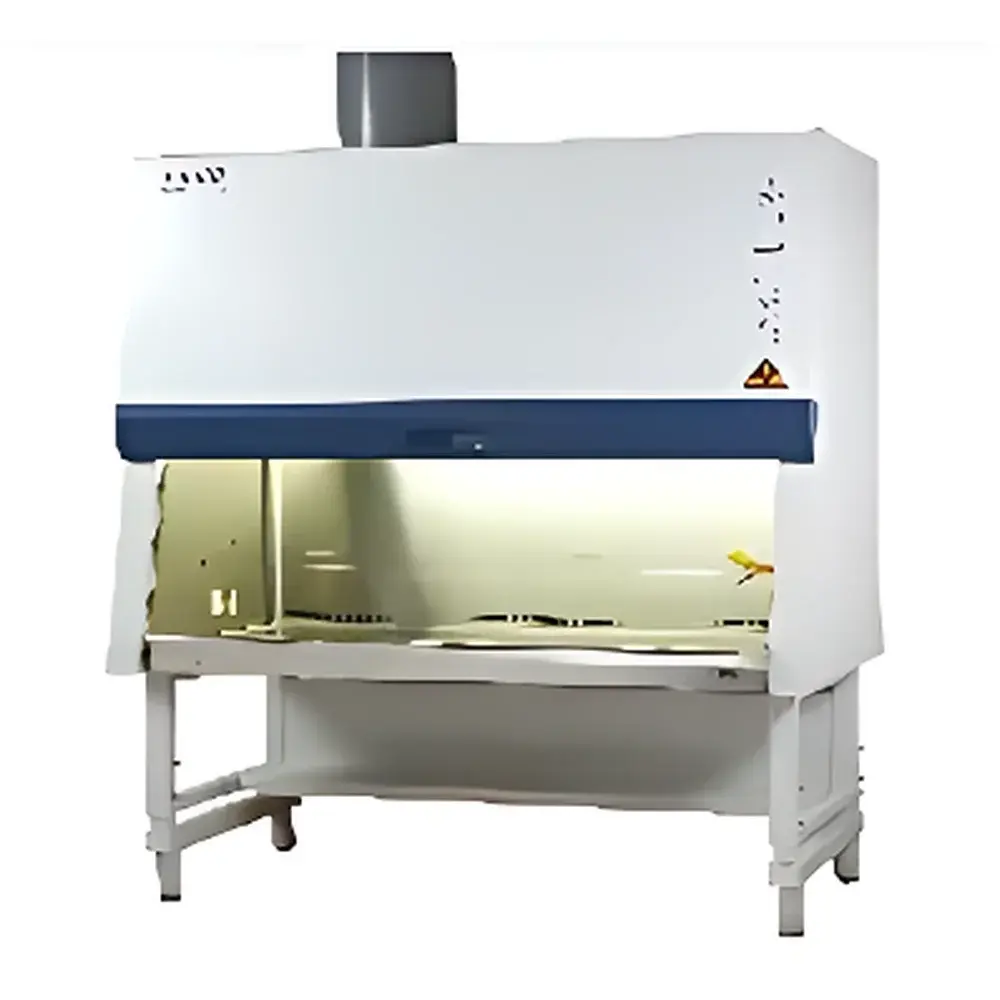
Esco LB2-4B1 Class II Type B1 Biological Safety Cabinet
| Brand | Esco |
|---|---|
| Origin | Singapore |
| Model | LB2-4B1 |
| Certification | NSF/ANSI 49 & YY0569 |
| ULPA Downflow Filter Efficiency | >99.999% for particles ≥0.12 µm |
| HEPA Exhaust Filter Efficiency | >99.99% for particles ≥0.3 µm |
| Noise Level (per EN 12469) | <58 dBA |
| External Dimensions (L×W×H) | 1420 × 815 × 1568 mm |
| Internal Work Area (L×W×H) | 1260 × 623 × 715 mm |
| Construction | 304 Stainless Steel Work Surface, Isocide™ Antimicrobial Coating, Seamless Front Intake & Sloped Ergonomic Design |
Overview
The Esco LB2-4B1 is a certified Class II, Type B1 biological safety cabinet engineered to provide personnel, product, and environmental protection during microbiological and biomedical procedures involving low-to-moderate risk agents (BSL-2 and select BSL-3 applications). Operating on the principle of inward airflow containment combined with total exhaust (via dedicated ducted ventilation), the LB2-4B1 maintains a continuous negative-pressure envelope around all potentially contaminated zones—including the supply plenum, fan chamber, and filter housings—ensuring no recirculation of contaminated air into the work area or laboratory environment. Its design complies strictly with NSF/ANSI 49 (2022) and China’s YY0569-2011 standards, validated through independent third-party testing. The cabinet employs a dual-filtration strategy: a ULPA downflow filter delivering laminar, particle-free vertical airflow over the work surface at a uniform velocity, and a HEPA exhaust filter treating all contaminated effluent before discharge to the outside. This architecture meets the stringent requirements for handling volatile toxic chemicals in conjunction with biohazards—a key differentiator of Type B1 cabinets versus Type A2 or C1 configurations.
Key Features
- Dynamic™ Negative Pressure Containment System: A proprietary Esco engineering solution that isolates all positive-pressure zones (e.g., blower compartment, filter housings) within a continuous negative-pressure cavity, preventing leakage even under filter breach or seal failure scenarios.
- ULPA Downflow Filtration: Certified >99.999% efficiency for particles ≥0.12 µm, ensuring ultra-low bioburden exposure across the entire 1260 mm work surface.
- Ergonomic 10° Tilted Work Surface & Viewing Angle: Reduces operator neck and shoulder strain during extended use; integrated wide-profile armrests further minimize musculoskeletal fatigue.
- Seamless Front Intake & One-Piece 304 Stainless Steel Tray: Eliminates crevices where contaminants may accumulate; tray is removable for autoclaving or chemical decontamination.
- Isocide™ Antimicrobial Coating: Applied to all external painted surfaces, inhibiting bacterial and fungal colonization per ISO 22196:2011 test methodology.
- Optimized Airfoil Geometry & Enhanced Side Inlet Ports: Suppresses turbulence and reverse flow at the work area perimeter, maintaining stable inflow velocity profiles per EN 12469 Annex D.
- Safety-Interlocked UV Lamp (30W, 254 nm): Mounted behind the control panel to prevent direct ocular exposure; automatically deactivates when sash exceeds safe operating height.
- 6.0 mm+ Tempered, UV-Resistant, Anti-Shatter Glass Sash: Frameless, double-laminated construction with easy-clean surface finish; position-sensing sash controller enables real-time airflow recalibration.
Sample Compatibility & Compliance
The LB2-4B1 supports a broad range of life science workflows including cell culture, microbial isolation, molecular cloning, diagnostic assay preparation, and pharmaceutical aseptic processing involving low-volatility solvents. It is not intended for use with high-vapor-pressure compounds (e.g., ether, benzene) unless paired with supplemental local exhaust. All units undergo full-system validation per NSF/ANSI 49 Section 7 (personnel protection), Section 8 (product protection), and Section 9 (cross-contamination control), with documented smoke visualization, tracer gas containment, and airflow velocity mapping. Certificates of Conformance include traceable calibration records for anemometers and particle counters used during testing. The cabinet satisfies GLP and GMP facility requirements when integrated into validated HVAC systems compliant with ISO 14644-1 Class 5 (ISO Class 5) cleanroom specifications.
Software & Data Management
While the LB2-4B1 operates via analog-digital hybrid controls (no embedded OS), its intelligent sash sensor interface logs operational parameters—including sash height, runtime, UV exposure duration, and alarm events—for manual audit trail generation. Optional data logging modules (sold separately) enable RS-485 or Modbus RTU integration with centralized BMS platforms. All firmware updates adhere to IEC 62304 Class B software lifecycle requirements. For regulated environments, configuration changes are restricted via password-protected administrator mode, supporting FDA 21 CFR Part 11 compliance when paired with electronic signature-capable LIMS systems.
Applications
- Aseptic handling of primary human cells and stem cell lines under BSL-2 conditions
- Preparation of viral vectors and lentiviral transduction reagents
- Handling of select BSL-3 pathogens requiring chemical disinfectant compatibility (e.g., Mycobacterium tuberculosis cultures with phenolic agents)
- QC testing of sterile injectables and ophthalmic solutions per USP and
- Environmental monitoring sample processing in pharmaceutical cleanrooms
- Teaching laboratories requiring NSF-certified containment for undergraduate microbiology curricula
FAQ
What distinguishes Type B1 from Type A2 cabinets?
Type B1 cabinets exhaust 100% of air externally and do not recirculate any portion internally, making them suitable for work involving volatile toxic chemicals alongside biological agents. Type A2 cabinets recirculate ~70% of filtered air, limiting their use with hazardous vapors.
Is ducting mandatory for the LB2-4B1?
Yes. As a total-exhaust cabinet, it requires hard-ducted connection to a dedicated exhaust system with stable static pressure compensation—typically −125 to −150 Pa at the canopy collar—to maintain certified inflow velocity and containment integrity.
Can the LB2-4B1 be installed in a room without a central exhaust system?
No. Unlike Type A2 cabinets, it cannot operate with a thimble or canopy bypass; installation must comply with ASHRAE 110 and local mechanical code requirements for dedicated exhaust duct runs.
How often should ULPA and HEPA filters be replaced?
Filter service intervals depend on usage intensity and ambient particulate load; typical replacement occurs every 5–7 years for ULPA and 3–5 years for exhaust HEPA, contingent upon annual performance verification per EN 1822-5.
Does the LB2-4B1 support remote monitoring or IoT integration?
Native Ethernet or Wi-Fi capability is not included, but third-party analog signal adapters (4–20 mA outputs for inflow velocity and sash position) allow integration into facility-wide SCADA or CMMS platforms.
Related Products




