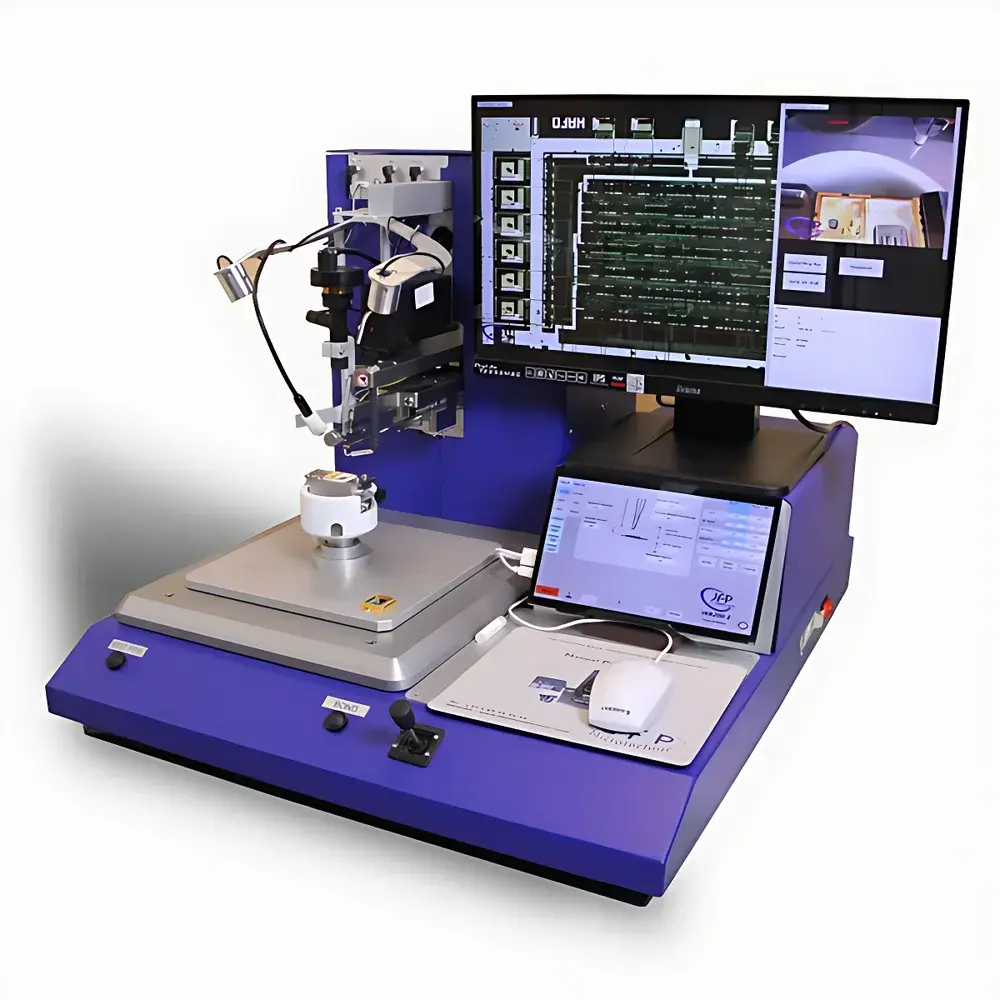
JFP WB 200-e Automatic 360° Ball Bonding System
| Brand | JFP |
|---|---|
| Origin | France |
| Equipment Type | Automatic Wire Bonder |
| Model | WB 200-e |
| Bonding Technology | Thermosonic Ball Bonding with 360° Rotational Capillary Actuation |
| Max. Z-Travel | 40 mm |
| Z-Axis Resolution | 0.23 µm |
| XY-Stage Range | 80 × 80 mm |
| XY/Z Resolution | 0.23 µm |
| Ultrasonic Power Range | 0–5 W |
| Frequency | 62 kHz (standard), optional 40/80 kHz |
| Bond Force Range | 10–150 cN |
| Bond Time Range | 0–2000 ms |
| Wire Diameter Support | Au/Al 17–50 µm, Ribbon 40–250 µm (w) × 12–25 µm (t) |
| Heating Stage Temp. Range | 60–250 °C (±1% accuracy) |
| Vision System | 5 MP industrial camera, 8× optical zoom, programmable coaxial & oblique LED illumination |
| Footprint | 640 × 710 × 550 mm |
| Weight | 60 kg |
Overview
The JFP WB 200-e Automatic 360° Ball Bonding System is a high-precision, desktop-class thermosonic wire bonder engineered for advanced semiconductor packaging applications requiring fine-pitch interconnects, deep-cavity accessibility, and multi-height substrate geometries. Based on Couette-flow-assisted ultrasonic energy transfer and real-time Z-axis servo-controlled capillary actuation, the system implements a proprietary 360° rotational bonding head architecture—enabling true omnidirectional ball bond placement without mechanical repositioning of the substrate or stage. This design directly addresses critical limitations in conventional wedge/ball bonders when processing LTCC-based 5G RF filters, MEMS sensor stacks with stepped topography, IGBT die-to-DBC substrates, and VCSEL arrays with non-planar emitter layouts. The WB 200-e operates under ISO 9001-certified manufacturing protocols and conforms to JEDEC J-STD-020 moisture sensitivity level (MSL) handling guidelines during bonding sequence execution.
Key Features
- 360° Rotational Capillary Actuation: Enables full-spherical bond trajectory planning and execution—eliminating arc-induced misalignment in narrow-pitch (<30 µm) and high-step (>100 µm) configurations.
- Sub-Micron Motion Control: Dual-axis servo-driven XY stage and independent Z-axis with 0.23 µm resolution ensures repeatable bond placement accuracy across thermal drift cycles.
- Deep-Cavity Bonding Capability: 200 mm throat depth and ±180° rotating cantilever arm support bonding within enclosures up to 110 mm tall and 200 mm deep—compatible with hermetic TO-can, ceramic LGA, and stacked-die packages.
- AI-Assisted Graphical Programming Interface: Intuitive drag-and-drop motion sequencing with automatic loop shape generation (reverse-loop, height-adjusted, length-constrained); reduces operator training time to under 3 minutes per process setup.
- Dual-Channel Thermosonic Control: Independent parameter sets for first (ball) and second (stitch) bonds—including force (10–150 cN), time (0–2000 ms), power (0–100%), and ultrasonic frequency selection (62 kHz standard, 40/80 kHz optional).
- Integrated Dual-Vision Architecture: Primary 5 MP microscope with 8× optical zoom and auto-focus compensation for thermal expansion-induced pad shift (±1 µm correction); secondary side-view camera captures dynamic wire deformation and loop formation in real time.
Sample Compatibility & Compliance
The WB 200-e accommodates substrates up to 80 × 80 mm and thicknesses up to 110 mm, including ceramic (Al₂O₃, AlN), silicon, LTCC, and organic laminate carriers. It supports gold (17–50 µm), aluminum (17–50 µm), and ribbon wire (40–250 µm width, 12–25 µm thickness) bonding under controlled ambient conditions (class 10,000 cleanroom compatible). All bonding recipes are timestamped and logged with full audit trail per FDA 21 CFR Part 11 requirements when paired with optional secure user authentication and electronic signature modules. Process data export complies with ASTM F2119-22 (Standard Guide for Wire Bonding Process Characterization) and IPC-7095C (Design and Assembly Process Implementation for BGAs).
Software & Data Management
The embedded 10-inch capacitive touchscreen runs JFP’s BondOS™ v4.2 firmware, supporting offline recipe development, in-line parameter adjustment, and automated program replication. Each bond cycle logs force/time/power curves, Z-position profiles, and vision-derived alignment offsets in CSV/Excel-compatible format. Data retention includes full GLP/GMP-compliant metadata: operator ID, timestamp, environmental temperature/humidity, calibration status, and EFO spark count history. Remote diagnostics and firmware updates are supported via encrypted Ethernet connection; no cloud storage is enabled by default—ensuring full data sovereignty per EU GDPR and U.S. ITAR export control regulations.
Applications
- 5G RF Front-End Modules: Precision ball bonding of low-inductance loops on LTCC baluns and BAW filter substrates with <35 µm pitch.
- MEMS Packaging: Interconnection of pressure sensor diaphragms and microphone capsules with asymmetric cavity depths and thermal gradient compensation.
- Power Electronics: Die-to-substrate bonding on DBC/AMB ceramics for SiC and GaN IGBT modules under elevated thermal load (up to 250 °C preheat).
- Optoelectronics: Array-level bonding of VCSEL emitters with sub-50 µm pitch and variable die thickness (e.g., thinned vs. unthinned wafers).
- R&D Prototyping: Rapid iteration of novel bond loop geometries—including reverse-loop, stair-step, and multi-plane trajectories—for next-generation heterogeneous integration.
FAQ
What wire types and diameters does the WB 200-e support?
Gold (17–50 µm), aluminum (17–50 µm), and flat ribbon wire (40–250 µm wide × 12–25 µm thick) are fully supported. Custom capillary tooling (1.58 mm shank) is available for specialized wire forms.
Is the system compliant with FDA 21 CFR Part 11 for regulated production environments?
Yes—when configured with optional audit trail logging, electronic signatures, and role-based access control, the WB 200-e meets ALCOA+ data integrity principles and supports GMP validation documentation packages.
How does the 360° rotational bonding head improve fine-pitch capability?
By decoupling bond angle from stage motion, the rotating capillary eliminates cumulative kinematic error inherent in XY-stage-only systems—enabling stable, repeatable 30 µm pitch bonding without sacrificing loop height control or mechanical robustness.
Can the WB 200-e perform both ball and wedge bonding?
The WB 200-e is optimized for thermosonic ball bonding. Wedge bonding requires separate tooling and is not natively supported; however, hybrid configurations using external wedge modules may be evaluated under engineering consultation.
What heating stage options are available for high-temperature bonding processes?
Standard HP-series stages include HP-60 (Ø60 mm), HP-50×50 (for Dill-compatible fixtures), HP-100 (100 × 100 mm), and HP-200 (200 × 150 mm), all featuring ±1% temperature stability and ±10 mm vertical adjustment range.
Related Products