G-WON GMK-600 Portable Alcohol Content Analyzer for Alcoholic Beverages
| Brand | G-WON |
|---|---|
| Origin | South Korea |
| Model | GMK-600 |
| Measurement Range | 0–22.0% v/v |
| Resolution | 0.1% |
| Accuracy | ±0.5% |
| Temperature Compensation Range | 5–70 °C |
| Power Supply | 9 V alkaline battery (1 pc) |
| Measurement Time | ~10 s |
| Dimensions | 154 × 108 × 43 mm |
| Weight | ~1.0 kg |
Overview
The G-WON GMK-600 Portable Alcohol Content Analyzer is a dedicated, handheld instrument engineered for rapid, on-site quantification of ethanol concentration in alcoholic beverages—including wines, spirits, and fermented liquors. It operates on the principle of near-infrared (NIR) absorption spectroscopy optimized for the C–H and O–H vibrational bands characteristic of ethanol in aqueous-alcoholic matrices. Unlike breathalyzers or refractometric estimators, the GMK-600 performs direct liquid-phase analysis using an integrated optical sensing chamber and temperature-stabilized photodiode array. Its measurement range (0–22.0% v/v ethanol) covers typical commercial beverage categories—from low-alcohol beers to fortified wines—while maintaining traceable accuracy under variable ambient conditions. The device is not intended for forensic blood alcohol testing or regulatory compliance with ISO 8536-5 or ASTM E2915; rather, it serves as a process control and quality verification tool for production facilities, distilleries, importers, and laboratory technicians requiring repeatable, field-deployable alcohol assessment.
Key Features
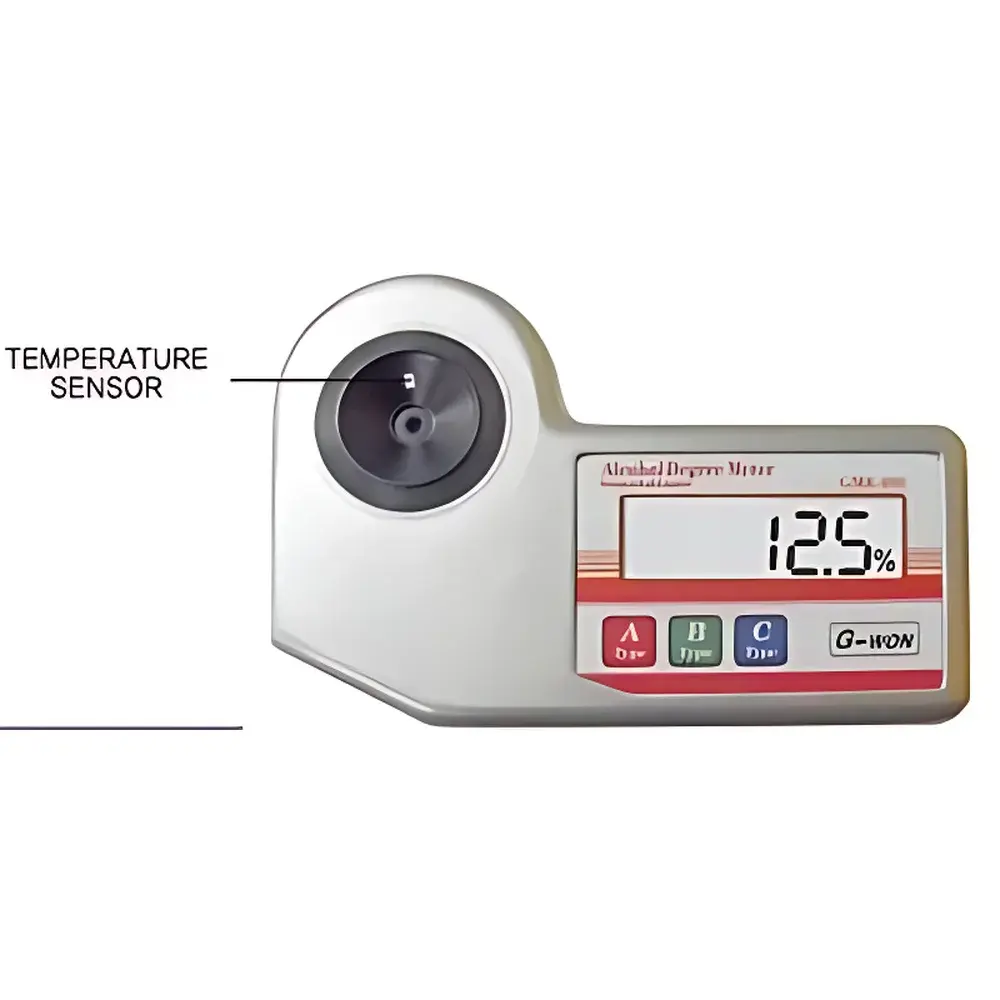
- Triple-calibration memory: Stores and applies three independent calibration profiles (labeled A, B, and C), enabling rapid switching between product types—e.g., wine (low-sugar matrix), grain-based spirit (high-ethanol, low-water), and fruit liqueur (high-sugar interference)—without manual recalibration.
- Integrated sample-temperature sensing: A Pt100-grade thermistor is embedded directly within the sample chamber, measuring liquid temperature in real time (5–70 °C) to apply dynamic thermal compensation algorithms—critical for minimizing density- and viscosity-related refractive index drift.
- Auto-calibration protocol: Executes a full optical baseline reset prior to each measurement cycle using internal reference standards; failure to complete this sequence disables result output, enforcing measurement integrity.
- Power-efficient architecture: Operates from a single 9 V alkaline battery with low-power LED illumination and sleep-mode logic; battery status indicator alerts users ≥15% remaining capacity.
- Ergonomic industrial design: Compact footprint (154 × 108 × 43 mm), IP54-rated enclosure, and tactile keypad ensure reliable operation in humid cellar environments or mobile inspection settings.
Sample Compatibility & Compliance
The GMK-600 accepts clear, non-turbid liquid samples with minimal suspended solids (<5 µm particle size) and low viscosity (<50 mPa·s at 20 °C). It is validated for use with ethanol–water mixtures containing up to 15% (w/w) soluble sugars (e.g., residual glucose/fructose in wine) and ≤0.5% (v/v) volatile congeners (e.g., esters, higher alcohols). Samples must be free of particulate matter, emulsions, or heavy sedimentation. While the instrument does not carry CE marking for medical devices or FDA 510(k) clearance, its operational methodology aligns with general principles outlined in AOAC Official Method 988.12 (alcohol in beverages by distillation–hydrometry) for screening-level verification. Data logging and audit trails are not supported; therefore, it is not suitable for GLP or GMP-regulated release testing without supplementary documentation protocols.
Software & Data Management
The GMK-600 is a standalone hardware analyzer with no USB, Bluetooth, or PC connectivity. All operations—including calibration profile selection, unit display (%, v/v), and auto-shutdown (after 5 min idle)—are managed via front-panel controls. Measurement results and real-time sample temperature are displayed simultaneously on a dual-line LCD. No firmware updates, remote diagnostics, or electronic record retention are available. Users are advised to manually log results alongside batch ID, operator initials, and environmental conditions when employed in quality documentation workflows.
Applications
- Pre-bottling verification of alcohol content in wineries and craft distilleries.
- Import/export documentation support for customs declarations requiring % ABV validation.
- In-process monitoring during fermentation termination or spirit dilution stages.
- Supplier qualification testing for bulk alcohol deliveries (e.g., neutral grape spirit, rectified ethyl alcohol).
- Educational demonstration of ethanol quantification principles in food science laboratories.
FAQ
Does the GMK-600 require periodic external calibration with certified reference standards?
Yes. While the instrument performs automatic optical baseline correction before each test, traceability requires quarterly verification using NIST-traceable ethanol–water reference solutions (e.g., 5.0%, 12.5%, and 20.0% v/v).
Can the GMK-600 measure alcohol in cloudy or carbonated beverages?
No. Turbidity or dissolved CO₂ introduces scattering artifacts that compromise NIR signal integrity. Samples must be clarified by filtration (0.45 µm) and degassed prior to analysis.
Is temperature compensation applied automatically during measurement?
Yes. The embedded Pt100 sensor continuously monitors sample temperature and adjusts the ethanol calibration curve in real time per preloaded polynomial coefficients.
What is the expected battery life under typical usage?
Approximately 800 measurements per 9 V alkaline battery, assuming ambient temperature of 25 °C and average measurement frequency of 10 tests/hour.
Does the device comply with ISO/IEC 17025 requirements for accredited testing laboratories?
No. The GMK-600 lacks documented uncertainty budgets, calibration certificate traceability, and data audit functionality required for ISO/IEC 17025 accreditation. It functions as a screening tool—not a primary reference method.
Related Products