
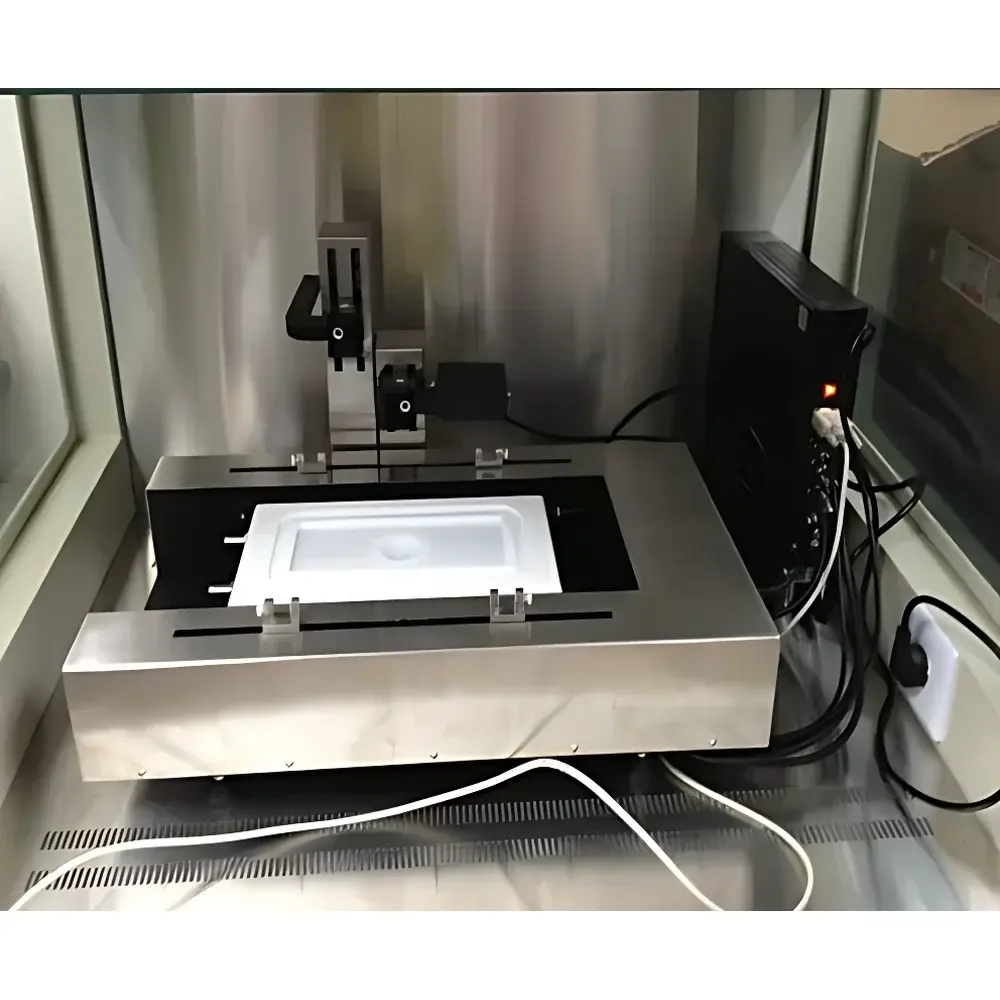
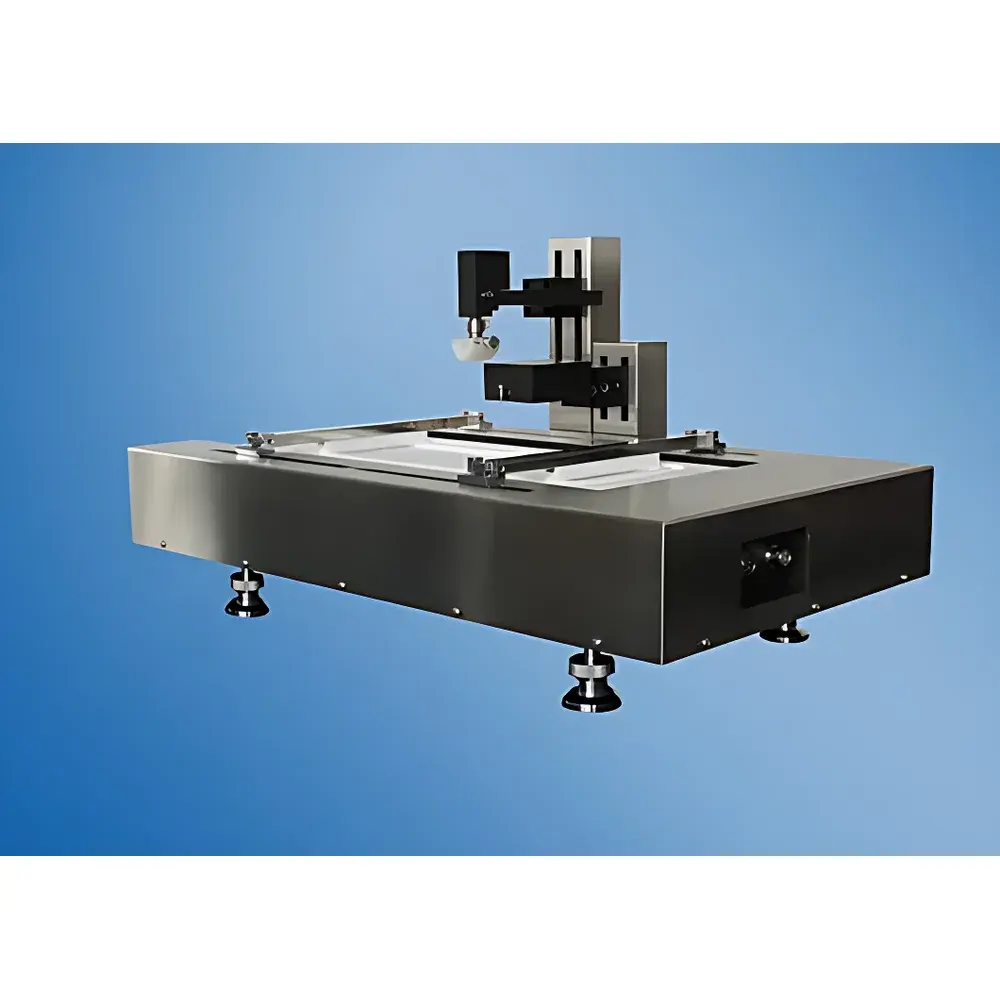
ZYKX JML04C1M Langmuir-Blodgett Trough with Wilhelmy Plate Surface Tensiometer
| Brand | ZYKX |
|---|---|
| Origin | Beijing, China |
| Model | JML04C1M |
| Surface Tension Range | 0–150 mN/m |
| Resolution | 0.05 mN/m |
| Measurement Method | Wilhelmy Plate |
| Trough Material | PTFE (Full Fluoropolymer) |
| Trough Dimensions | 200 mm × 80 mm |
| Compression Ratio | up to 90% |
| Barrier Speed | 0.48–97 mm/min |
| Vertical Dipping Speed | 0.22–45 mm/min |
| Dipping Modes | Upward/Downward |
| Power Supply | AC 220 V ±10%, 50 Hz |
| Max. Power Consumption | 150 W |
| Operating Temperature | Ambient (with optional external thermostatic bath) |
| Relative Humidity | 30–85% RH |
| Software Interface | Windows-based GUI with data export, curve fitting, and post-processing capability |
Overview
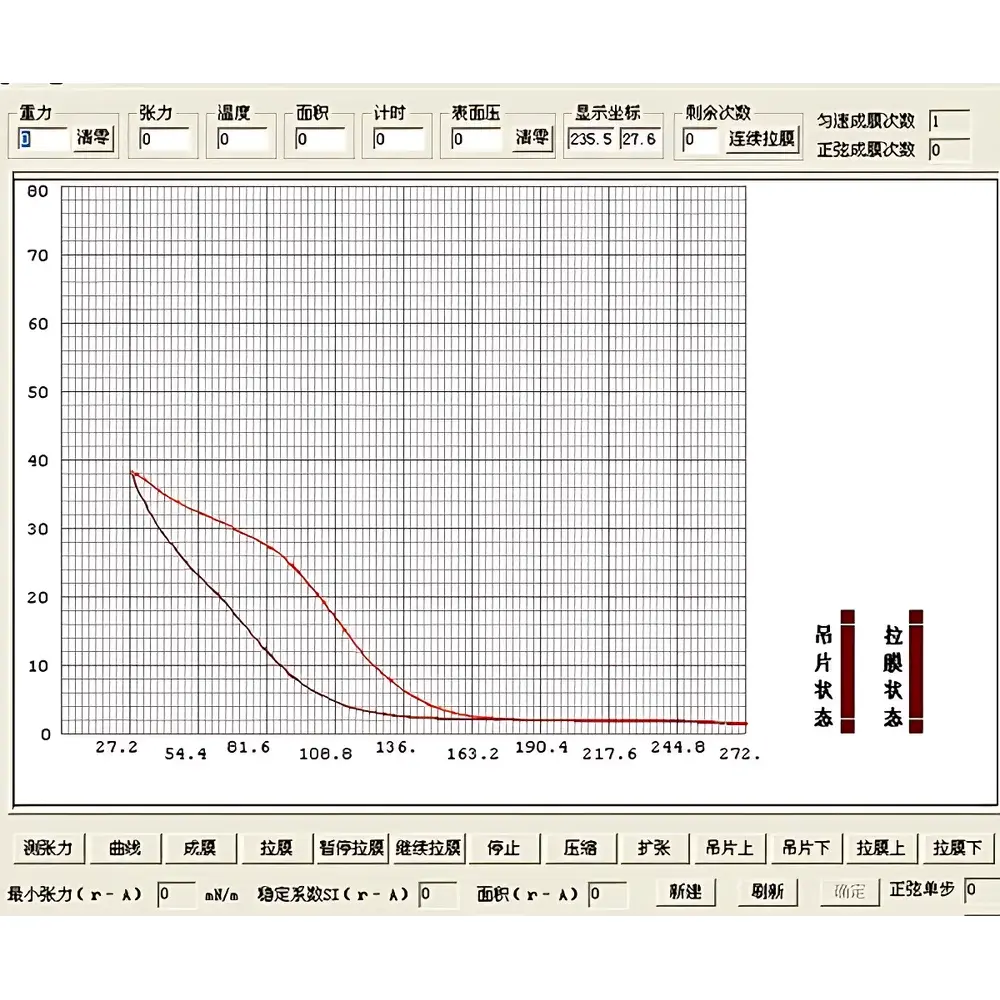
The ZYKX JML04C1M Langmuir-Blodgett (LB) Trough is a precision surface science instrument engineered for the quantitative characterization of monolayers formed by amphiphilic molecules at the air–water interface. It operates on the fundamental principles of interfacial thermodynamics and mechanical equilibrium, utilizing the Wilhelmy plate method to measure surface pressure (π) as a function of molecular area (A) — generating π–A isotherms that reveal phase transitions, collapse pressures, compressibility moduli, and molecular packing density. This instrument supports both Langmuir monolayer compression studies and vertical LB deposition onto solid substrates (e.g., silicon wafers, glass slides, or ITO-coated surfaces), enabling controlled fabrication of ultrathin functional films for applications in biomimetic membranes, organic electronics, sensor development, and nanomaterial templating. Its design adheres to established experimental protocols defined in ASTM D971 (Standard Test Method for Surface Tension of Petroleum Products) and ISO 6295 (Petroleum products — Determination of interfacial tension), while its operational stability meets GLP-aligned laboratory requirements for reproducible interfacial measurements.
Key Features
- Fully automated operation via embedded microcontroller and PC-based control software, minimizing operator-induced variability in barrier movement, dipping cycles, and data acquisition timing.
- High-precision Wilhelmy plate sensor with 0.05 mN/m resolution and full-scale range of 0–150 mN/m, calibrated traceably to NIST-traceable standards.
- PTFE-constructed Langmuir trough (200 mm × 80 mm active area) ensuring chemical inertness, minimal solvent adsorption, and ultra-low leakage (<0.1 mm²/min under standard operating conditions).
- Motorized, leak-proof barrier system with adjustable speed (0.48–97 mm/min) and programmable compression/expansion profiles, supporting dynamic hysteresis analysis and multi-cycle isobaric relaxation experiments.
- Vertical dipping module with dual-direction (up/down) motion, variable speed (0.22–45 mm/min), and real-time force feedback for precise control of transfer ratio and film integrity during LB deposition.
- Integrated surface tension measurement capability independent of monolayer formation — suitable for pure solvent baseline calibration, surfactant critical micelle concentration (CMC) determination, and interfacial aging studies.
- Thermostatic compatibility: accepts external water circulation from a precision bath (±0.1 °C stability) for temperature-controlled isotherm acquisition across physiological (37 °C) or cryogenic ranges.
Sample Compatibility & Compliance
The JML04C1M accommodates a broad spectrum of amphiphilic systems including phospholipids (DPPC, POPC), fatty acids (stearic acid, palmitic acid), block copolymers (Pluronics), peptides, proteins (e.g., SP-B, SP-C analogs), and synthetic lung surfactant mimics. It is routinely employed in research aligned with USP (Bacterial Endotoxins Test) interfacial screening, ISO 10993-4 (Biological evaluation of medical devices — Selection of tests for interactions with blood), and NIH-funded studies on neonatal respiratory distress syndrome (NRDS) pathophysiology. The PTFE trough material complies with FDA-recommended inert surface criteria for pharmaceutical excipient interface characterization. All firmware and software logs support audit trails required under 21 CFR Part 11 for regulated environments when paired with validated Windows OS configurations.
Software & Data Management
The instrument is operated through a native Windows application offering real-time visualization of π–A and γ–A isotherms, automatic detection of phase transition points (LE–LC, LC–SS), and built-in calculation of compressibility modulus (Cs⁻¹ = −A(dπ/dA)). Raw force and position data are stored in CSV and HDF5 formats, enabling downstream analysis in MATLAB, Python (SciPy/Pandas), or OriginLab. The software includes batch processing tools for averaging replicate isotherms, normalizing to molecular weight, and exporting publication-ready vector graphics (SVG, EPS). Calibration certificates, user-defined metadata tagging, and timestamped experiment logs ensure full traceability per ISO/IEC 17025 documentation requirements.
Applications
- Quantitative biophysical analysis of pulmonary surfactant monolayers and synthetic replacements in NRDS/ARDS therapeutic development.
- Structure–function correlation of membrane-active peptides and antimicrobial lipopeptides at model lipid interfaces.
- Design and optimization of LB-assembled organic field-effect transistors (OFETs) and nonlinear optical (NLO) thin films.
- Interfacial rheology of microemulsions and Pickering-stabilized foams in enhanced oil recovery (EOR) formulations.
- Environmental monitoring of dissolved organic carbon (DOC) speciation via surface activity profiling in natural waters.
- Template-directed synthesis of metal–organic frameworks (MOFs) and 2D covalent organic frameworks (COFs) at the air–water interface.
FAQ
What surface pressure range can the JML04C1M resolve with reliable linearity?
The system maintains linearity across the full 0–150 mN/m range, with certified accuracy ±0.3 mN/m below 50 mN/m and ±0.5 mN/m above — verified using standard sodium dodecyl sulfate (SDS) and octanol reference solutions.
Is the trough compatible with aggressive solvents such as chloroform or hexane?
Yes — the all-PTFE construction resists swelling and degradation in halogenated, aromatic, and aliphatic organic solvents; however, solvent vapor management (e.g., fume hood integration) is recommended for long-term operational safety.
Can the software generate ISO/IEC 17025-compliant calibration reports?
Yes — the software exports calibration event logs (date, operator ID, standard used, deviation values) and supports digital signature workflows when deployed on domain-authenticated Windows systems.
Does the system support sequential multilayer deposition with alternating hydrophilic/hydrophobic substrates?
Yes — programmable dip-count sequencing, substrate rotation indexing (via optional motorized stage), and real-time transfer ratio monitoring enable Y-type, X-type, and Z-type LB architectures.
What maintenance intervals are recommended for optimal sensor longevity?
Wilhelmy plates should be cleaned ultrasonically in ethanol after each use; full recalibration is advised every 200 operational hours or quarterly — whichever occurs first — using certified tensiometer standards.



