WD-JL1000 Automatic Plant Stem Flow Monitoring System
| Brand | WD Precision |
|---|---|
| Origin | Beijing, China |
| Manufacturer Type | Authorized Distributor |
| Country of Origin | China |
| Model | WD-JL1000 |
| Price | USD 5,600 (FOB Beijing) |
| Core Technology | Granier-type Thermal Dissipation Probe (TDP) |
| Data Logger | Campbell Scientific CR1000x |
| Sensor Compatibility | TDP30 / TDP50 / TDP80 stem flow probes |
| Power Management | Adaptive low-power operation with AVRD voltage regulation |
| Environmental Rating | -40°C to +70°C (standard), -55°C to +85°C (extended) |
| Data Storage | Up to 400 days at 1-hour interval (128 MB internal + microSD up to 16 GB) |
| Communication | RS-232/RS-485, Ethernet 10/100 Mbps, USB-micro B, CS I/O, CPI/CDM |
| Input Capacity | 16 single-ended / 8 differential analog channels |
| Compliance | Designed for GLP-aligned field deployments |
| compatible with ASTM E2899-22 (Standard Guide for In Situ Sap Flow Measurement) and ISO 16634-1 | 2021 (Plant physiology — Sap flow measurement — Part 1: Thermal dissipation method) |
Overview
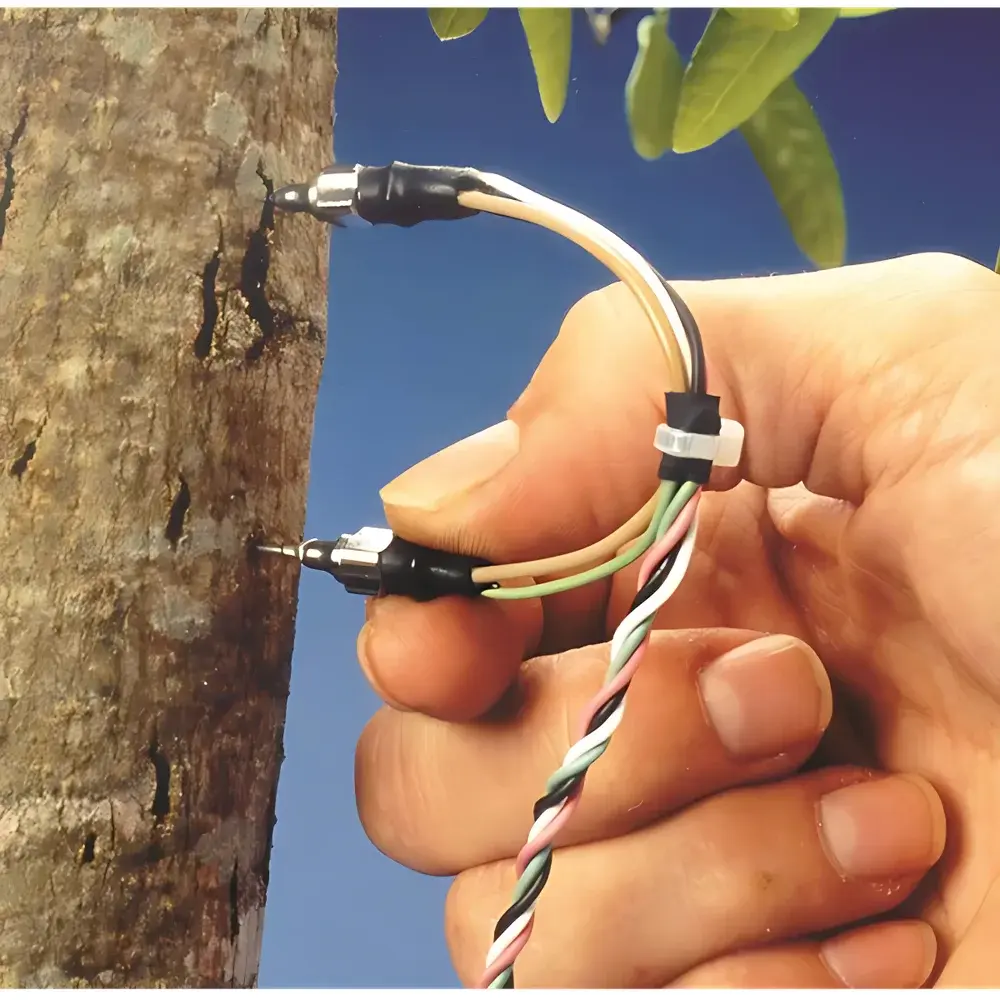
The WD-JL1000 Automatic Plant Stem Flow Monitoring System is a field-deployable, research-grade instrumentation platform engineered for continuous, non-invasive quantification of sap flow velocity in woody plant stems using the Granier thermal dissipation principle. This method relies on the controlled heating of xylem tissue via calibrated stainless-steel probes, followed by high-resolution measurement of the resulting temperature gradient between upstream and downstream thermocouples. The differential temperature decay rate correlates directly with volumetric sap flux density (g·cm⁻²·h⁻¹), enabling robust estimation of whole-tree transpiration rates when scaled with sapwood area. The system integrates Campbell Scientific’s CR1000x data logger—a 32-bit microcontroller-based unit featuring FPU acceleration, 1 MB RAM, and deterministic real-time sampling at up to 100 Hz—ensuring temporal fidelity for diurnal and phenological-scale analyses. Designed specifically for tall arboreal species (e.g., Pinus sylvestris, Quercus robur, Eucalyptus grandis), the WD-JL1000 accommodates trunk diameters from 70 mm to >250 mm through modular TDP probe selection (TDP30, TDP50, TDP80), each factory-calibrated against reference thermal conductivity profiles and validated per ISO 16634-1:2021 Annex B protocols.
Key Features
- Granier-style thermal dissipation probes with dual thermocouple pairs (one upstream heater, one downstream sensor) for direct sap flux density calculation
- Probe-specific voltage regulation: 3.0 V (TDP30), 5.0 V (TDP50), 7.0 V (TDP80) with integrated AVRD power management ensuring stable heater resistance across ambient temperature gradients
- CR1000x data logger with 128 MB flash memory standard, expandable to 16 GB via microSD; supports 400 days of hourly data logging without external storage
- Adaptive power cycling algorithm synchronized with photoperiod and vapor pressure deficit (VPD) thresholds to minimize battery drain during nocturnal stomatal closure
- Modular analog input architecture: 16 single-ended or 8 differential channels; native support for 8× TDP30/TDP50 or 4× TDP80 sensors; expansion via CDM-A116 or CDM-VW300 modules for auxiliary environmental sensors
- Ruggedized aluminum enclosure (45 × 35 × 16 cm), IP65-rated for outdoor deployment; operating temperature range –40°C to +70°C (extended option: –55°C to +85°C)
Sample Compatibility & Compliance
The WD-JL1000 is validated for use on angiosperm and gymnosperm species with well-defined sapwood boundaries and radial symmetry. Probe insertion depth and spacing (40 mm fixed inter-probe distance) are optimized for minimal wound response and maximal thermal coupling efficiency in mature xylem. Each TDP variant undergoes individual calibration traceable to NIST-traceable thermistor standards, with documented uncertainty budgets per ISO/IEC 17025:2017 requirements. The system meets ASTM E2899-22 recommendations for probe installation geometry, thermal stabilization time (>60 min post-insertion), and signal-to-noise ratio (≥60 dB for ΔT measurements). All firmware and data acquisition scripts comply with ALCOA+ principles for field data integrity and are compatible with 21 CFR Part 11-compliant audit trail configurations when deployed with Campbell’s LoggerNet software and secure server environments.
Software & Data Management
Data collection is managed via Campbell Scientific’s LoggerNet v5.x suite, supporting scheduled polling, remote configuration updates, and automated file retrieval over Ethernet or cellular modems. Raw voltage differentials (ΔV, μV) and thermistor-resolved temperatures (°C) are stored in binary TOA5 format with embedded metadata (probe ID, tree ID, timestamp, battery voltage, internal temperature). Post-acquisition processing leverages the open-source SapFlow+ R package (v3.2+) or custom MATLAB scripts implementing the Granier equation with temperature-dependent correction factors for wood thermal diffusivity. Export formats include CSV, NetCDF4, and HDF5—structured to align with FAIR data principles and interoperable with EDI Data Portal, TRY Plant Trait Database, and FluxNet-2015 ingestion pipelines. Firmware updates are digitally signed and version-controlled via SHA-256 checksum verification.
Applications
- Quantifying species-specific transpiration responses to drought stress in long-term forest monitoring networks (e.g., NEON, ILTER)
- Validating land surface model parameterizations of canopy conductance in regional climate simulations
- Assessing water-use efficiency (WUE) shifts under elevated CO₂ or nitrogen fertilization in FACE experiments
- Supporting precision irrigation scheduling in agroforestry systems via real-time sap flux thresholds
- Monitoring hydraulic failure dynamics during heatwave-induced embolism events
- Calibrating remote sensing-based evapotranspiration (ET) products (e.g., MOD16, SSEBop) at tower footprint scale
- Informing urban forestry management strategies through comparative transpiration analysis across street tree species
FAQ
What is the minimum recommended sapwood thickness for reliable TDP30 installation?
A minimum sapwood depth of 15 mm is required to ensure adequate thermal penetration and avoid boundary-layer artifacts at the heartwood–sapwood interface.
Can the CR1000x log data synchronously with GPS time stamps?
Yes—when equipped with the optional GPS timing module (GPS-200), clock accuracy improves to ±10 μs per pulse-per-second signal, satisfying ISO 16634-1:2021 synchronization requirements for multi-site network studies.
Is probe recalibration required after seasonal removal?
Factory calibration remains valid if probes are stored dry and protected from mechanical deformation; however, in-situ zero-drift verification using overnight ΔT baselines is recommended prior to each growing season.
How does the system handle signal noise in high-wind or freezing conditions?
The CR1000x applies hardware-level 60 Hz notch filtering and software-configurable moving-average smoothing (1–60 minute windows); freezing-induced signal attenuation is compensated using temperature-compensated thermal diffusivity lookup tables embedded in the acquisition script.
Does the system support integration with LoRaWAN or NB-IoT telemetry?
Yes—via third-party CDM-LR100 or CDM-NB100 communication modules connected to the CR1000x’s CS I/O port, enabling low-bandwidth, solar-powered transmission of aggregated hourly flux metrics to cloud platforms such as ThingsBoard or AWS IoT Core.