
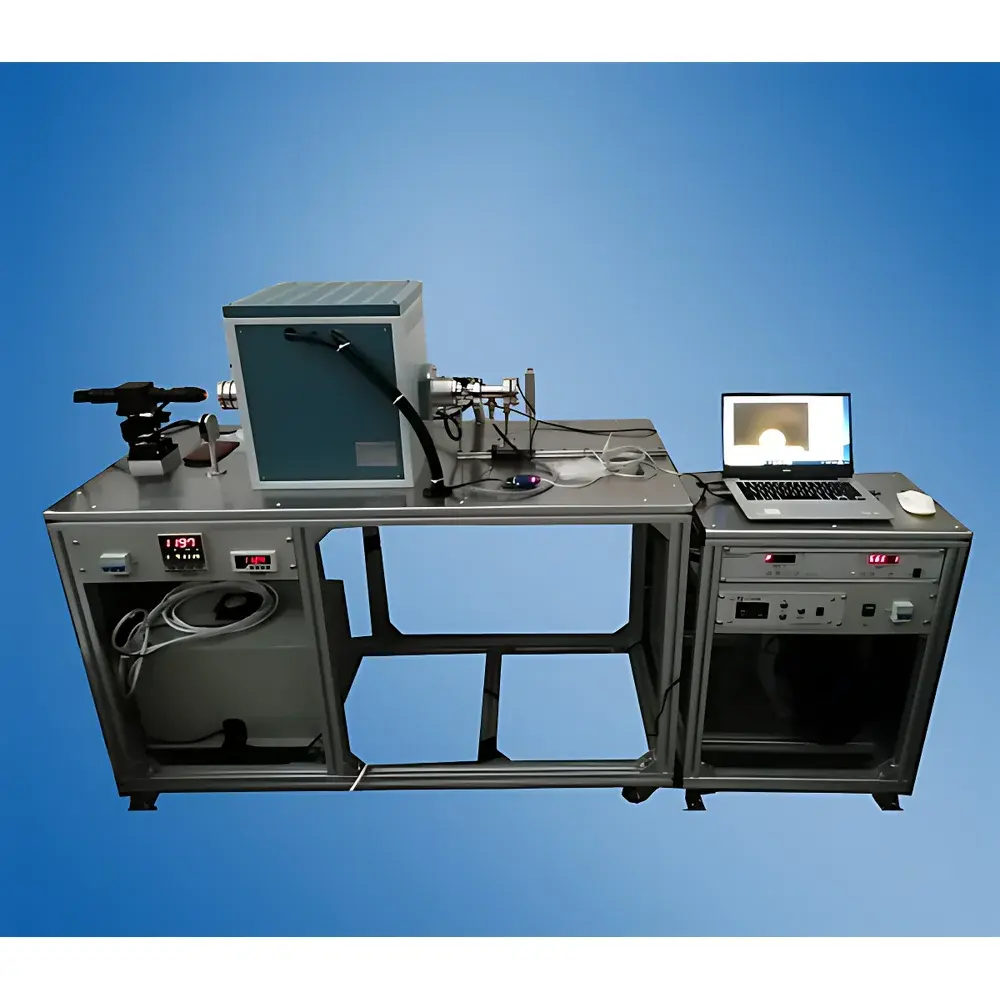
ZYKX SCI-1100 High-Temperature Vacuum Contact Angle Measurement System
| Brand | ZYKX |
|---|---|
| Origin | Beijing, China |
| Model | SCI-1100 |
| Instrument Type | Benchtop Laboratory System |
| Contact Angle Range | 0° < θ < 180° |
| Contact Angle Accuracy | ±0.1° (circle fitting method) |
| Sample Stage Dimensions | 20 × 20 mm |
| Optical Magnification | 55–320 pixel/mm |
| Surface/Interfacial Tension Range | 0.01–1000 mN/m |
| Surface/Interfacial Tension Accuracy | ±0.1 mN/m |
| Maximum Operating Temperature | 1100 °C (long-term), 1700 °C (short-term peak) |
| Vacuum Level | ≤5 × 10⁻⁵ Pa |
| Heating Rate | 3–5 °C/min |
| Temperature Control | 40-segment programmable PID with K/S/B-type thermocouples |
| Cooling System | Water-cooled, 1200 W capacity, 5–35 °C setpoint, 10–20 L/min flow rate |
| Imaging | Industrial color CCD (0.0005 lux sensitivity), 750 TV lines, 30 fps standard (upgradable to 60/100 fps), 300 mm working distance lens with 0.7–5× continuous zoom |
| Software Analysis Methods | Tangent, Circle Fit, Ellipse Fit, Height/Width, Sessile Drop, Automatic Image-Based Analysis |
| Data Output | EXCEL-compatible reports with embedded temperature metadata, curve-fitting results, left/right angle differentiation, and AVI video export |
Overview
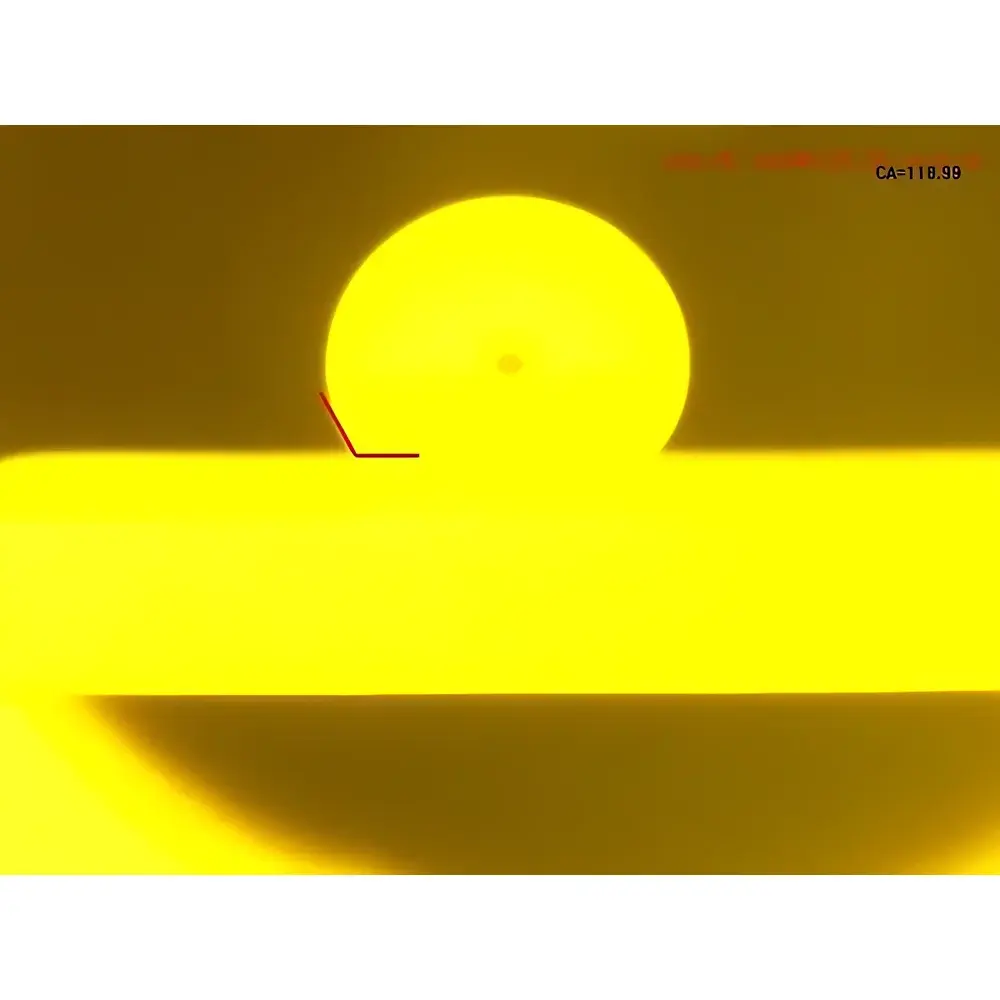
The ZYKX SCI-1100 High-Temperature Vacuum Contact Angle Measurement System is an engineered solution for quantitative interfacial characterization under extreme thermal and atmospheric conditions. Based on the optical sessile drop method, it captures high-resolution dynamic images of liquid droplets on solid substrates while precisely controlling temperature (up to 1700 °C) and ambient pressure (down to 5 × 10⁻⁵ Pa). This enables direct observation and quantification of wetting dynamics—such as contact angle evolution, spreading kinetics, and interfacial tension changes—in environments mimicking industrial processes including vacuum brazing, ceramic sintering, molten metal infiltration, and high-temperature composite fabrication. The system integrates a water-cooled high-vacuum furnace with a programmable multi-zone heating profile, a long-working-distance telecentric imaging path, and a calibrated LED illumination module—all synchronized via real-time temperature-triggered acquisition. Its design adheres to fundamental principles of Young’s equation and the pendant/sessile drop methods, ensuring thermodynamically consistent derivation of surface energy components (e.g., via Owens–Wendt or Wu harmonic mean models) when combined with multiple probe liquids.
Key Features
- High-temperature vacuum chamber with dual-stage pumping (mechanical + turbo-molecular), achieving ultimate vacuum ≤5 × 10⁻⁵ Pa and compatible with inert gas purging (Ar, N₂, He)
- Programmable 40-segment PID temperature controller with K-, S-, or B-type thermocouple inputs; ±1 °C long-term stability at 1100 °C, ±0.1 °C resolution below 1000 °C
- Optimized optical train: 300 mm working distance telecentric lens with 0.7–5× continuous zoom, delivering 55–320 pixel/mm spatial resolution and minimal distortion across full field-of-view
- Industrial-grade low-light color CCD camera (0.0005 lux sensitivity, 750 TV lines), supporting both single-frame capture and high-speed video acquisition (standard 30 fps; optional 60/100 fps modules)
- Six validated contact angle calculation algorithms—including tangent, circle/ellipse fitting, height/width, and fully automated edge-detection-based analysis—each selectable per measurement protocol
- Integrated interfacial tension determination via pendant drop analysis, covering 0.01–1000 mN/m with ±0.1 mN/m repeatability
- Temperature-synchronized image capture: automatic frame acquisition at user-defined setpoints or incremental intervals (e.g., every 50 °C)
- Full data traceability: timestamped images tagged with real-time temperature, vacuum level, and environmental metadata; exportable as annotated TIFF/PNG with embedded EXIF-style headers
Sample Compatibility & Compliance
The SCI-1100 accommodates flat, polished samples up to 14 mm in diameter and 10 mm in thickness, mounted on a precision-machined 20 × 20 mm stage. It supports conductive and non-conductive substrates—including refractory ceramics (Al₂O₃, SiC, ZrO₂), transition metals (Ni, Ti, Mo), intermetallics, graphite, and C/C composites—without requiring conductive coatings. All vacuum and thermal subsystems comply with ISO 27401 (vacuum equipment safety), IEC 61000-6-3 (EMC emissions), and GB/T 19001–2016 (equivalent to ISO 9001). While not pre-certified for FDA 21 CFR Part 11, the software architecture supports audit trail logging, electronic signature integration, and role-based access control—enabling qualification for GLP/GMP-regulated R&D workflows upon site-specific validation.
Software & Data Management
ZYKX’s proprietary ContactAngle Pro v4.2 software provides a unified interface for hardware control, image acquisition, and thermodynamic analysis. It features batch processing for time-series datasets, enabling automated extraction of contact angle vs. temperature curves, dynamic spreading coefficients, and surface free energy evolution plots. Raw images are stored in lossless format with embedded calibration parameters (pixel-to-mm mapping, lens distortion coefficients). Analytical outputs—including contact angle histograms, interfacial tension confidence intervals (based on Laplace equation fitting residuals), and Owens–Wendt polarity/dispersion breakdowns—are exportable to Excel with full metadata linkage. The system supports CSV/JSON API exports for integration into LIMS or MATLAB-based modeling pipelines. All measurement sessions generate immutable log files containing operator ID, instrument serial number, firmware version, and environmental timestamps—meeting ALCOA+ (Attributable, Legible, Contemporaneous, Original, Accurate, Complete, Consistent, Enduring, Available) data integrity criteria.
Applications
This system serves critical roles in advanced materials development where interfacial behavior governs process viability and final performance. In ceramic–metal joining research, it quantifies wettability of Ag–Cu–Ti active brazes on Si₃N₄ or AlN substrates under vacuum, informing joint strength and void formation. In aerospace turbine component development, it evaluates molten superalloy infiltration into porous Ni-based foams at 1400 °C—directly correlating dynamic contact angles with capillary-driven infiltration rates. For nuclear fuel cladding studies, it assesses UO₂–Zr alloy interactions under simulated accident conditions (1600 °C, Ar atmosphere). Additional use cases include high-temperature battery electrode–electrolyte compatibility screening, refractory coating adhesion prediction, and thermally induced surface reconstruction analysis in 2D material heterostructures.
FAQ
What vacuum level is required to prevent oxidation during high-temperature measurements?
For most reactive metals (e.g., Ti, Nb, Mo), a base pressure ≤1 × 10⁻⁴ Pa is sufficient; the SCI-1100 achieves ≤5 × 10⁻⁵ Pa, enabling stable measurements up to 1600 °C in vacuum or controlled Ar/N₂ atmospheres.
Can the system measure advancing and receding contact angles dynamically?
Yes—via sequential dispensing and retraction using an optional syringe pump module (not included standard), synchronized with temperature ramping and frame capture.
Is calibration traceable to NIST standards?
Geometric calibration uses certified stage micrometers; contact angle verification employs standardized goniometer reference slides (certified ±0.2°); interfacial tension validation follows ASTM D971 procedures with pure water and diiodomethane reference fluids.
What maintenance is required for the vacuum system?
Mechanical pump oil replacement every 6 months; turbo-molecular pump bearing inspection every 12,000 operating hours; O-ring replacement recommended annually or after exposure to aggressive vapors.
Does the software support custom scripting for automated analysis sequences?
Yes—Python API access is available under extended license, enabling integration with external thermal modeling tools or statistical process control dashboards.



