
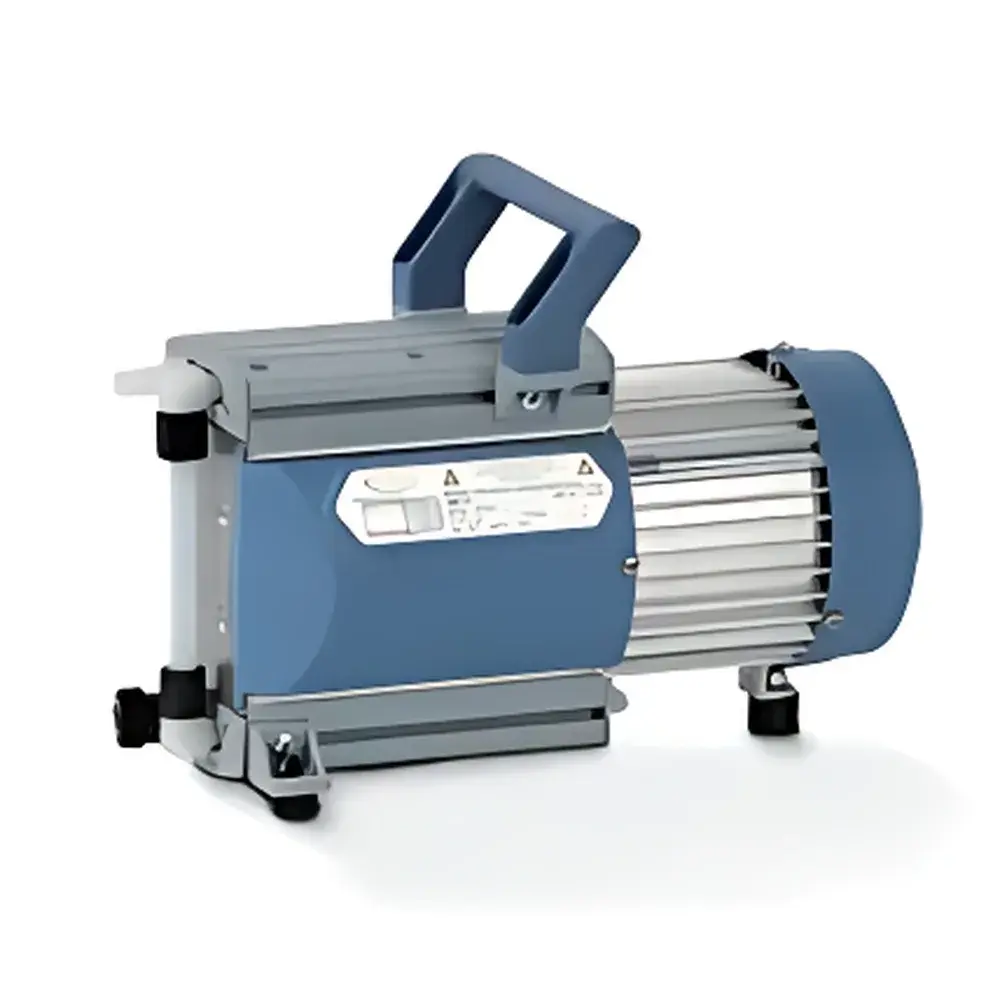
VACUUBRAND MD 1C Three-Stage Chemical-Resistant Diaphragm Vacuum Pump
| Brand | VACUUBRAND® |
|---|---|
| Origin | Germany |
| Model | MD 1C |
| Pump Type | Oil-Free Diaphragm Pump |
| Stages | 3 |
| Max. Pumping Speed (50/60 Hz) | 1.3 / 1.5 m³/h |
| Ultimate Vacuum (Absolute, without gas ballast) | 2 / 1.5 mbar |
| Ultimate Vacuum (Absolute, with gas ballast) | 4 / 3 mbar |
| Operating Temperature Range | 10–40 °C |
| Motor Power Rating | 0.08 kW |
| Rated Speed (50/60 Hz) | 1500 / 1800 min⁻¹ |
| Inlet Connection | Hose nozzle DN 8–10 mm |
| Outlet Connection | Hose nozzle DN 8 mm |
| Noise Level (50 Hz, typical) | 45 dBA |
| Weight | 6.9 kg |
| Dimensions (L×W×H) | 316 × 143 × 175 mm |
| Protection Class | IP 42 |
| ATEX Certification (230 V only) | II 3G IIC T3 X, Internal Atmosphere Only |
Overview
The VACUUBRAND MD 1C is a compact, three-stage, oil-free diaphragm vacuum pump engineered for continuous, chemically aggressive environments in analytical, pharmaceutical, and research laboratories. It operates on positive displacement principle via PTFE-coated, multi-layer “sandwich” diaphragms—designed to withstand prolonged exposure to corrosive vapors, acidic gases, and high-boiling-point solvents such as chlorinated hydrocarbons, acetone, methanol, and ethyl acetate. Unlike single- or dual-stage pumps, the MD 1C’s triple-stage architecture achieves both high volumetric throughput (up to 1.5 m³/h at 60 Hz) and deep ultimate vacuum (≤2 mbar absolute), without requiring lubricating oil or periodic oil changes. Its robust mechanical design eliminates hydrocarbon contamination risks—making it suitable for applications demanding ultra-clean vacuum conditions, including rotary evaporation, vacuum filtration, degassing of solvents, and inert atmosphere glove box evacuation.
Key Features
- Chemical resistance throughout wetted path: All fluid-contact surfaces—including diaphragms, valves, and pump head housings—are constructed from fluoropolymer materials (PTFE, FPM, and ETFE), validated per DIN EN ISO 15203 for long-term compatibility with aggressive media.
- Triple-stage compression architecture: Enables simultaneous optimization of pumping speed and ultimate vacuum performance—critical for processes involving condensable vapors where backstreaming or vapor lock must be avoided.
- Integrated gas ballast valve: Allows controlled admission of ambient air into the final compression stage to prevent condensation of volatile solvents within the pump chamber; maintains stable vacuum even during extended solvent evaporation cycles.
- Low-noise, low-vibration operation: Precision-balanced motor and elastomeric mounting reduce operational noise to ≤45 dBA (at 50 Hz) and minimize mechanical transmission to sensitive instrumentation.
- Maintenance-free drive system: Brushless induction motor with sealed bearings and no grease requirements ensures >20,000 hours of continuous service life under standard operating conditions.
- Compact footprint and plug-and-play readiness: Pre-assembled unit includes integrated inlet/outlet hose nozzles (DN 8–10 mm and DN 8 mm respectively), eliminating need for custom fittings or alignment procedures.
Sample Compatibility & Compliance
The MD 1C is routinely deployed in GLP- and GMP-regulated environments where trace hydrocarbon contamination must be excluded—such as USP sterile compounding labs or ISO 14644-1 Class 5 cleanrooms. Its construction complies with EU Directive 2014/34/EU (ATEX) for use in Zone 2/22 hazardous areas (certified II 3G IIC T3 X, 230 V only). All materials meet FDA 21 CFR §177.1550 for repeated food-contact use and are RoHS-compliant. The pump is compatible with common laboratory vacuum accessories—including Büchner funnels, cold traps, and vacuum desiccators—and supports integration into automated systems via optional analog pressure feedback signals.
Software & Data Management
While the MD 1C operates as a standalone analog device, it is fully compatible with third-party vacuum control platforms (e.g., VACUUBRAND’s RC 6 basic controller or LabVIEW-based SCADA systems) via its 0–10 V analog output interface. When paired with a digital vacuum gauge (e.g., VACUUBRAND’s DVR 2 or DCP 3000 series), users can log real-time pressure curves, trigger event-based alarms, and generate audit-ready reports compliant with FDA 21 CFR Part 11 requirements—including electronic signatures, time-stamped data, and immutable change history.
Applications
- Rotary evaporation of acid-sensitive or halogenated compounds
- Vacuum-assisted crystallization and recrystallization workflows
- High-purity solvent degassing prior to HPLC or GC analysis
- Evacuation of Schlenk lines and inert-gas glove boxes
- Membrane filtration under corrosive conditions (e.g., wastewater analysis)
- Freeze-drying pre-evacuation stages requiring oil-free vacuum integrity
FAQ
Can the MD 1C handle highly condensable vapors like dichloromethane or toluene?
Yes—when operated with the gas ballast valve open, the MD 1C effectively prevents internal condensation and maintains stable vacuum performance across full solvent volatility ranges.
Is routine maintenance required beyond diaphragm replacement?
No—the motor, crankshaft, and valve assemblies are sealed and require no scheduled lubrication or adjustment. Diaphragm replacement intervals typically exceed 12,000 operating hours under normal load conditions.
Does the pump comply with ISO 8573-1 for compressed air purity classes?
N/A—the MD 1C is a vacuum pump, not a compressed air source; however, its oil-free design ensures zero hydrocarbon carryover into evacuated chambers, satisfying ISO 8573-1 Class 0 requirements for contaminant-free vacuum environments.
What is the maximum permissible ambient temperature for continuous operation?
The pump is rated for uninterrupted duty between 10 °C and 40 °C; operation outside this range may affect diaphragm elasticity and long-term sealing performance.
Can the MD 1C be mounted vertically or inverted?
It must be installed horizontally on a level, vibration-dampened surface per VACUUBRAND Installation Manual Section 4.2; vertical or inverted orientation compromises diaphragm seating and gas ballast functionality.



