
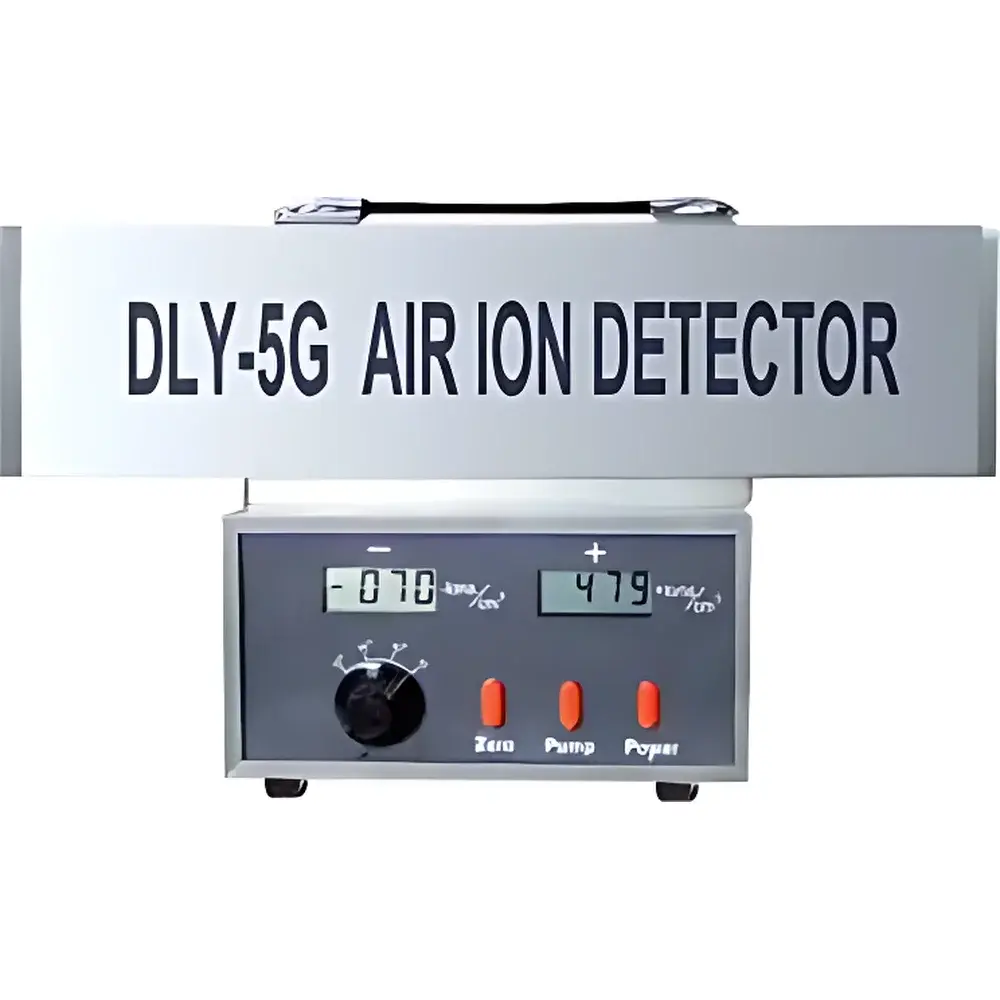
DLY-5G Dual-Display Moisture-Resistant Air Positive/Negative Ion Concentration Analyzer
| Origin | Beijing, China |
|---|---|
| Manufacturer Type | Authorized Distributor |
| Origin Category | Domestic (PRC) |
| Model | DLY-5G |
| Price Range | USD 2,800 – 7,000 |
| Detection Range | 10–1.999×10⁹ ions/cm³ |
| Resolution | 10 ions/cm³ |
| Ion Mobility | 0.15 cm²/V·s |
| Sampling Airflow Velocity | 180 cm/s |
| Response Time Constant | ~15 s |
| Accuracy | ±10% for ion concentration and mobility |
| Power Supply | DC 12 V (rechargeable Li-ion battery) or AC 220 V |
| Operating Environment | −0 °C to +40 °C, ≤90% RH (short-term operation permitted >90% RH) |
| Compliance | GB/T 18809–2002 |
Overview
The DLY-5G Dual-Display Moisture-Resistant Air Positive/Negative Ion Concentration Analyzer is a field-deployable, precision electrostatic detection instrument engineered for quantitative measurement of airborne small, medium, and large air ions—both positive and negative polarities—in ambient and artificially ionized environments. It operates on the principle of Gerdien tube-based aspiration condenser ionometry: ambient air is drawn at a controlled velocity (180 cm/s) through a parallel-plate ion collector (Wesix-type design), where charged particles are deposited onto gold-plated electrodes. The resulting current is converted into ion concentration (ions/cm³) via calibrated charge-to-concentration algorithms incorporating ion mobility (0.15 cm²/V·s). Its dual-channel analog signal processing architecture enables simultaneous, independent quantification of cationic and anionic species—critical for evaluating ion balance ratios in natural and therapeutic settings. Designed per internationally harmonized methodologies referenced in GB/T 18809–2002, the DLY-5G ensures metrological traceability to global standards used in atmospheric physics, environmental health research, and biometeorological monitoring.
Key Features
- Dual high-contrast LCD displays showing real-time positive and negative ion concentrations side-by-side—enabling direct assessment of ion polarity ratio without manual switching or recalibration.
- Gold-plated Wesix parallel-plate collector with optimized electrode geometry and surface finish, delivering high charge collection efficiency (>92%) and long-term stability under variable humidity conditions.
- Integrated active electrode dehumidification system: thermally regulated micro-heaters maintain collector surface temperature above dew point, preventing condensation-induced leakage current and drift—even at sustained relative humidity up to 95% RH.
- Auto-zero compensation circuitry dynamically nulls thermal EMF and background offset drift, eliminating manual zeroing before each measurement cycle.
- Rechargeable high-capacity lithium-ion battery (DC 12 V) supports ≥8 hours of continuous field operation; also compatible with vehicle power systems and AC 220 V mains via universal adapter.
- Robust aerospace-grade aluminum alloy enclosure (IP54-rated ingress protection), lightweight (≤2.3 kg), ergonomically balanced for handheld or tripod-mounted deployment in forested, coastal, alpine, and urban microclimate studies.
Sample Compatibility & Compliance
The DLY-5G is validated for use across diverse atmospheric matrices—including forest canopy air, coastal marine boundary layer, freshwater lake/river proximity zones, indoor HVAC environments, and ionizer-equipped wellness spaces. Its performance remains stable across particulate loadings typical of Class 100,000 cleanrooms (≤3.5×10⁶ particles/m³ ≥0.5 µm) and ambient urban aerosol concentrations (<100 µg/m³ PM₂.₅). The instrument conforms to GB/T 18809–2002 “Air Negative Ions—Determination Method,” which aligns with ISO 8503-2 (surface roughness referencing for collector plates) and ASTM D6202 (electrostatic charge measurement protocols). While not FDA-cleared as a medical device, its output data meets GLP documentation requirements for environmental exposure assessments supporting epidemiological studies on ion-mediated physiological responses.
Software & Data Management
Data logging is performed internally with timestamped storage (up to 10,000 records) and exportable via USB-C interface to CSV-formatted files compatible with Excel, MATLAB, and R statistical platforms. Optional PC software (Windows/macOS) provides time-series visualization, moving-average smoothing (1–60 s windows), batch calibration management, and audit-trail-enabled report generation compliant with ISO/IEC 17025 documentation frameworks. All firmware updates are digitally signed and verified prior to installation—ensuring integrity per IEC 62443-3-3 cybersecurity guidelines for laboratory instrumentation.
Applications
- Environmental meteorology: Long-term monitoring of ion dynamics in relation to solar radiation, precipitation events, and atmospheric electrical potential gradients.
- Tourism resource evaluation: Quantitative validation of “negative ion-rich” sites (e.g., waterfalls, old-growth forests, sea cliffs) for eco-labeling and visitor health impact reporting.
- Indoor air quality (IAQ) auditing: Verification of commercial ionizer efficacy and decay kinetics in office buildings, hospitals, and educational facilities.
- Bioclimatology research: Correlation of ambient ion concentrations with autonomic nervous system biomarkers (HRV, salivary cortisol) in field-based human exposure trials.
- Regulatory compliance support: Supplemental data collection for municipal environmental health departments assessing green infrastructure benefits per WHO Air Quality Guidelines Annex B.
FAQ
What ion mobility value does the DLY-5G assume during concentration calculation?
The instrument uses a fixed mobility coefficient of 0.15 cm²/V·s—representative of small air ions (diameter < 1.6 nm) under standard temperature and pressure, consistent with IUPAC-recommended values for atmospheric ion physics.
Can the DLY-5G distinguish between small, intermediate, and large ions?
No—it measures total integrated ion current within the mobility range defined by its collector geometry and airflow profile. Size fractionation requires differential mobility analyzers (DMA) or tandem Gerdien-tube configurations.
Is calibration traceable to NIST or other national metrology institutes?
Calibration is performed against primary-standard radioactive ion sources (²¹⁰Po) traceable to CNAS-accredited reference laboratories in China; full calibration certificates include uncertainty budgets per ISO/IEC 17025.
Does the instrument meet requirements for GLP-compliant environmental monitoring programs?
Yes—its audit-log functionality, electronic signature support, and calibration history retention satisfy core GLP principles outlined in OECD Series on Principles of Good Laboratory Practice.
How frequently must the collector plates be cleaned?
Under normal field use (≤8 hrs/day, ≤70% RH average), cleaning is recommended every 120 operating hours using spectroscopic-grade isopropanol and lint-free wipes; gold plating minimizes oxidation-related maintenance intervals.







