
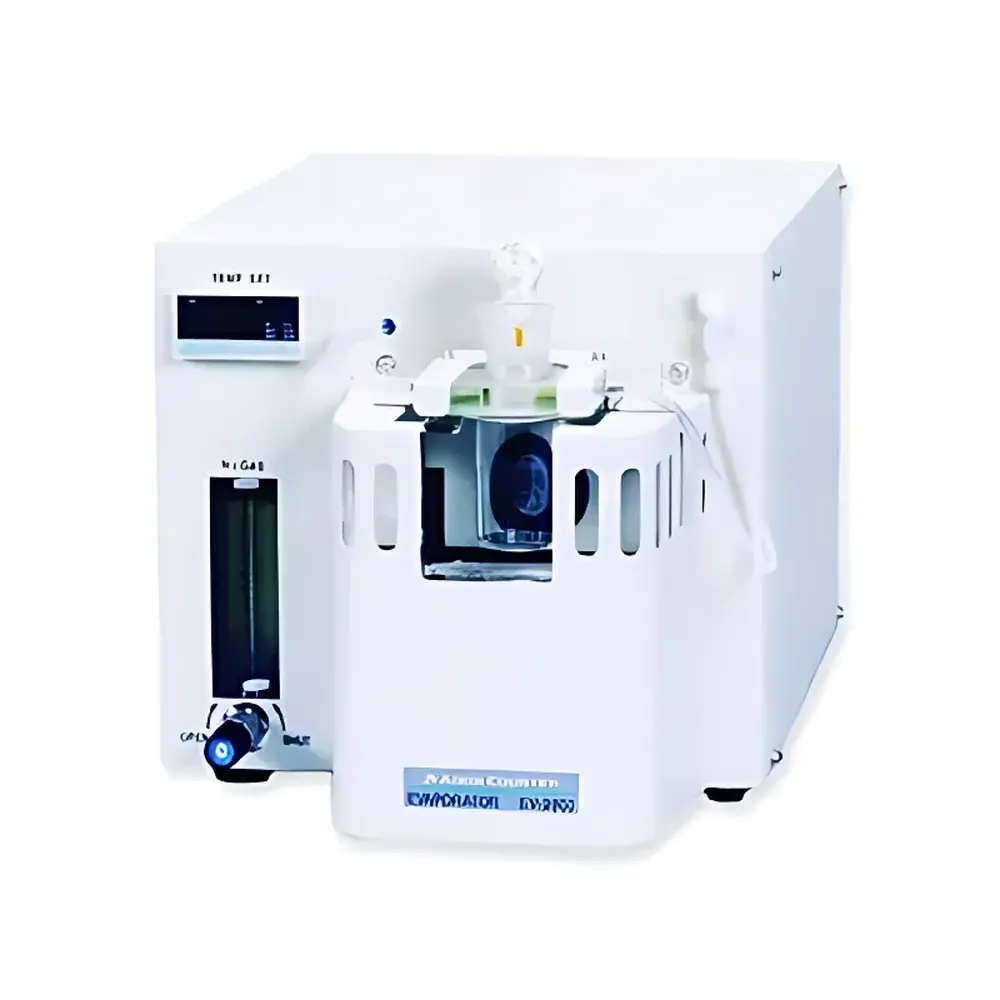
EV-2000 Solid Sample Evaporator by Hiranuma
| Heating Temperature Range | Ambient to 350 °C |
|---|---|
| Heater Type | Cartridge Heater |
| Max. Sample Volume | <10 mL |
| Carrier Gas | Nitrogen or Dry Air (dry air compressor optional) |
| Gas Flow Rate | 30–300 L/min |
| Inlet Pressure | ≤0.8 MPa |
| Desiccant | Molecular Sieve |
| Power Supply | AC 100–240 V, 50/60 Hz, 100 VA |
| Dimensions (W×D×H) | 220 × 430 × 200 mm |
| Weight | Approx. 8 kg |
Overview
The EV-2000 Solid Sample Evaporator, engineered by Hiranuma (Japan) and distributed for global laboratory use, is a precision thermal desorption system designed specifically for quantitative water determination in solid and powdered samples incompatible with conventional Karl Fischer (KF) titration. Unlike standard KF coulometric or volumetric cells—which require sample solubility and chemical inertness toward reagents—the EV-2000 thermally liberates water via controlled pyrolytic evaporation under inert or dry carrier gas flow. It operates on the principle of evolved gas analysis (EGA), where liberated water vapor is swept from the heated sample chamber into a downstream KF titrator (e.g., Hiranuma MKC series) for real-time quantification. The instrument supports three programmable heating profiles—stepwise ramping, isothermal hold, and multi-stage temperature gradients—to differentiate between surface-adsorbed (free) moisture and structurally bound (crystalline or chemically coordinated) water, enabling speciation-level moisture characterization essential for pharmaceutical excipients, metal oxides, catalysts, and hygroscopic polymers.
Key Features
- Triple-stage programmable temperature control (ambient to 350 °C) with independent ramp rate, hold time, and endpoint settings per segment
- Cartridge-type heating element ensuring uniform thermal distribution and rapid thermal response (±0.5 °C stability at setpoint)
- Compact benchtop architecture (220 × 430 × 200 mm; ~8 kg) with integrated gas flow regulation and pressure monitoring
- Dual carrier gas compatibility: optimized for high-purity nitrogen (99.999%) or optionally supplied dry air (with integrated desiccant column and optional compressor module)
- Gas flow range of 30–300 L/min, adjustable via calibrated needle valve and validated with built-in flowmeter (NIST-traceable calibration available)
- Sample chamber constructed from borosilicate glass and quartz-lined stainless steel to prevent catalytic decomposition or adsorption artifacts
- Electrical safety compliance: CE-marked, conforms to IEC 61010-1 for laboratory electrical equipment
Sample Compatibility & Compliance
The EV-2000 accommodates heterogeneous solid matrices including crystalline hydrates, ceramic precursors, battery cathode materials (e.g., LiCoO₂, NMC), silica gels, cellulose derivatives, and API powders. Its design eliminates solvent interference and avoids reagent degradation pathways common in direct KF dissolution. Method validation aligns with USP “Water Determination” and ASTM E1868–22 “Standard Test Method for Moisture Content of Solids by Thermogravimetric Analysis (TGA) Coupled with Karl Fischer Titration.” When paired with a GLP-compliant KF titrator featuring 21 CFR Part 11 audit trail functionality, the full EV-2000/KF workflow supports regulatory submissions for pharmaceutical manufacturing (ICH Q5C), quality control release testing, and raw material specification verification.
Software & Data Management
While the EV-2000 operates as a standalone hardware module with manual parameter setting via front-panel controls, it is fully interoperable with Hiranuma’s MKC-710/720 series titrators via RS-232 or USB virtual COM port. Full method synchronization—including temperature program initiation triggered by titrator start command—is supported. Data export (CSV/TXT) includes timestamped temperature log, gas flow reading, and integrated water mass (µg) per heating segment. All exported files retain metadata (operator ID, sample ID, method name, instrument serial) to satisfy ALCOA+ data integrity principles. Optional PC-based configuration software (Hiranuma EV-Control Suite v3.2) enables batch method storage, remote firmware updates, and PDF report generation compliant with ISO/IEC 17025 documentation requirements.
Applications
- Quantification of residual solvents and hydration states in active pharmaceutical ingredients (APIs) per ICH Q5C guidelines
- Moisture speciation in lithium-ion battery cathode materials to assess structural stability during cycling
- Quality assurance of desiccated reference standards (e.g., NIST SRM 2890) and certified reference materials (CRMs)
- Process validation of fluid-bed dryer and lyophilizer endpoint determination in biologics manufacturing
- Research into water sorption/desorption hysteresis in MOFs and porous carbons using segmented thermal profiling
- Compliance testing of excipient moisture content against EP 2.5.12 and JP 2.07 monographs
FAQ
Can the EV-2000 be used with non-Hiranuma Karl Fischer titrators?
Yes—provided the external titrator offers analog voltage output (0–10 V) or digital trigger capability (TTL/RS-232) for synchronized start/stop, and accepts water mass input via serial command protocol.
Is calibration traceable to national standards?
Temperature calibration is performed using a NIST-traceable platinum resistance thermometer (PRT) at three points (105 °C, 200 °C, 300 °C); gas flow calibration utilizes a primary-standard bubble meter certified to ISO 6789.
What maintenance is required for long-term reliability?
Desiccant (4Å molecular sieve) must be regenerated weekly at 300 °C under vacuum or replaced quarterly; quartz liner cleaning with dilute nitric acid is recommended after every 50 runs involving halogenated or sulfur-containing samples.
Does the system support GMP audit trails?
The EV-2000 itself does not store electronic records; however, when integrated with a 21 CFR Part 11-compliant titrator and LIMS, full electronic audit trail—including operator actions, method changes, and raw data—can be maintained end-to-end.
What is the maximum allowable sample mass for accurate water recovery?
For optimal recovery (>99.5%), total sample mass should remain ≤2.0 g when water content exceeds 10 wt%; for ultra-trace analysis (<100 µg water), ≤500 mg is recommended to minimize thermal lag and ensure complete desorption within the programmed ramp profile.
Related Products




