
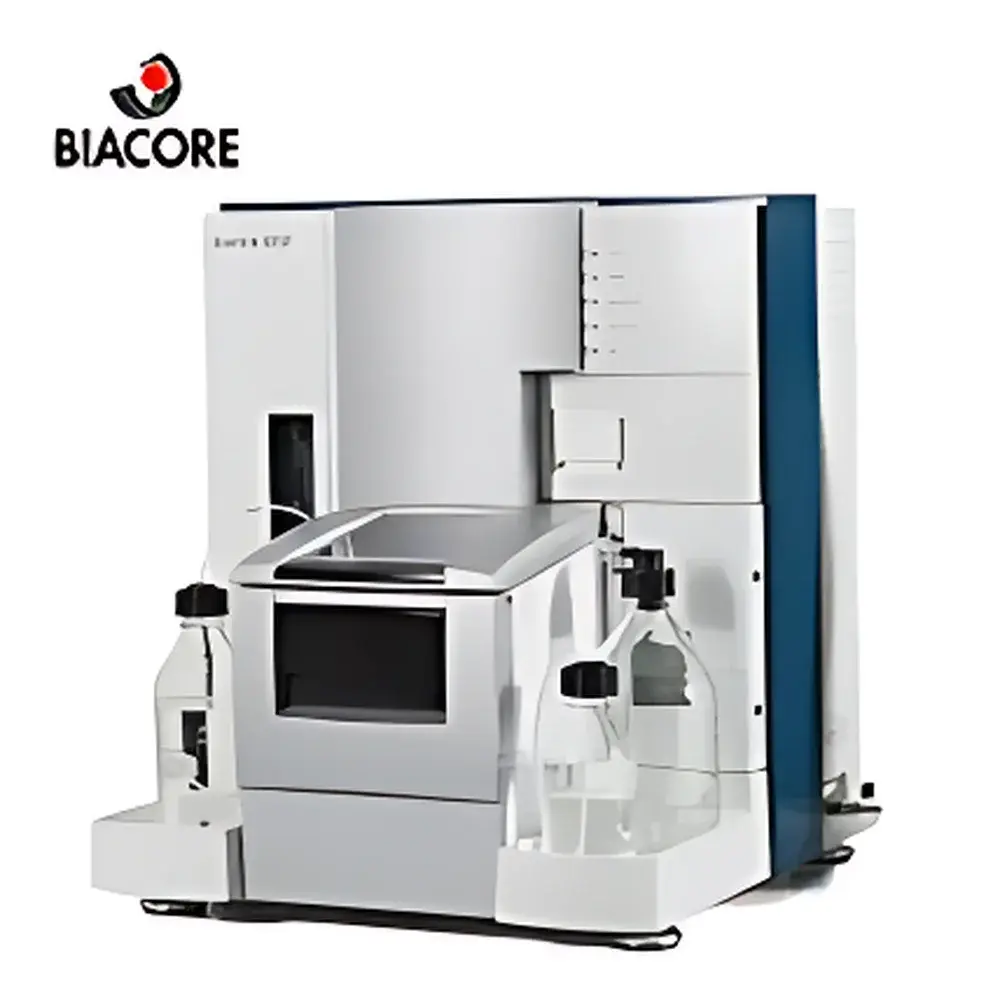
Cytiva Biacore S200 High-Sensitivity Surface Plasmon Resonance (SPR) Molecular Interaction Analyzer
| Brand | Cytiva |
|---|---|
| Origin | USA |
| Model | Biacore S200 |
| Sample Capacity | One 96-well or 384-well microplate |
| Injection Volume | 2–350 µL |
| Analysis Time per Cycle | 2–15 min |
| Temperature Control Range | 4°C to 45°C |
| Detection Limit | No theoretical lower molecular weight limit for analyte binding detection |
Overview
The Cytiva Biacore S200 is a high-sensitivity, label-free surface plasmon resonance (SPR) biosensor system engineered for quantitative analysis of biomolecular interactions in real time. Leveraging the physical principle of SPR—where changes in refractive index at a gold sensor surface are measured as a function of mass accumulation during binding events—the instrument delivers precise kinetic rate constants (ka, kd) and equilibrium dissociation constants (KD) across a broad dynamic range. Designed for early-stage drug discovery workflows, the Biacore S200 supports both high-throughput fragment screening and in-depth characterization of lead candidates, with particular utility in small-molecule (LMW), peptide, and protein–protein interaction studies. Its optical architecture and fluidic design minimize nonspecific signal drift and maximize signal-to-noise ratio, enabling robust data acquisition from low-abundance or low-affinity interactions without labeling or amplification.
Key Features
- High-sensitivity SPR detection capable of resolving binding responses from analytes with no practical lower molecular weight limit—including fragments below 200 Da
- Integrated microfluidic handling supporting single-cycle kinetics (SCK) for up to 384 samples per run, completing full fragment screening in under 16 hours
- Precise temperature control (4°C–45°C) with ±0.1°C stability, critical for reproducible thermodynamic profiling and assay optimization
- Flexible injection volume range (2–350 µL) accommodates diverse sample formats—from nanoliter-scale fragment libraries to milligram-per-milliliter purified proteins
- Automated competition and epitope binning assays for mapping binding sites and differentiating functional mechanisms among lead compounds
- Modular sensor chip compatibility (e.g., CM5, SA, NTA, C1) enables covalent, streptavidin-, or nickel-based immobilization strategies aligned with target class and experimental objective
Sample Compatibility & Compliance
The Biacore S200 accepts samples in standard 96-well or 384-well microplates, as well as individual vials (up to 33) or custom rack configurations (up to 78 positions). It is routinely deployed in GLP-compliant environments for preclinical candidate selection and has been validated for use in protocols adhering to ICH M3(R2), USP , and ISO 13485 frameworks. While not inherently 21 CFR Part 11–compliant out-of-the-box, the system integrates with Cytiva’s Biacore Evaluation Software (v5.x or later), which supports audit trails, electronic signatures, and user-access controls when configured within validated IT infrastructure. All sensor surfaces meet ISO 10993–5 biocompatibility standards for in vitro diagnostic use.
Software & Data Management
Data acquisition, processing, and reporting are managed through Cytiva’s Biacore Evaluation Software, a Windows-based application built for scientific rigor and regulatory readiness. The software provides automated global fitting of association/dissociation phases using heterogeneous or bivalent analyte models, residual plot diagnostics, and batch analysis workflows for multi-plate experiments. Export options include CSV, Excel, and XML formats compatible with LIMS integration and third-party statistical platforms (e.g., GraphPad Prism, R). Raw sensorgrams and processed results are stored with metadata tags (user ID, timestamp, method version, chip lot number), satisfying traceability requirements under FDA and EMA guidelines for analytical method validation (ICH Q2(R2)).
Applications
- Fragment-based drug discovery (FBDD): identification and ranking of weak-binding fragments via single-concentration binding level screens
- Lead optimization: determination of on-rates, off-rates, and affinity maturation trends across SAR series
- Epitope mapping and mechanism-of-action studies using competitive inhibition and sandwich assays
- Binding stoichiometry and avidity assessment for multivalent therapeutics (e.g., bispecific antibodies, antibody–drug conjugates)
- Stability and aggregation monitoring via real-time binding decay profiles under controlled thermal conditions
- QC release testing for therapeutic proteins where binding potency correlates with biological activity
FAQ
What is the minimum analyte concentration detectable on the Biacore S200?
Detection sensitivity is context-dependent—governed by immobilized ligand density, analyte molecular weight, binding kinetics, and noise floor—but sub-nanomolar concentrations are routinely resolved for high-affinity interactions (>10⁷ M⁻¹·s⁻¹ ka).
Can the Biacore S200 be used for membrane protein analysis?
Yes—when coupled with supported lipid bilayer (SLB) or nanodisc immobilization chemistries on specialized sensor chips (e.g., L1, HPA), the system enables kinetic analysis of GPCRs, ion channels, and other integral membrane targets.
Is method transfer possible between Biacore T200 and S200 platforms?
Assay methods—including flow rates, injection volumes, regeneration conditions, and evaluation models—are largely interoperable; however, S200-specific optimizations for enhanced sensitivity and throughput may require minor recalibration.
Does the system support kinetic analysis of transient or low-affinity interactions?
Yes—its high mass transport efficiency, low dispersion fluidics, and advanced noise suppression algorithms allow reliable resolution of fast-dissociating complexes (kd > 1 s⁻¹) and weak binders (KD > 100 µM) when combined with appropriate surface chemistry and referencing strategies.




