
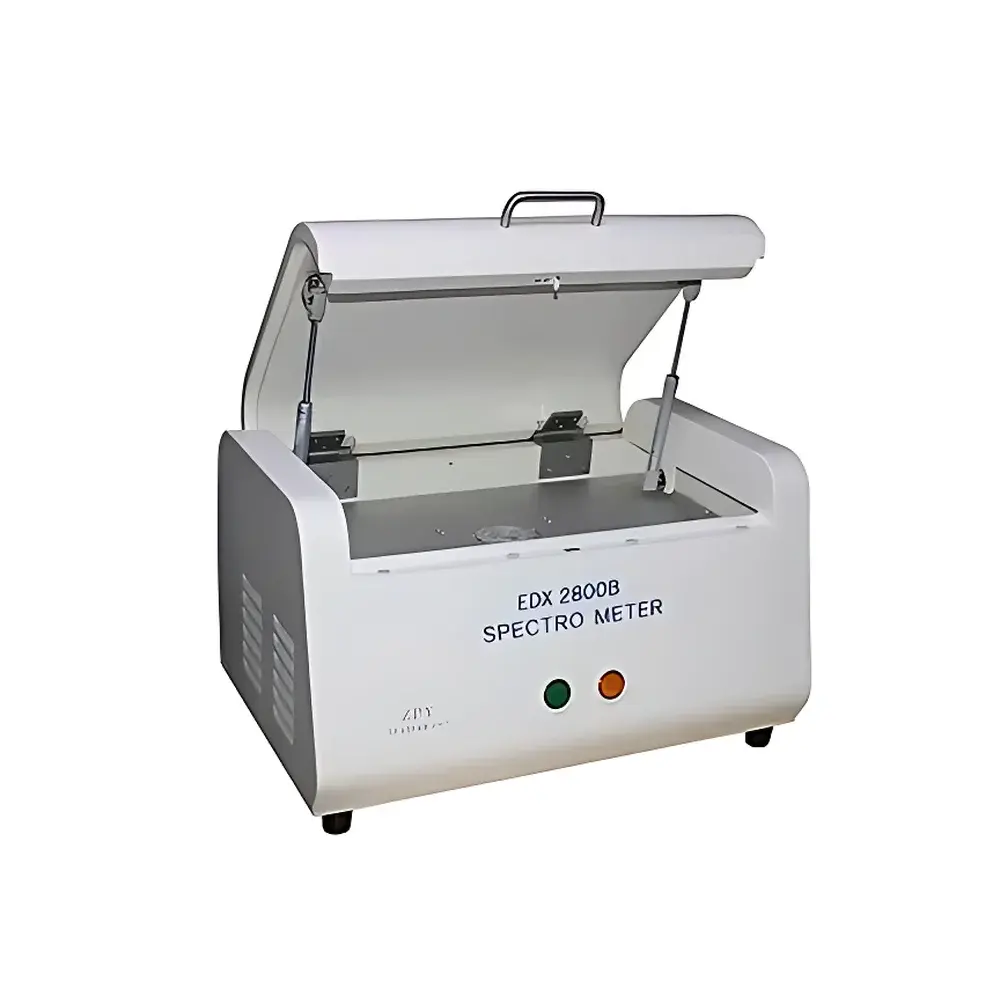
ZYKX ZY-2800B Energy Dispersive X-Ray Fluorescence Spectrometer
| Brand | ZYKX |
|---|---|
| Model | ZY-2800B |
| Origin | Beijing, China |
| Configuration | Benchtop/Floor-standing |
| Application Type | General-purpose ED-XRF |
| Elemental Range | S (16) to U (92) |
| Detection Limit (Cd, Pb, Cr, Hg, Br) | ≤1 ppm |
| Measurement Time | 100–300 s |
| Energy Resolution | 149 ± 5 eV (at Mn Kα) |
| Operating Temperature | 15–30 °C |
| Relative Humidity | 40–50 % RH |
| Power Supply | AC 220 V ±5 V, 50/60 Hz |
| Detector | Silicon PIN (Si-PIN), Peltier-cooled |
| X-ray Tube | Air-cooled, 50 W, max. 50 kV / 1 mA |
| Multichannel Analyzer | 2048 channels |
| Collimator Options | 8 apertures (0.2–8 mm) |
| Filter Options | 6 automatic filter positions |
| Interface | USB 2.0 |
Overview
The ZYKX ZY-2800B Energy Dispersive X-Ray Fluorescence (ED-XRF) Spectrometer is an analytical instrument engineered for precise, non-destructive elemental composition analysis of solid, powder, and thin-film samples. Based on the fundamental principle of X-ray fluorescence—where primary X-rays excite atoms in a sample, causing emission of characteristic secondary (fluorescent) X-rays—the system quantifies elemental identity and concentration by measuring energy spectra using a silicon PIN (Si-PIN) semiconductor detector. Designed specifically for regulatory compliance testing, the ZY-2800B delivers trace-level detection (≤1 ppm) for restricted substances mandated under EU RoHS Directive 2011/65/EU, EN 71-3 (toys), and 94/62/EC (packaging), including Cd, Pb, Hg, Cr, Br, and Cl. Its air-cooled microfocus X-ray tube (50 kV, 50 W), combined with Peltier-based detector cooling, eliminates reliance on liquid nitrogen while maintaining spectral resolution of 149 ± 5 eV at Mn Kα—meeting ISO 21043-1:2022 requirements for ED-XRF performance verification.
Key Features
- Integrated SES (Spectral Enhancement Signal) processing architecture, enhancing signal-to-noise ratio and improving low-concentration quantification accuracy.
- Automated collimator and filter selection system with eight collimator sizes (0.2–8 mm) and six interchangeable filters—enabling adaptive excitation conditions optimized per sample matrix and target element.
- Intelligent work curve auto-selection algorithm prevents manual misassignment; software cross-references sample type, thickness, and expected composition to select optimal calibration models.
- Dual-stage radiation safety design: lead-shielded chamber with interlocked door sensor and real-time beam status monitoring—compliant with IEC 61010-1 and GB/T 18805-2002 radiation safety standards.
- Active thermal management system featuring intelligent X-ray tube temperature control and dual-path heat dissipation, ensuring stable tube output and extending operational lifetime beyond 10,000 hours.
- USB 2.0 high-fidelity data interface supporting deterministic transfer latency (<5 ms) and full spectral frame integrity—critical for audit-ready data capture in GLP/GMP environments.
- Modular hardware architecture with field-replaceable detector, tube, and MCA units—minimizing downtime during preventive maintenance or component replacement.
Sample Compatibility & Compliance
The ZY-2800B accommodates diverse geometries via its open large-sample chamber (200 × 200 × 100 mm), supporting irregular solids, coated substrates, granular powders, and layered films without destructive preparation. It supports certified reference materials including EC681K (RoHS multi-element standard) and pure Ag (for instrumental drift correction). Analytical validity is traceable to NIST SRM standards and aligned with ASTM E1621–22 (Standard Guide for XRF Analysis of Environmental Samples) and ISO 12885:2020 (XRF — Quantitative analysis of coated materials). All measurement protocols include built-in uncertainty estimation per ISO/IEC 17025:2017 Annex A.3, with full audit trail logging enabled for FDA 21 CFR Part 11 compliance when paired with validated software configuration.
Software & Data Management
XRAYAnalyzer v3.x is a Windows-native application developed exclusively for regulatory ED-XRF workflows. It features dual-language UI (English/Chinese) with optional localization support for French, German, and Japanese. Core capabilities include: automated peak deconvolution using iterative least-squares fitting; matrix-matched calibration with internal standard correction; spectral overlay for comparative analysis of up to six samples simultaneously; and customizable reporting templates compliant with RoHS documentation requirements (including declaration of conformity annexes). All raw spectra, processed results, instrument parameters, and operator actions are logged with time-stamped, immutable records—including detector temperature, tube voltage/current, and collimator/filter position—ensuring full data integrity and chain-of-custody adherence.
Applications
The ZY-2800B serves as a primary screening and quantitative tool across electronics manufacturing (PCB solder, plating baths, component leads), toy safety laboratories (EN 71-3 extractable heavy metals), packaging material testing (halogen-free verification per IEC 61249-2-21), and metallurgical QC (alloy grade verification, coating thickness via fundamental parameter method). It is routinely deployed in third-party testing labs accredited to ISO/IEC 17025 and in corporate R&D centers performing material substitution studies for REACH SVHC screening. Its ability to resolve overlapping peaks (e.g., As Kβ/Cr Kα, Pb Mα/Br Kα) through high-resolution Si-PIN detection enables unambiguous identification in complex matrices where wavelength-dispersive systems may require extended dwell times.
FAQ
Does the ZY-2800B comply with ISO/IEC 17025 documentation requirements?
Yes—full instrument parameter logging, electronic signatures, and audit-trail-enabled report generation are natively supported.
Can it quantify chlorine (Cl) reliably at sub-100 ppm levels?
Yes—when using optimized vacuum path mode and 0.2 mm collimation, Cl detection limits reach 8 ppm in polymer matrices per ASTM D7299–18 validation.
Is liquid nitrogen required for detector operation?
No—the Si-PIN detector uses thermoelectric (Peltier) cooling, eliminating cryogen handling and associated infrastructure costs.
What calibration standards are supplied with the system?
The base configuration includes EC681K RoHS reference set and pure silver for daily intensity normalization.
How is measurement reproducibility verified during routine use?
Automated daily check routines execute against built-in Ag reference peak stability metrics; deviation >2% triggers recalibration alert per ISO 8599:2021 protocol.
Is remote diagnostics supported?
Yes—optional secure TLS-encrypted remote access module allows firmware updates and diagnostic log retrieval under ITAR-compliant network policies.
Related Products




