
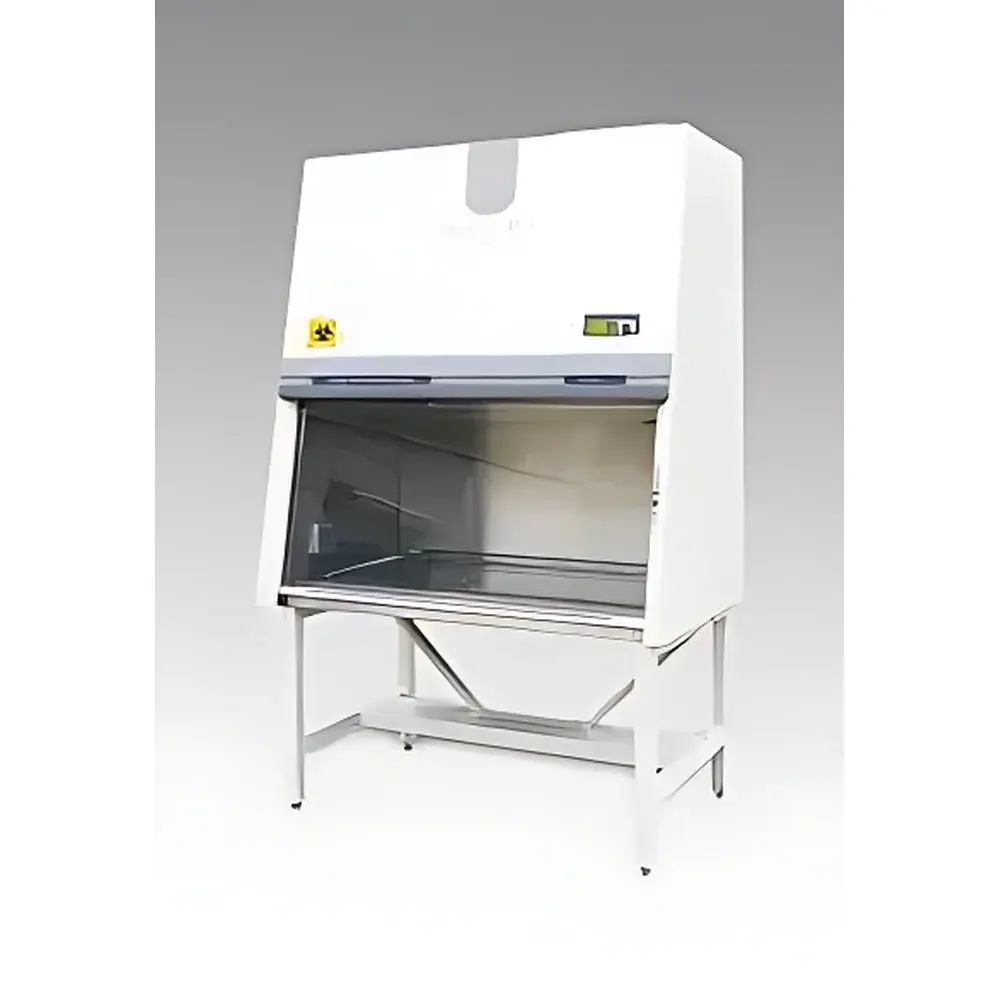
ZHBIO ZSB-1200IIA2 Class II A2 Biological Safety Cabinet
| Origin | Shanghai, China |
|---|---|
| Manufacturer Type | Authorized Distributor |
| Origin Category | Domestic (PRC) |
| Model | ZSB-1200IIA2 |
| Pricing | Upon Request |
| Airflow Pattern | 70% recirculated / 30% exhausted |
| Primary Filter | ULPA (≥99.999% @ 0.1–0.2 µm) |
| Exhaust Filter | HEPA (≥99.99% @ 0.3 µm) |
| Inflow Velocity | 0.5–0.6 m/s |
| Downflow Velocity | 0.25–0.5 m/s |
| Downflow Control Accuracy | ±0.015 m/s |
| Wind Speed Resolution | 0.01 m/s |
| Differential Pressure Range | 0–500 Pa |
| Differential Pressure Accuracy | ±1% |
| Noise Level | <67 dB(A) |
| Vibration Half-Peak | ≤5 µm |
| Illumination | ≥650 lx |
| Working Area Dimensions (W×D×H) | 1230 × 635 × 655 mm |
| External Dimensions (W×D×H) | 1420 × 805 × 2270 mm |
| Net Weight | 250 kg |
| Power Supply | AC 220 V, 50/60 Hz |
| Rated Power | 660 W |
| Operating Ambient | 10–30 °C, ≤85% RH (at 25 °C), 80–105 kPa |
Overview
The ZHBIO ZSB-1200IIA2 is a Class II, Type A2 biological safety cabinet engineered for precision containment in biosafety level 2 (BSL-2) laboratories. It operates on the principle of laminar airflow combined with dual-filtered recirculation and exhaust—70% of the downward air is recirculated through a ULPA filter after passing across the work surface, while 30% is exhausted via a dedicated ducted or thimble-connected system after passing through a secondary HEPA filter. This configuration ensures simultaneous protection of personnel, product (sample integrity), and environment—meeting the fundamental tripartite safety mandate defined by NSF/ANSI 49–2022 and EN 12469:2000. The cabinet employs a constant-velocity airflow control architecture, dynamically compensating for fluctuations in supply voltage and increasing filter resistance over time—thereby maintaining stable inflow and downflow velocities within certified tolerances without manual recalibration. Its structural integrity is reinforced by an epoxy-coated stainless steel frame and integrated gasketed sash seal, eliminating leakage pathways under both normal operation and transient fault conditions.
Key Features
- Constant-velocity airflow regulation with real-time motor speed adjustment to maintain inflow (0.5–0.6 m/s) and downflow (0.25–0.5 m/s) within ±0.015 m/s tolerance despite ULPA/HEPA loading or voltage variation
- Dual-stage filtration: ULPA primary filter (≥99.999% efficiency for 0.1–0.2 µm particles) and HEPA exhaust filter (≥99.99% for 0.3 µm particles)
- Independent low-velocity alarm circuit—electrically isolated from the main controller—to trigger audible and visual alerts if primary airflow regulation fails
- ULPA/HEPA health monitoring suite: predictive failure warning, end-of-life alarm, and physical breach detection—all delivered via multilingual (English-configurable) LCD interface with concurrent audio signaling
- Full-parameter operational surveillance: real-time display of inflow velocity, downflow velocity, static pressure differential (0–500 Pa), cumulative filter runtime, and UV lamp status
- Ergonomic sash design: 10° inclined, anti-reflective laminated safety glass with UV-blocking coating; interlocked with UV sterilization cycle to prevent operator exposure
- Integrated utility provisions: splash-proof GFCI outlets, standardized gas/water valve ports, and externally mounted fluorescent lighting to minimize contamination risk
- Pre-programmable UV decontamination cycle with timer-based activation and automatic shutoff
Sample Compatibility & Compliance
The ZSB-1200IIA2 supports open-vessel manipulations involving non-volatile low-to-moderate risk biological agents (e.g., bacterial cultures, viral vectors, primary mammalian cells) and limited use with minute quantities of low-hazard chemical vapors when connected to external exhaust. It is validated for compliance with ISO 14644-1 Class 5 (ISO Class 5) clean air performance in the work area. Structural and functional conformity is demonstrated per NSF/ANSI 49–2022 Annex A for Class II A2 cabinets, including smoke pattern verification, airflow velocity mapping, and microbial containment challenge testing (using Bacillus atrophaeus spores). All electronic logging functions—including parameter history, alarm events, and UV exposure duration—support audit-ready documentation aligned with GLP and ISO/IEC 17025 requirements. Optional firmware enables 21 CFR Part 11-compliant electronic signatures and audit trail generation upon integration with validated LIMS platforms.
Software & Data Management
The embedded microcontroller runs a deterministic real-time OS with non-volatile memory storage for ≥12 months of operational logs. Parameters—including date/time-stamped airflow readings, pressure differentials, filter runtime hours, and alarm triggers—are exportable via USB-C interface in CSV format. The LCD interface supports English-language configuration and provides immediate visual feedback for all critical thresholds (e.g., sash height deviation, fan fault, UV interlock breach). No cloud connectivity or remote access capabilities are implemented—ensuring data sovereignty and eliminating cybersecurity attack surfaces common in networked lab devices. Calibration records, maintenance logs, and user-access permissions (via physical key switch) are retained locally and printable via optional thermal receipt printer module.
Applications
This cabinet is routinely deployed in BSL-2-certified environments across biopharmaceutical process development (cell line maintenance, transfection, media preparation), clinical microbiology (specimen processing, culture isolation), environmental testing laboratories (waterborne pathogen enumeration), and academic research (CRISPR editing workflows, stem cell passaging). Its robust negative-pressure envelope and ULPA-grade recirculation make it suitable for handling genetically modified organisms (GMOs) requiring physical containment but not volatile toxic compounds. When ducted externally, it accommodates applications involving trace ethanol, acetone, or formaldehyde—provided vapor concentrations remain below 25% of their respective lower explosive limits (LEL) and local exhaust ventilation rates exceed cabinet exhaust volume by ≥20%.
FAQ
What certification standards does the ZSB-1200IIA2 meet?
It conforms to NSF/ANSI 49–2022 for Class II A2 cabinets and EN 12469:2000 for performance and safety requirements.
Can this cabinet be installed without external ducting?
Yes—it may operate in recirculating mode with appropriate room air exchange rates (minimum 12 ACH) and absence of hazardous vapors; however, ducted exhaust is required for volatile chemicals or high-risk aerosol-generating procedures.
Is the ULPA filter replaceable in situ without tools?
Filter replacement requires standard hex-key tools and adherence to manufacturer-recommended decontamination protocols prior to access; full procedural guidance is included in the technical manual.
Does the unit support integration with building management systems (BMS)?
No analog or digital BMS interface is provided; all monitoring and control remain self-contained.
What is the recommended service interval for preventive maintenance?
Annual certification per NSF/ANSI 49 is mandatory; biannual inspection of sash seals, gaskets, and electrical interlocks is advised for continuous-use installations.




