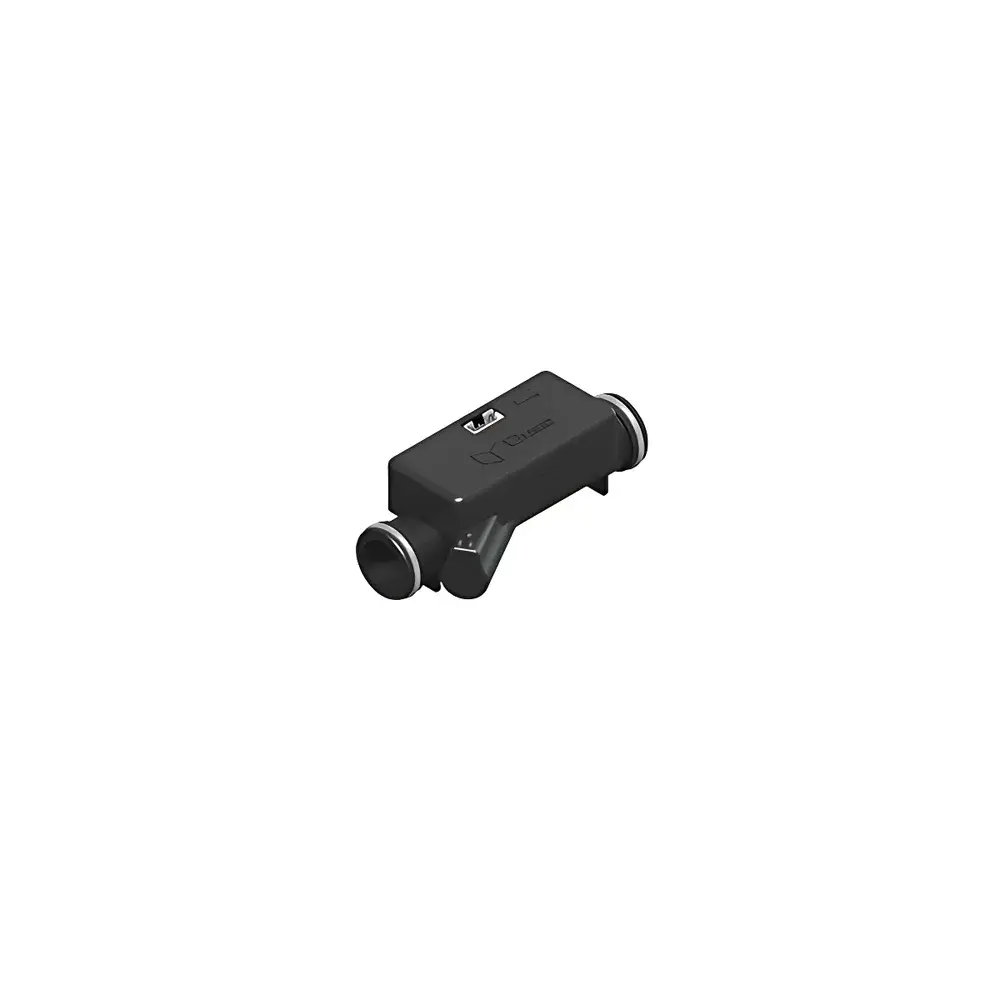
Cubic Gasboard-8500FS-L240H Ultrasonic Oxygen Flowmeter
| Brand | Cubic |
|---|---|
| Origin | Hubei, China |
| Model | Gasboard-8500FS-L240H |
| Measurement Principle | Ultrasonic Time-of-Flight (TOF) |
| Flow Range | 0–240 L/min |
| O₂ Concentration Range | 0–100% vol |
| O₂ Accuracy | ±3% F.S. (5–45 °C) |
| Flow Accuracy | ±2% F.S. |
| O₂ Resolution | 0.1% vol |
| Flow Resolution | 0.1 L/min |
| Response Time (O₂) | <0.1 s |
| Response Time (Flow) | <2 ms |
| Operating Temp. | −20 to +55 °C |
| Operating Humidity | 0–95% RH (non-condensing) |
| Storage Temp. | −20 to +70 °C |
| Communication Interfaces | UART-TTL, I²C, Custom Analog Output |
Overview
The Cubic Gasboard-8500FS-L240H Ultrasonic Oxygen Flowmeter is a fully integrated, five-parameter gas sensing module engineered for clinical and biomedical gas delivery systems. It employs dual-path ultrasonic time-of-flight (TOF) measurement to determine volumetric flow rate with zero mechanical wear, while simultaneously quantifying oxygen concentration via built-in paramagnetic or electrochemical sensing—depending on configuration—alongside ambient temperature, relative humidity, and atmospheric pressure. Unlike thermal mass flowmeters, this device exhibits no zero drift over time and requires no routine recalibration, making it suitable for long-term deployment in regulated medical environments. Its architecture supports real-time closed-loop control of oxygen therapy devices, including high-flow nasal cannula (HFNC) systems and critical-care ventilators where dynamic response and metrological stability are essential under variable humidity and temperature conditions.
Key Features
- Ultrasonic TOF-based flow measurement: Immune to gas composition changes, insensitive to particulates or condensate, and unaffected by sensor fouling—ideal for humidified oxygen streams.
- Simultaneous five-parameter output: Real-time O₂ concentration (0–100% vol), volumetric flow (0–240 L/min), temperature (−20 to +55 °C), relative humidity (0–95% RH), and barometric pressure (typically 80–110 kPa).
- Sub-millisecond dynamic response: Flow signal latency <2 ms; O₂ response <0.1 s—enabling precise synchronization with servo-controlled blower or valve actuation in ventilator feedback loops.
- Full environmental compensation: On-board temperature and humidity sensors feed into embedded algorithms that correct both flow and O₂ readings across the full operational range, minimizing cross-sensitivity errors.
- Low-power, digital-native interface: UART-TTL and I²C protocols support direct integration with microcontroller units (MCUs) or FPGA-based control platforms; analog output available per OEM specification.
- Medical-grade reliability: Designed to meet IEC 60601-1 basic safety requirements and compatible with ISO 80601-2-12 (ventilators) and ISO 8573-1 (compressed air purity) testing frameworks.
Sample Compatibility & Compliance
The Gasboard-8500FS-L240H is validated for use with humidified medical oxygen (up to 100% RH, non-condensing), blended O₂/air mixtures, and other binary gas systems where oxygen partial pressure remains within physiological ranges. It does not require gas-specific calibration and maintains accuracy across varying dew points typical in heated humidifier circuits (e.g., 37 °C, 44 mg/L). The sensor housing complies with IP20 ingress protection and is constructed from medical-grade thermoplastics compatible with common disinfectants (e.g., 70% isopropyl alcohol, hydrogen peroxide vapor). While not certified as an active medical device under FDA 510(k) or CE-MDR, its performance characteristics align with design inputs referenced in ISO 13485 quality management systems and support verification per ASTM F2755 (standard guide for oxygen analyzer performance in respiratory care devices).
Software & Data Management
The module outputs raw and compensated data via configurable serial frames (default: ASCII or binary protocol), supporting asynchronous polling or interrupt-driven acquisition. Firmware includes factory-trimmed linearization coefficients and NIST-traceable calibration metadata stored in EEPROM. For regulatory documentation, timestamped audit logs can be generated upon request using external host firmware—supporting GLP/GMP traceability when paired with compliant data acquisition software. Optional SDKs (C/C++, Python) enable integration into validation workflows requiring 21 CFR Part 11-compliant electronic records, including user authentication, change control, and electronic signatures for calibration events.
Applications
- High-flow nasal cannula (HFNC) systems requiring continuous, drift-free O₂ titration and flow monitoring at up to 240 L/min.
- Critical care ventilators performing spontaneous breathing trials, where rapid detection of inspiratory/expiratory flow reversal informs weaning protocols.
- Portable oxygen concentrators and transport ventilators needing compact, low-power, multi-parameter gas sensing without moving parts.
- Lab-scale gas blending stations validating O₂/N₂ mixture ratios prior to clinical use or bioreactor feed control.
- Preclinical respiratory research setups measuring minute ventilation, dead space, and fractional O₂ uptake in animal models.
FAQ
Does this sensor require periodic calibration in the field?
No. The ultrasonic flow path and O₂ sensing elements are factory calibrated with NIST-traceable standards. Long-term stability eliminates the need for routine recalibration under normal operating conditions.
Can it operate reliably in saturated humidified gas streams?
Yes—provided condensation does not form inside the flow channel. The device is rated for 0–95% RH (non-condensing) and includes active thermal and hygric compensation to maintain accuracy across humidification levels typical in clinical HFNC applications.
Is analog output standard or optional?
Analog voltage or current output (e.g., 0–5 V, 4–20 mA) is available as a custom configuration; default interfaces are UART-TTL and I²C.
What is the maximum allowable differential pressure across the sensor?
The Gasboard-8500FS-L240H is designed for low-pressure-drop installation in line with medical gas circuits; maximum recommended differential pressure is ≤1.5 kPa at 240 L/min to preserve acoustic coupling integrity and avoid turbulence-induced measurement noise.
How is traceability documented for quality assurance purposes?
Each unit ships with a unique serial number and calibration certificate listing individual sensor gain, offset, and compensation coefficients. Digital calibration data is embedded in onboard memory and accessible via host command.