
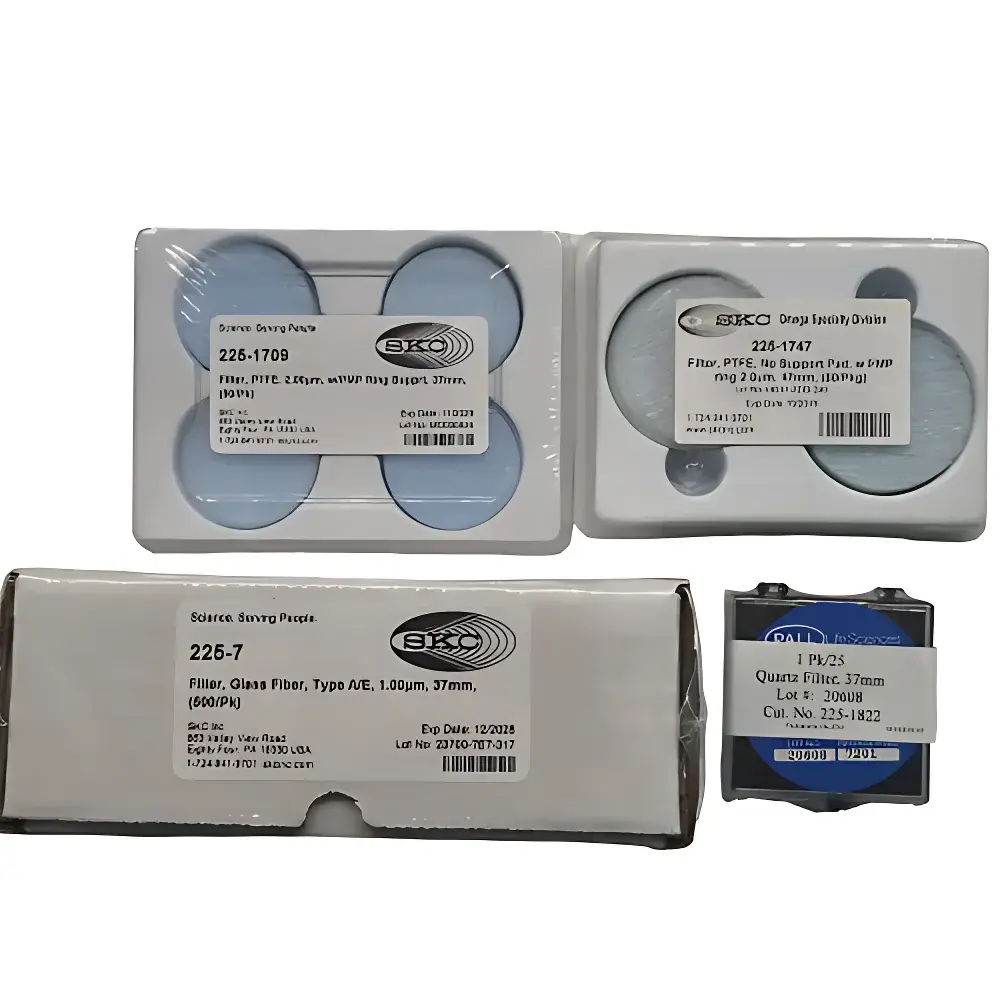
SKC Air Sampling Membrane Filters
| Brand | SKC |
|---|---|
| Origin | USA |
| Product Type | Imported Air Sampling Filter Membranes |
| Material Options | Cellulose Ester (MCE), Polyvinyl Chloride (PVC), Polytetrafluoroethylene (PTFE), Polycarbonate (PC), Silver (Ag), Glass Fiber (GF), Quartz (QZ), Gelatin (GEL) |
| Available Diameters | 13 mm, 25 mm, 37 mm, 47 mm, 90 mm, 102 mm, 8×10 inch |
| Pore Sizes | 0.3–10 µm (material-dependent) |
| Packaging | 25–1000 pieces per box |
| Sterilization | Gamma-irradiated (Gelatin), Autoclavable (PTFE, PC, Ag, GF, QZ), Solvent-compatible (Ag, MCE, PTFE) |
Overview
SKC Air Sampling Membrane Filters are precision-engineered consumables designed for quantitative collection and subsequent analytical characterization of airborne particulates in occupational health, environmental monitoring, and industrial hygiene applications. These filters serve as the critical interface between air sampling instrumentation—such as personal or area air pumps, cyclones, impactors, and bioaerosol samplers—and downstream laboratory analysis methods including gravimetric analysis, atomic absorption spectroscopy (AAS), inductively coupled plasma mass spectrometry (ICP-MS), scanning electron microscopy (SEM), transmission electron microscopy (TEM), X-ray diffraction (XRD), and microbial culture or molecular detection. Each filter material is selected for its intrinsic physicochemical properties—including hydrophilicity/hydrophobicity, chemical inertness, thermal stability, ash content, surface morphology, and compatibility with solvents or growth media—to ensure fidelity in particle retention, minimal background interference, and methodological compliance with international standards such as ISO 7708, ISO/IEC 17025, NIOSH Manual of Analytical Methods (NMAM), OSHA Method ID-121, and ASTM D6330.
Key Features
- Material-specific performance optimization: MCE for metal and asbestos analysis; PVC for low-ash gravimetric determination of hexavalent chromium; PTFE for high-temperature or solvent-resistant collection of PAHs, pesticides, and isocyanates; PC for TEM-grade fiber enumeration due to uniform pore geometry and electron transparency; Ag for XRD and TEM of crystalline silica; GF and QZ for high-efficiency PM10/PM2.5 and diesel particulate matter collection; Gelatin for viable bioaerosol capture and direct plating.
- Consistent pore structure and thickness: Tight pore size distribution (±5% tolerance), validated via bubble point testing and SEM imaging; nominal pore sizes certified per manufacturer specifications (e.g., 0.45 µm, 0.8 µm, 5 µm).
- Trace-metal-clean manufacturing: Low-background quartz (Tissuquartz®, Type R-100) and silver filters produced in Class 100 cleanrooms to minimize elemental contamination for ICP-MS and AAS.
- Regulatory-ready formats: Pre-sterilized (gamma-irradiated) gelatin filters; autoclavable PTFE, PC, Ag, GF, and QZ membranes; black-grid MCE variants for enhanced fiber contrast in optical microscopy.
- Standardized dimensions and packaging: Compatible with SKC, Thermo Fisher, Casella, and other globally deployed air sampling cassettes and holders; individually sealed or bulk-packed in certified clean packaging.
Sample Compatibility & Compliance
SKC membrane filters meet the physical and chemical requirements of major regulatory sampling protocols. MCE filters comply with NIOSH 7400 (asbestos), 7300 (metals), and 7074 (fibers); PVC filters satisfy OSHA ID-121 for Cr(VI); PTFE and QZ filters support EPA TO-11A and ISO 21501-4 for aerosol mass concentration; Gelatin filters align with ISO 16000-17 and EU Directive 2004/108/EC for viable fungal and bacterial spore collection. All filters undergo lot-specific certification for weight, thickness, and pore integrity. Ash content is documented per batch (e.g., <0.001% for QZ, <0.01% for GF), and endotoxin levels are reported where applicable (e.g., <0.03 EU/filter for gamma-irradiated Gelatin). Filters intended for GLP/GMP environments include full traceability documentation, CoA, and compliance with FDA 21 CFR Part 11–ready data handling when used with SKC’s digital sampling systems.
Software & Data Management
While membrane filters themselves are passive consumables, their use is fully integrated into SKC’s digital air sampling ecosystem. When paired with SKC’s AirCheck TOUCH or SideKick sampling pumps, filter lot numbers, sampling duration, flow rate, and environmental parameters are automatically logged via Bluetooth to the SKC AirMetrics™ cloud platform. This enables audit-trail generation, automated calibration certificate association, and seamless linkage to LIMS systems via HL7 or CSV export. For regulatory submissions (e.g., OSHA Form 91, EPA Air Toxics reports), filter-specific metadata—including material type, pore size, diameter, and sterilization status—is embedded in structured electronic records, supporting ALCOA+ principles (Attributable, Legible, Contemporaneous, Original, Accurate, Complete, Consistent, Enduring, Available).
Applications
- Occupational exposure assessment: Quantification of respirable crystalline silica (QZ, Ag), asbestos fibers (MCE, PC), welding fumes (MCE, QZ), and hexavalent chromium (PVC).
- Environmental PM monitoring: Size-fractionated collection of PM10, PM2.5, and ultrafine particles using QZ, GF, or PTFE in cascade impactors and TEOM systems.
- Industrial hygiene validation: Verification of local exhaust ventilation (LEV) efficiency via challenge aerosols collected on PC or PTFE membranes.
- Bioaerosol surveillance: Viable collection of bacteria, viruses, and fungi using gamma-sterilized Gelatin filters for culture-based or qPCR analysis per ISO 16000-17 and EN 13098.
- Research-grade aerosol science: Fundamental studies of particle deposition efficiency, filtration mechanisms, and nanoparticle agglomeration behavior using TEM-optimized PC and Ag membranes.
FAQ
Which filter material is recommended for NIOSH Method 582 (asbestos by PCM)?
Cellulose ester (MCE) filters—specifically 25 mm or 37 mm, 0.8 µm pore size—are specified for Phase Contrast Microscopy (PCM) analysis per NIOSH 582. Black-grid variants improve fiber contrast.
Can SKC PTFE filters be used for acid digestion prior to ICP-MS?
Yes. PTFE membranes are chemically inert to concentrated HNO₃, HF, and aqua regia at elevated temperatures, making them suitable for trace-metal digestion workflows without introducing polymeric contaminants.
Are Gelatin filters compatible with viral RNA extraction protocols?
Yes. SKC Gelatin filters dissolve completely in standard lysis buffers (e.g., QIAzol, AVL), enabling direct elution of captured virions into nucleic acid extraction workflows without mechanical disruption or filter residue interference.
What is the maximum operating temperature for Quartz filters during thermal desorption?
Tissuquartz® filters maintain structural integrity up to 300 °C in inert atmospheres, supporting thermal desorption GC-MS analysis of semi-volatile organic compounds (SVOCs) adsorbed onto collected particulates.
Do SKC filters include lot-specific certificates of analysis?
Yes. Every production lot is accompanied by a Certificate of Analysis documenting pore size verification, weight uniformity, ash content (where applicable), and sterility assurance (for gamma-irradiated products). Certificates are available upon request and archived for ≥10 years.
Related Products







