
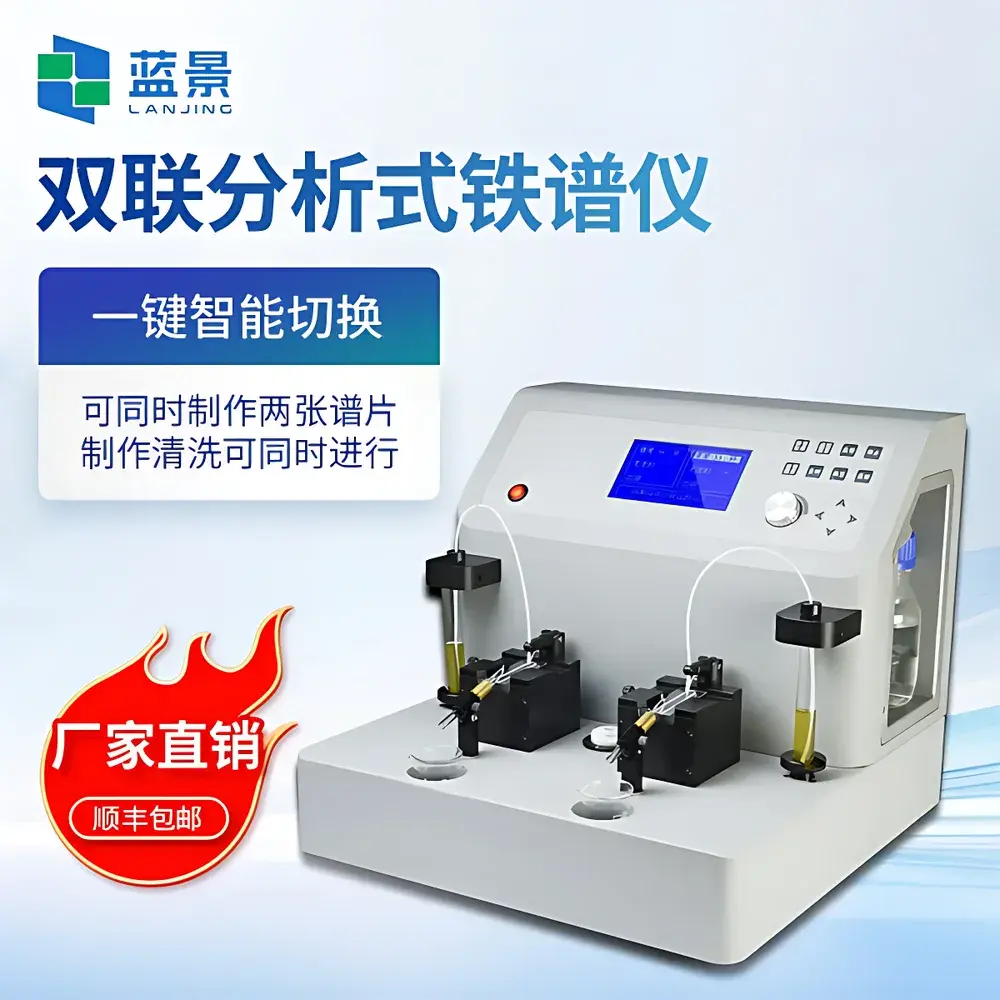
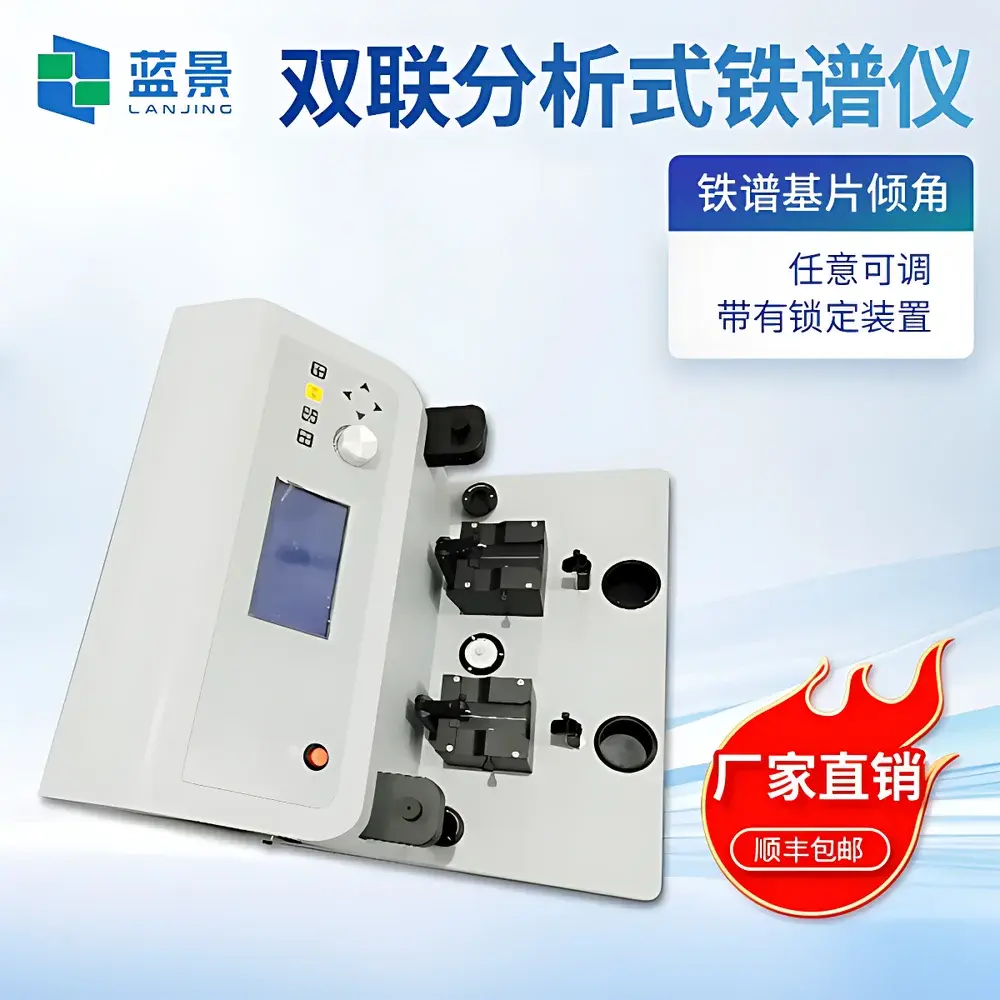
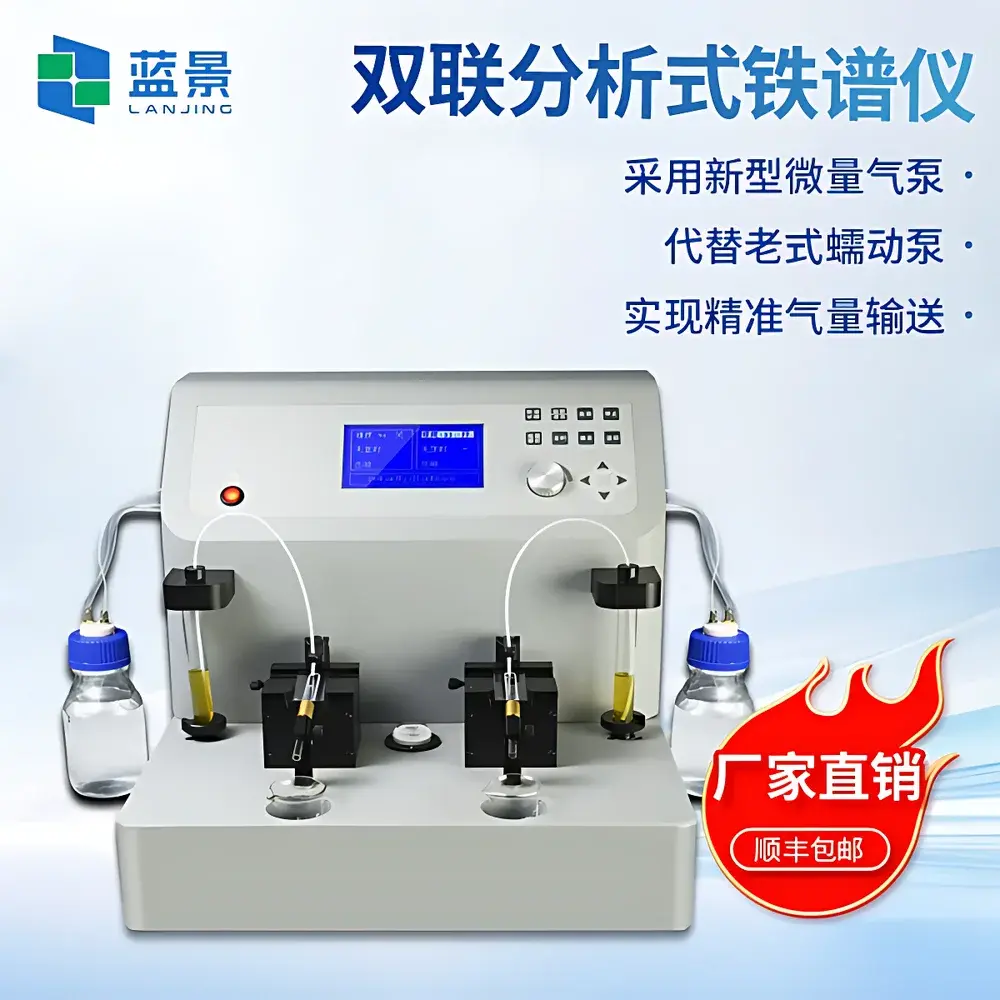
Lanjing LJ-TPY-2 Dual-Channel Analytical Ferroscope
| Brand | Lanjing |
|---|---|
| Origin | Shandong, China |
| Manufacturer Type | OEM Manufacturer |
| Country of Origin | China |
| Model | LJ-TPY-2 |
| Magnetic Field Strength | >1.6 T at air-gap center |
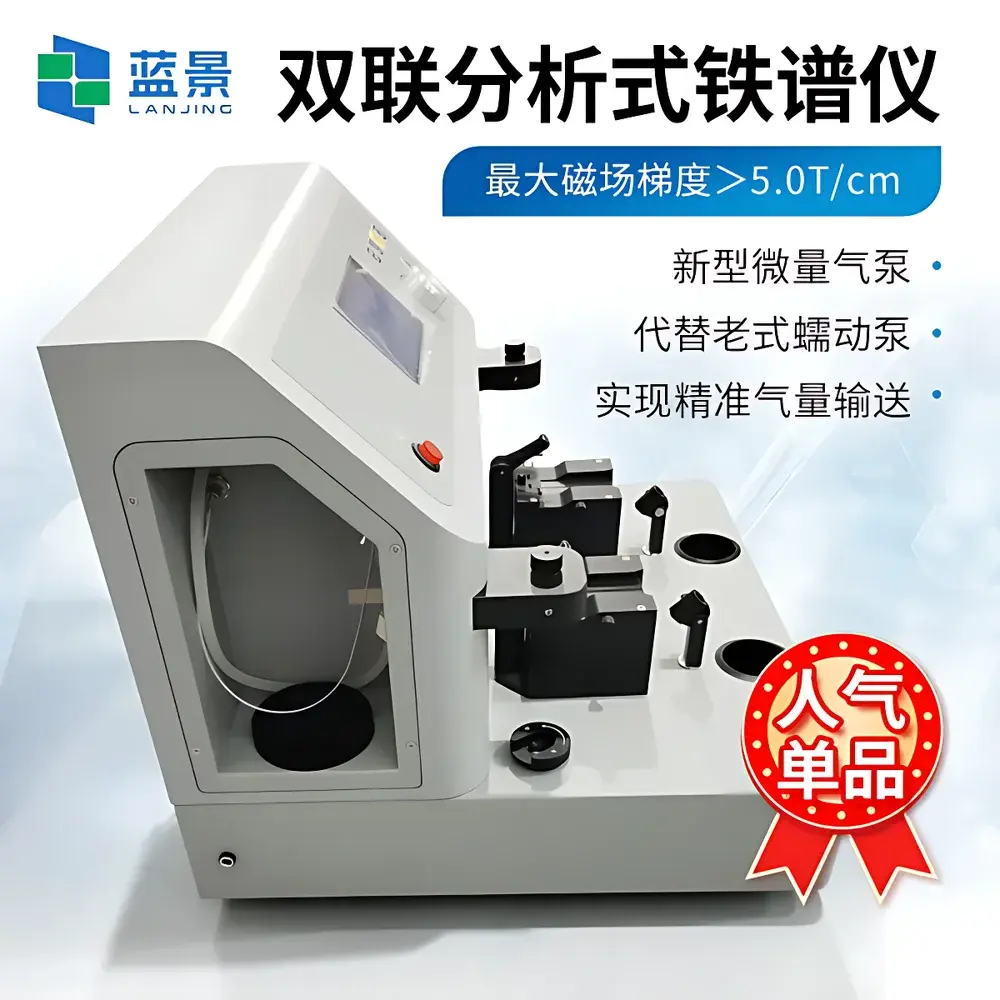
| Maximum Magnetic Gradient | >5.0 T/cm |
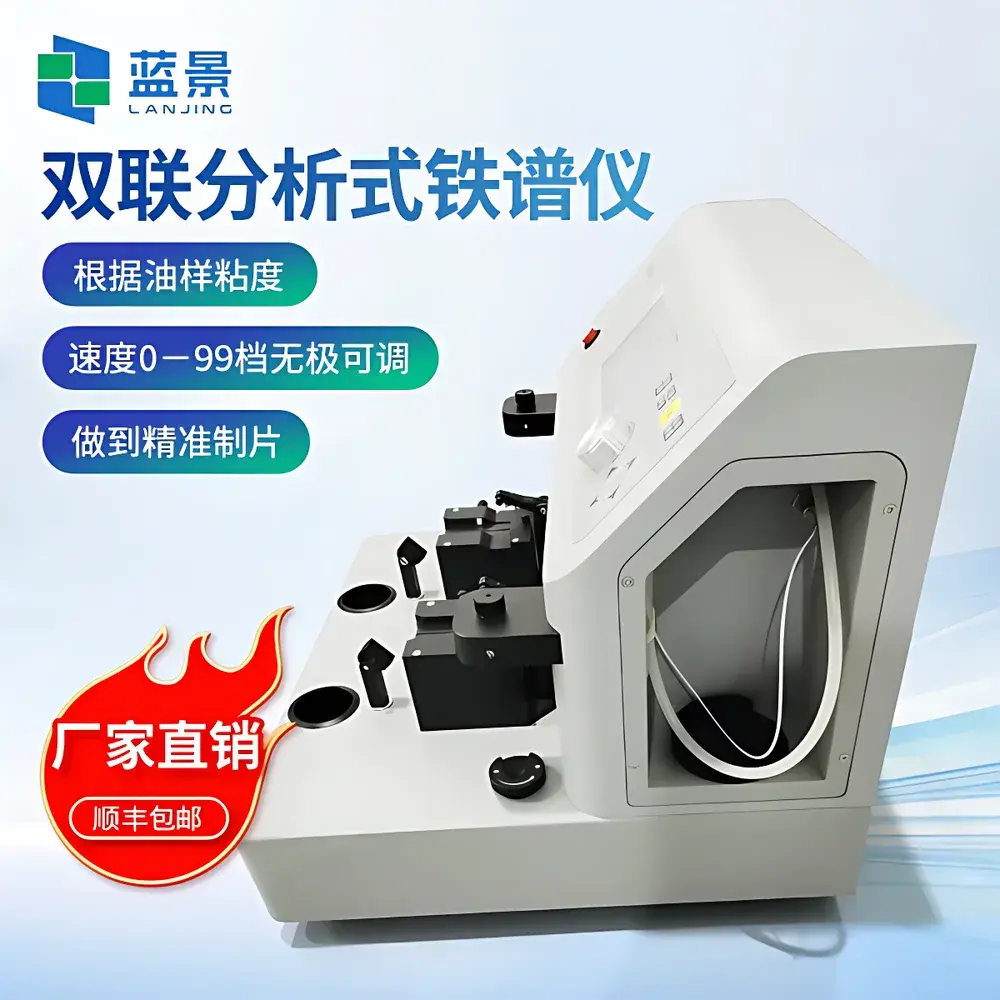
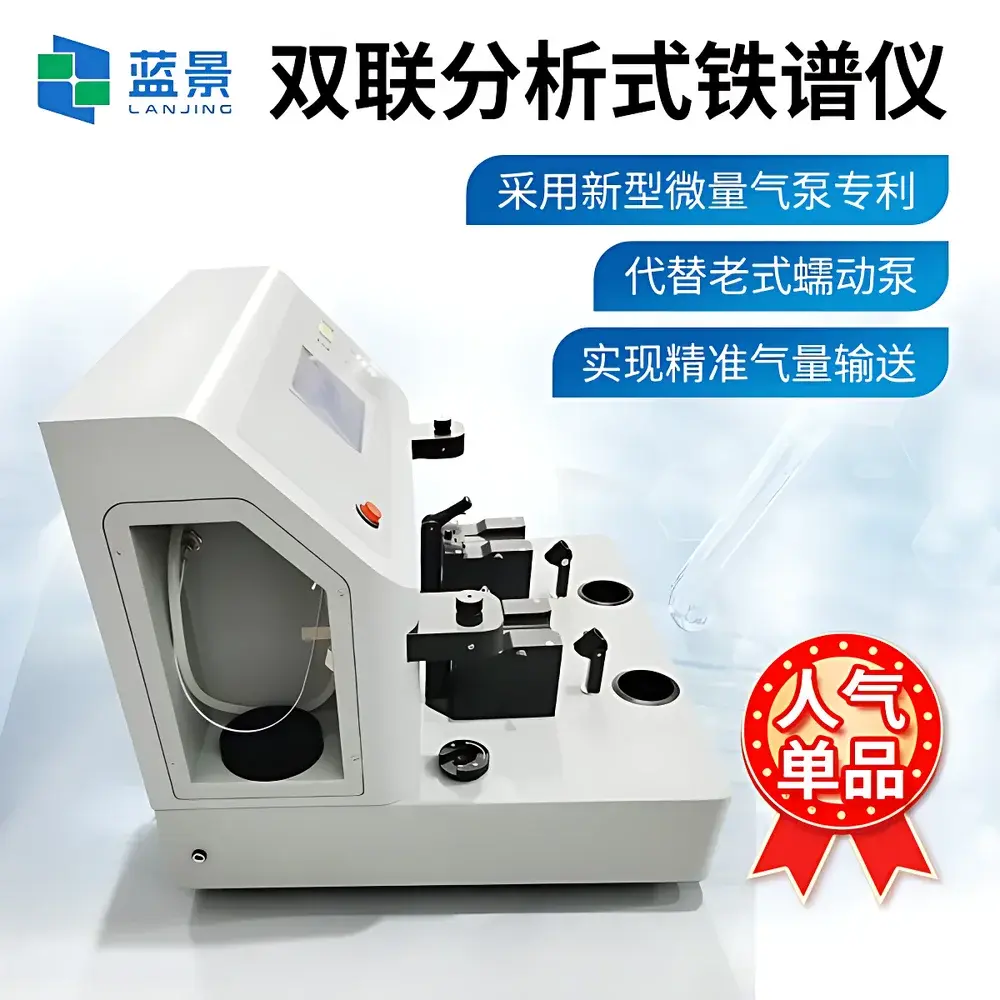
| Oil Sample Delivery | Electronically controlled micro-air pump with 0–99 stepless flow adjustment |
| Ferrogram Substrate Dimensions | 0.17 × 24 × 60 mm |
| Substrate Tilt Angle | Continuously adjustable with mechanical lock |
| Timer Range | 0–60 min (with audible alert) |
| Display | 240 × 128 high-resolution LCD |
| Dual-Channel Operation | Simultaneous preparation of two ferrograms |
| Power Supply | 220 V, 50 Hz |
Overview
The Lanjing LJ-TPY-2 Dual-Channel Analytical Ferroscope is an engineered solution for quantitative wear particle analysis in lubricating oils used across critical rotating machinery—including gas turbines, marine diesel engines, hydraulic systems, and wind turbine gearboxes. It operates on the principle of high-gradient magnetic separation (HGMS), leveraging a precisely controlled magnetic field to extract ferromagnetic and paramagnetic wear debris from oil samples and deposit them onto standardized glass substrates in order of particle size and magnetic susceptibility. This spatially resolved deposition forms a ferrogram—a diagnostic “fingerprint” of machine wear—enabling morphological, dimensional, and semi-quantitative compositional assessment under optical or scanning electron microscopy. Unlike generic particle counters, the LJ-TPY-2 delivers deterministic spatial ordering of particles, supporting root-cause diagnostics such as sliding vs. fatigue vs. cutting wear mechanisms per ASTM D7690 and ISO 11500 guidelines.
Key Features
- Dual-channel architecture enables concurrent preparation of two independent ferrograms—doubling throughput without compromising reproducibility or cross-contamination risk.
- Electronically regulated micro-air pump replaces legacy peristaltic delivery, ensuring stable, pulse-free oil flow across viscosities (ISO VG 32 to VG 680), with 0–99 stepless flow calibration for repeatable sedimentation kinetics.
- Adjustable substrate tilt angle (0°–30°) with mechanical locking allows optimization of particle migration velocity and deposition density for fine (<1 µm) or coarse (>100 µm) wear populations.
- Integrated anti-overflow metal housing and one-touch tube clearance system mitigate operational downtime due to clogging or spillage—critical in field-deployed or maintenance bay environments.
- 240 × 128 backlit LCD interface provides real-time monitoring of timer, flow setting, tilt angle, and system status—designed for gloved operation and low-light conditions.
- DC-compatible power input supports battery-backed operation in remote or mobile labs, complying with IEC 61000-4-30 Class A voltage fluctuation tolerance requirements.
Sample Compatibility & Compliance
The LJ-TPY-2 accepts mineral, synthetic, and bio-based lubricants (including engine oils, hydraulic fluids, gear oils, and greases after solvent dilution). It accommodates sample volumes from 0.5 mL to 5.0 mL and handles particulate loadings up to 2000 ppm w/w without filter pre-treatment. All ferrogram substrates conform to ASTM D5183 specifications for thickness (0.17 mm ± 0.01 mm), flatness (≤0.5 µm deviation), and surface roughness (Ra < 10 nm). Optional metrological validation includes accredited test reports per GB/T 2423 series (low/high temperature operation & storage, damp heat, sinusoidal vibration), supporting GLP-compliant deployment in third-party certification labs. While not FDA 21 CFR Part 11–certified out-of-the-box, audit trails generated by optional FITS software meet ALCOA+ data integrity criteria when deployed with time-stamped, user-locked instrument logs.
Software & Data Management
The system integrates with Ferrogram Image Treatment Software (FITS), a Windows-based application supporting ISO 4406:2017 particle count coding, ASTM E2412 spectral trend mapping, and customizable wear severity indices (e.g., Wear Debris Concentration Index, WDCI). FITS records full metadata—flow rate, tilt angle, exposure time, operator ID, and ambient temperature—and exports structured CSV/Excel reports compatible with CMMS platforms such as IBM Maximo and SAP PM. Raw image files are saved in TIFF format with embedded EXIF tags; no proprietary compression is applied. Audit-ready export packages include digital signatures and hash verification for forensic traceability.
Applications
- Condition-based maintenance (CBM) programs for aviation turbine engines (per SAE ARP1285 and Rolls-Royce RRES 90001).
- Root-cause failure analysis following catastrophic gearbox failures in offshore wind farms (IEC 61400-25 compliance).
- Accelerated lubricant oxidation testing in R&D labs evaluating antioxidant package efficacy.
- Verification of filtration efficiency for beta-ratio-rated filters (ISO 16889).
- Forensic metallurgical investigation of bearing spalling, gear pitting, and piston ring scuffing.
FAQ
What magnetic field specifications ensure reliable separation of sub-micron wear particles?
The LJ-TPY-2 generates >1.6 T at the air-gap center with a gradient exceeding 5.0 T/cm—sufficient to capture magnetite particles down to ~0.3 µm under standard flow conditions, as verified via NIST-traceable Hall probe calibration.
Can the instrument be validated for ISO 17025-accredited laboratories?
Yes—when paired with optional metrological reports (GB/T 2423 series) and FITS software with electronic signature capability, the system meets foundational requirements for method validation per ISO/IEC 17025:2017 Clause 7.7.
Is dual-channel operation truly independent, or does it share fluidic pathways?
Each channel has dedicated air supply lines, flow control valves, and substrate holders—eliminating cross-talk and enabling parallel processing of dissimilar oil types (e.g., turbine oil + hydraulic fluid) without cleaning interlocks.
How is reproducibility quantified during ferrogram preparation?
Repeatability is assessed using control oil spiked with certified reference particles (NIST SRM 2800); typical CV for particle density across 10 replicates is ≤8.2% at 50 µm threshold, per internal SOP-LJ-TPY-003.
Does the system support automated particle classification post-imaging?
FITS includes rule-based morphology classifiers (sliding, fatigue, laminar, cutting) trained on >12,000 manually annotated images; AI-assisted categorization is available as an add-on module compliant with EN 62304 Class B software lifecycle requirements.
Related Products





