
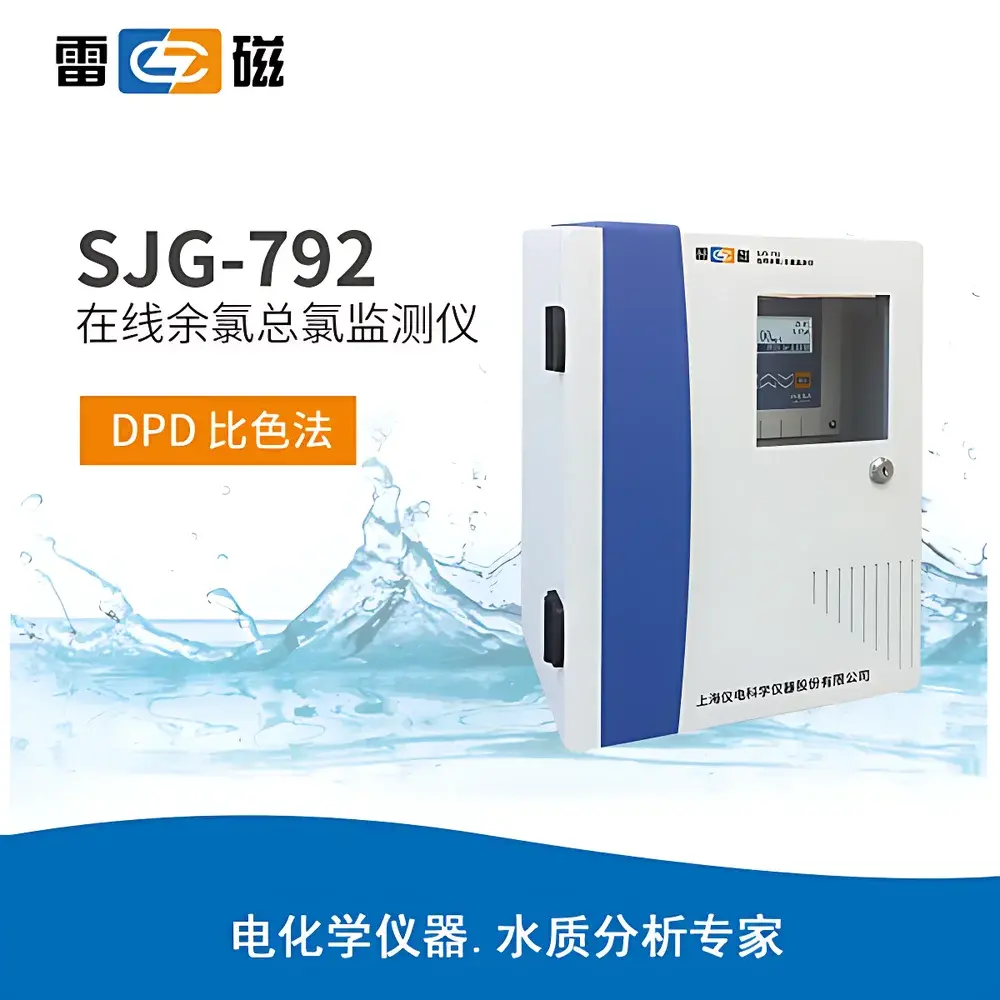
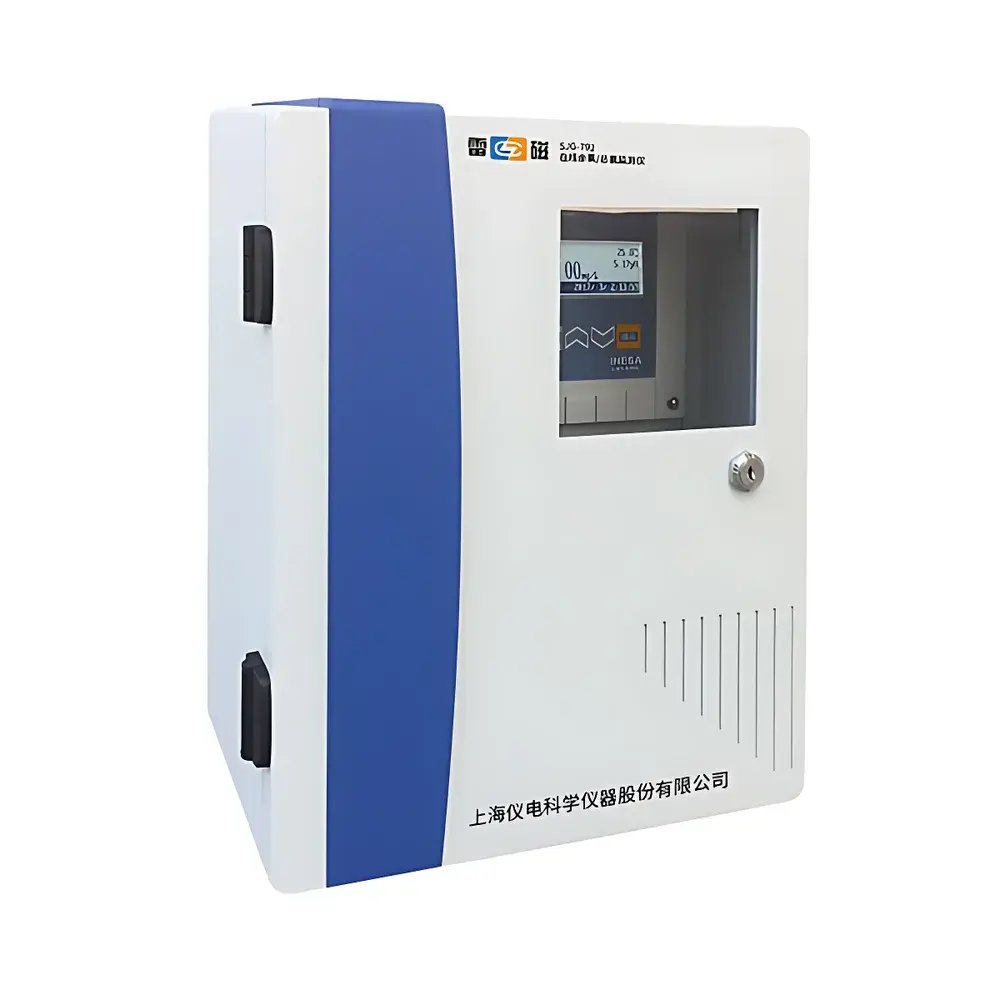
Leici SJG-792 Online Residual and Total Chlorine Analyzer
| Brand | Leici |
|---|---|
| Origin | Shanghai, China |
| Model | SJG-792 |
| Instrument Type | Online Analyzer |
| Measurement Principle | Electrochemical Amperometric Sensor Method |
| Measured Parameters | Residual Chlorine, Total Chlorine |
| Range | (0.00–5.00) mg/L |
| Accuracy | ±5% (for values >1 mg/L) or ±0.05 mg/L (for values ≤1 mg/L) |
| Repeatability | ±0.025 mg/L (≤1 mg/L) |
| Resolution | 0.01 mg/L |
| Limit of Detection (LOD) | ≤0.05 mg/L |
| Display | Dot-matrix LCD |
| Data Storage | Up to 700 records with SD card export |
| Output | Isolated 4–20 mA DC (configurable span), RS-232 or RS-485 (Modbus RTU) |
| Ingress Protection | IP65 |
| Power Supply | AC (220 ± 22) V, (50 ± 0.5) Hz |
| Calibration Options | Factory pre-loaded calibration curves, manual zero + up to two-point span calibration, in-process calibration support |
| Alarm Functions | Programmable high/low concentration thresholds |
| Diagnostics | Built-in self-diagnostic system |
| Power Failure Protection | Non-volatile memory retention |
Overview
The Leici SJG-792 Online Residual and Total Chlorine Analyzer is an industrial-grade electrochemical monitoring system engineered for continuous, real-time quantification of free residual chlorine and total chlorine in potable water, wastewater effluent, swimming pools, cooling towers, and disinfection process streams. It employs a dual-mode amperometric sensor architecture—optimized for both hypochlorous acid/hypochlorite (free chlorine) and chloramine-bound chlorine species (total chlorine)—with temperature-compensated current measurement and integrated membrane-based selective detection. Unlike colorimetric or DPD-based analyzers, the SJG-792 eliminates reagent consumption, optical path fouling, and photometric drift, delivering stable long-term operation in unattended environments. Its design conforms to core performance expectations outlined in ASTM D1253 (Standard Test Method for Determining Residual Chlorine in Water) and supports routine verification against NIST-traceable chlorine standards. The analyzer operates as a stand-alone node within distributed SCADA or PLC networks, requiring no external PC for basic functionality.
Key Features
- Electrochemical amperometric sensing platform with solid-state reference electrode and chlorine-selective membrane—enabling direct, reagent-free measurement without sample derivatization
- Simultaneous or configurable single-parameter mode for residual chlorine and total chlorine, with automatic mode switching via internal logic or remote command
- High-contrast dot-matrix LCD display with intuitive menu navigation, supporting English-language interface and on-device parameter configuration
- Factory-loaded calibration curves with user-accessible zero and multi-point (up to two) span calibration routines—including in-process calibration capability during live flow conditions
- Robust data handling: onboard storage for 700 timestamped measurements with automatic overwrite policy; manual export via microSD card (FAT32 formatted)
- Industrial I/O suite: isolated 4–20 mA analog output (fully programmable lower/upper range limits), plus selectable RS-232 or RS-485 serial interface compliant with Modbus RTU protocol (slave mode)
- Comprehensive diagnostics: real-time sensor health monitoring, electrolyte depletion alerts, membrane integrity checks, and communication fault logging
- IP65-rated polycarbonate enclosure—suitable for wall-mount or pipe-clamp installation in humid, splash-prone environments including pump stations and chemical feed rooms
- Non-volatile memory retention ensures measurement continuity and configuration integrity during power interruption
Sample Compatibility & Compliance
The SJG-792 is validated for aqueous matrices with pH 5.0–8.5, conductivity < 2,000 µS/cm, and suspended solids < 20 mg/L. It is not intended for seawater, highly turbid sludge streams, or solutions containing strong oxidants other than chlorine species (e.g., ozone, peroxide). For regulatory alignment, the analyzer supports documentation workflows compatible with GLP and GMP environments: all calibrations and alarms are time-stamped and logged internally; audit trails can be extracted via SD card for review under ISO/IEC 17025 or EPA-approved QA/QC protocols. While not FDA 21 CFR Part 11-certified out-of-the-box, its deterministic calibration traceability and immutable data log structure facilitate validation by end-user QA departments.
Software & Data Management
No proprietary software is required for commissioning or routine operation. Configuration, calibration, and alarm thresholds are managed locally via front-panel interface. For integration into centralized systems, the Modbus RTU register map provides read/write access to real-time concentration values, sensor status flags, calibration timestamps, and diagnostic codes (e.g., “membrane saturation”, “electrolyte low”). All stored records include UTC timestamp (via internal RTC), measurement type identifier, raw sensor signal (nA), temperature (°C), and operator-assigned batch or location tag. Exported CSV files are UTF-8 encoded and compatible with LIMS platforms, Microsoft Excel, and statistical process control (SPC) tools.
Applications
- Drinking water treatment plants: monitoring chlorine residual at clearwell outlets and distribution system entry points
- Wastewater disinfection contact basins: verifying CT compliance per EPA guidelines prior to discharge
- Pharmaceutical facility purified water (PW) and water-for-injection (WFI) loops—where low-level chlorine detection supports sanitization cycle validation
- Commercial swimming pool and spa management: maintaining NSF/ANSI 50-compliant free chlorine levels while minimizing chloramine buildup
- Food & beverage processing lines: verifying sanitizer concentration in CIP rinse stages
- Industrial cooling water systems: preventing microbiologically influenced corrosion (MIC) through controlled biocide dosing
FAQ
What maintenance intervals are recommended for the electrochemical sensor?
Sensor membrane replacement is advised every 6–12 months depending on water quality; electrolyte refill every 3–6 months. Routine zero calibration should be performed weekly; span calibration every 1–4 weeks based on application criticality.
Can the SJG-792 distinguish between free chlorine and combined chlorine without manual intervention?
Yes—the instrument automatically switches between residual and total chlorine modes using an integrated reagent injection module (sodium thiosulfate for quenching free chlorine prior to total chlorine measurement) and synchronized amperometric sampling sequence.
Is temperature compensation applied automatically during measurement?
Yes—integrated Pt1000 RTD measures sample temperature in real time and applies algorithmic compensation per the Clark-type sensor response curve, referenced to 25°C.
Does the device support HART communication?
No—only isolated 4–20 mA analog output and Modbus RTU over RS-232/RS-485 are supported. HART requires additional hardware layer not included in the SJG-792 design.
How is sensor drift monitored and corrected over time?
The built-in diagnostic engine continuously tracks baseline current offset, sensitivity decay, and response time lag. When deviations exceed configurable thresholds, it triggers a “sensor stability warning” and logs corresponding diagnostic parameters for root-cause analysis.







