
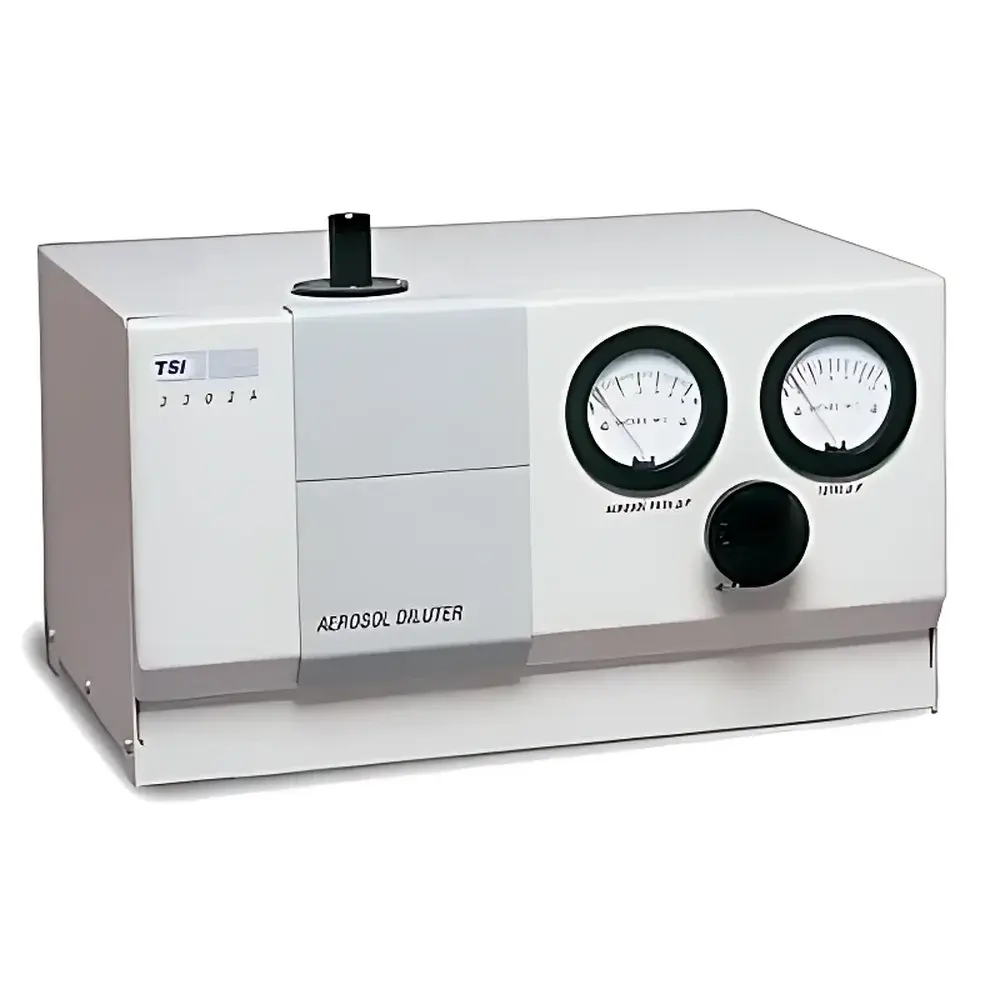
TSI 3302A Aerosol Diluter
| Origin | USA |
|---|---|
| Manufacturer Type | Authorized Distributor |
| Origin Category | Imported |
| Model | 3302A |
| Pricing | Available Upon Request |
| Dilution Ratios | 100:1 and 20:1 |
| Max Particle Loss | 7% |
| Sample Flow Rate | 5 L/min |
| Compressed Gas Requirement | None |
Overview
The TSI 3302A Aerosol Diluter is a precision-engineered, passive dilution device designed exclusively for integration with the TSI 3321 Aerodynamic Particle Sizer (APS) Spectrometer. It operates on the principle of turbulent mixing and laminar flow splitting to achieve highly reproducible, gravimetrically traceable dilution without introducing measurement artifacts or flow perturbations. Unlike active diluters relying on pumps or pressure regulation, the 3302A utilizes calibrated orifices and fixed-area flow paths to deliver stable, pulse-free dilution—critical for maintaining APS sizing accuracy and counting integrity during high-concentration aerosol characterization. Its primary function is to reduce inlet aerosol number concentrations into the optimal dynamic range of the APS (typically 10⁴–10⁶ particles/cm³), thereby preventing coincidence errors, detector saturation, and sizing bias in the 0.5–10 µm aerodynamic diameter range. The device is constructed from anodized aluminum and stainless-steel components, ensuring chemical inertness, minimal particle adhesion, and long-term dimensional stability under laboratory and field-deployed conditions.
Key Features
- Two fixed, NIST-traceable dilution ratios: 100:1 and 20:1, selected via manual valve configuration—no electronics, no calibration drift.
- Passive operation: requires no compressed air, vacuum source, or external power—ideal for mobile labs, cleanrooms, and ISO 14644-1 classified environments where pneumatic interference must be avoided.
- Low particle loss design: ≤7% total transmission loss across 0.5–10 µm, validated per ISO 27891 and TSI internal aerosol transport efficiency protocols using monodisperse PSL standards.
- Stable 5 L/min sample flow rate maintained within ±2% over ambient temperature (15–30 °C) and pressure (80–106 kPa) ranges—compatible with APS inlet specifications without flow correction.
- Modular stacking capability: two 3302A units can be serially connected to achieve a composite dilution ratio of 10,000:1, enabling analysis of combustion aerosols, spray dryer exhausts, or occupational hygiene samples exceeding 10⁸ particles/cm³.
- Non-invasive interface: standardized 3/4″ Swagelok® fittings and 1/2″ OD stainless-steel tubing connections ensure leak-tight integration with APS and upstream sampling lines per ASTM D6245-20.
Sample Compatibility & Compliance
The 3302A is compatible with liquid, solid, and mixed-phase aerosols—including diesel soot, pharmaceutical dry powder actuations, metal fumes, and atmospheric urban particulate matter—provided the aerosol is non-corrosive and thermally stable below 60 °C. It introduces no heating, cooling, or electrostatic charge modification, preserving native particle morphology and hygroscopic behavior prior to APS sizing. The device complies with key regulatory and quality frameworks: it supports GLP-compliant aerosol exposure studies (OECD 412, 413), aligns with USP guidance on particle measurement uncertainty, and meets the mechanical robustness requirements outlined in ISO 29463-3 for filter test aerosol conditioning systems. While not a standalone measuring instrument, its use is documented in FDA audit-ready SOPs for inhaler product development and cleanroom monitoring per ISO 14644-3 Annex B.
Software & Data Management
As a hardware-only dilution module, the 3302A does not incorporate embedded firmware, onboard memory, or digital communication interfaces. All operational parameters—including dilution factor selection, flow verification, and system integrity checks—are recorded manually or integrated into the host APS data acquisition workflow via TSI’s Instrument Manager™ software (v9.0+). When used with APS systems configured for 21 CFR Part 11 compliance, dilution settings are logged as metadata alongside raw size distribution histograms, enabling full traceability during regulatory submissions. Audit trails capture operator ID, timestamp, dilution mode, and flow verification results—ensuring alignment with ALCOA+ data integrity principles.
Applications
- Calibration and challenge testing of high-efficiency particulate air (HEPA) and ULPA filters per ISO 16890 and EN 1822.
- Occupational exposure assessment in welding, grinding, and nanomaterial handling operations where respirable fraction quantification is required.
- Inhalation toxicology studies requiring precise control of delivered dose concentration to animal exposure chambers.
- Pharmaceutical dry powder inhaler (DPI) and metered-dose inhaler (MDI) aerosol characterization under pharmacopeial guidelines (USP , Ph. Eur. 2.9.18).
- Real-time monitoring of combustion aerosols in engine test cells and biomass incineration facilities.
FAQ
Can the 3302A be used with instruments other than the TSI 3321 APS?
Yes—provided the downstream instrument accepts 5 L/min sample flow and has compatible inlet geometry and pressure drop characteristics; however, dilution ratio accuracy and particle loss performance are only validated for the 3321 APS platform.
Is periodic recalibration required?
No—dilution ratios are mechanically fixed and do not drift; users are advised to verify flow rate annually using a NIST-traceable mass flowmeter per ISO 17025 procedures.
Does the 3302A affect particle charge state or volatility?
No—it introduces no ionization, heating, or condensation surfaces; particle electrostatic and thermodynamic properties remain unaltered pre-analysis.
What maintenance is required?
Annual visual inspection of orifice integrity and O-ring condition; cleaning with isopropanol if exposed to oily or sticky aerosols—no routine replacement parts are specified.
Related Products







