
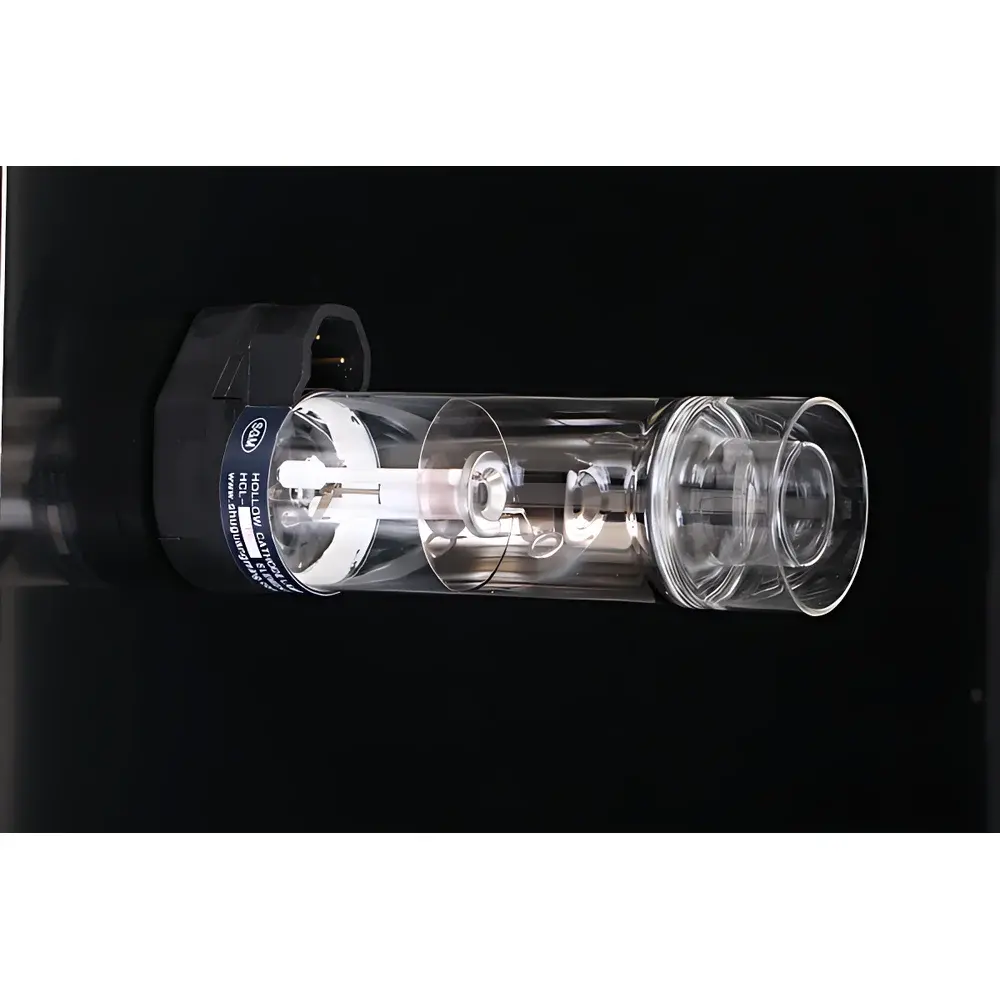
Hollow Cathode Lamp for PerkinElmer Instruments (SGM KY-PE)
| Brand | SGM |
|---|---|
| Origin | Beijing, China |
| Model | KY-PE |
| Designed Compatibility | PerkinElmer Atomic Absorption Spectrometers |
| Rated Lifetime | ≥5000 mAh (most elements), ≥3000 mAh (low-melting-point elements) |
| Intensity Noise | <0.1% RMS |
| Drift Stability | ≤1% over 30 min after 30-min warm-up |
| Spectral Background at Analytical Line | ≤1% |
Overview
The SGM KY-PE Hollow Cathode Lamp is a precision cathode emission source engineered specifically for integration with PerkinElmer atomic absorption spectrometry (AAS) systems. It operates on the fundamental principle of cathodic sputtering and atomic excitation under low-pressure inert gas discharge (typically argon or neon), generating narrow-line, element-specific radiation required for quantitative AAS analysis. Its optimized cathode geometry, high-purity metal or alloy construction, and rigorously controlled fill gas pressure ensure spectral purity, minimal self-absorption, and stable line intensity—critical prerequisites for achieving sub-part-per-trillion detection limits and long-term measurement reproducibility in regulated laboratory environments.
Key Features
- Element-specific spectral output compliant with PerkinElmer lamp socket and electrical interface specifications (e.g., pin configuration, operating voltage/current range)
- Extended operational lifetime: rated ≥5000 mAh for high-melting-point elements (e.g., Fe, Cu, Zn, Mn) and ≥3000 mAh for low-melting-point elements (e.g., Cd, Pb, As, Se), enabling consistent performance across extended analytical campaigns
- Low-intensity noise: root-mean-square (RMS) fluctuation <0.1% under nominal operating current, minimizing baseline instability and improving signal-to-noise ratio in absorbance measurements
- Thermal and electronic drift control: ≤1% relative intensity variation over any 30-minute interval following a standardized 30-minute warm-up period, supporting robust calibration stability during multi-sample batch analysis
- High spectral purity: background emission at the primary analytical wavelength ≤1%, reducing interferences from molecular bands or neighboring lines and enhancing selectivity per ASTM E1997 and ISO 11885 requirements
- Rugged ceramic-metal sealed envelope with low-outgassing gettering, ensuring long-term vacuum integrity and resistance to thermal cycling fatigue
Sample Compatibility & Compliance
The KY-PE lamp is validated for use with PerkinElmer AA spectrometers including the PinAAcle™, AAnalyst™, and earlier model series requiring standard 12-V DC, 10–25 mA operation. It meets essential functional equivalency criteria defined in USP , EPA Method 200.7, and ISO/IEC 17025-accredited AAS workflows. While not certified to IEC 61000-6-3 for EMC or ISO 14001 for environmental management, its design adheres to general laboratory safety standards for Class 3B optical sources (IEC 60825-1) and RoHS-compliant materials handling. No proprietary firmware or embedded electronics are present; compatibility is purely electro-optical and mechanical.
Software & Data Management
As a passive radiation source, the KY-PE lamp requires no firmware, drivers, or software integration. It functions transparently within PerkinElmer’s WinLab32™, AA Analyst™, or Syngistix™ software environments via standard instrument lamp control protocols. All lamp usage metrics—including cumulative operating hours, current settings, and warm-up history—are logged automatically by the host spectrometer’s audit trail system. This native logging supports GLP/GMP compliance when configured with 21 CFR Part 11–enabled software versions, providing time-stamped, user-attributed records for traceability and instrument qualification (IQ/OQ/PQ) documentation.
Applications
- Regulatory environmental testing: quantification of heavy metals (Pb, Cd, Cr, Ni, As) in wastewater, soil extracts, and drinking water per EPA Methods 200.7, 200.8, and 200.9
- Pharmaceutical elemental impurities screening: determination of catalyst residues (Pd, Pt, Rh) and toxic elements (Cd, Hg, Tl) in APIs and excipients per ICH Q3D guidelines
- Food safety monitoring: detection of nutritional minerals (Ca, Mg, Zn, Fe) and contaminants (Sn, Al, Sb) in fortified foods and infant formula per AOAC 984.27 and ISO 11171
- Geochemical and metallurgical assay support: routine analysis of ore digests, leachates, and alloy matrices in QC/QA laboratories operating under ISO/IEC 17025 accreditation
- Academic and method development labs requiring interchangeable, cost-effective lamp alternatives without compromising spectral fidelity or long-term calibration integrity
FAQ
Is the KY-PE lamp compatible with non-PerkinElmer AAS instruments?
No—it is mechanically and electrically optimized for PerkinElmer spectrometers only. Pinout, thermal envelope dimensions, and current regulation profiles differ across manufacturers; cross-platform use may result in unstable operation or premature failure.
What warm-up protocol is recommended for optimal stability?
Operate at nominal current for 30 minutes prior to calibration or sample analysis. Avoid frequent on/off cycling; continuous operation during daily batches improves thermal equilibrium and reduces drift.
How is lamp lifetime measured, and what defines end-of-life?
Lifetime is specified in milliampere-hours (mAh), representing total charge throughput. End-of-life is reached when peak intensity at the analytical line falls below 70% of initial value or when noise exceeds 0.3% RMS under identical operating conditions.
Does this lamp require special disposal procedures?
Yes—due to metallic cathode content (e.g., Cd, Pb, As) and sealed noble gas, it must be managed as hazardous electronic waste per local regulations (e.g., WEEE Directive, RCRA Subpart D). Do not incinerate or landfill.
Can the KY-PE lamp be used in deuterium background correction mode?
Yes—it is fully compatible with PerkinElmer’s simultaneous or sequential deuterium background correction systems, provided the lamp current and alignment meet factory-specified tolerances for spectral overlap and beam homogeneity.




