
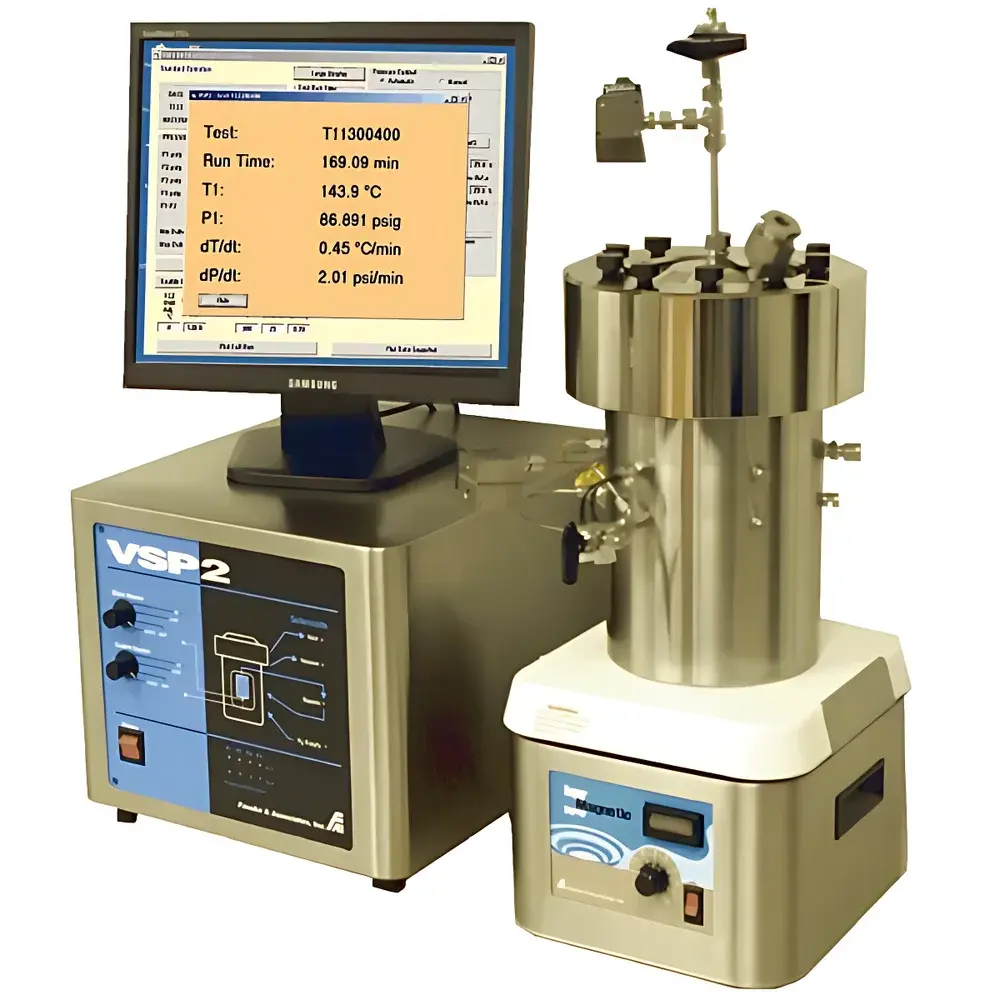
Fauske VSP2 Adiabatic Reaction Calorimeter
| Brand | Fauske |
|---|---|
| Origin | USA |
| Manufacturer Type | Authorized Distributor |
| Product Category | Imported Instrument |
| Model | VSP2 |
| Price Range | USD 135,000 – 270,000 (based on configuration and service package) |
| Measurement Mode | Adiabatic Calorimetry |
| Instrument Type | Reaction Calorimeter |
| Sample Volume | 116 mL |
| Cell Wall Thickness | 0.01 in (0.254 mm) |
| Thermal Inertia (φ) | ≤ 1.05 |
| Maximum Pressure Rating | >2000 psi (13.8 MPa) |
| Heating | Dual-zone (internal sample heater + external guard heater) |
| Pressure Equalization | Active dynamic compensation |
| Stirring | Optional magnetic stirring (standard & high-torque super-magnetic variants) |
| Cell Materials | 304 SS, 316 SS, Hastelloy C, Titanium, Quartz |
| Test Modes | Closed, Venting (small-scale relief), Isothermal, Dynamic Ramp, Quench Simulation |
Overview
The Fauske VSP2 Adiabatic Reaction Calorimeter is a low-thermal-inertia, pressure-rated adiabatic calorimeter engineered for rigorous process safety assessment of thermally unstable chemical systems. Based on the foundational methodology developed by the Design Institute for Emergency Relief Systems (DIERS), the VSP2 implements the classical adiabatic heat flow principle—where thermal losses to the environment are minimized via active temperature control of the surrounding guard zone—to deliver highly representative data under near-ideal adiabatic conditions. Unlike conventional differential scanning or heat-flux calorimeters, the VSP2 directly measures temperature and pressure rise rates (dT/dt, dP/dt) during runaway reactions under simulated failure scenarios—including cooling loss, agitation failure, reagent mischarge, rapid addition, contamination, or external fire exposure. Its φ-value (typically ≤1.05) ensures minimal heat sink effect, enabling direct scale-up of kinetic and thermodynamic parameters to plant-level design without empirical correction factors.
Key Features
- Low-thermal-inertia test cell (116 mL volume, 0.01 in wall thickness) with real-time pressure equalization to prevent rupture during rapid gas evolution
- Dual-zone heating architecture: independent internal sample heater and external guard heater maintain precise thermal equilibrium between sample and surroundings
- Modular cell material options—including 304/316 stainless steel, Hastelloy C, titanium, and quartz—to accommodate corrosive, reactive, or optically sensitive chemistries
- Integrated stirring capability: standard magnetic stirrer for low-viscosity systems; FAI Super-Magnetic Stirrer for slurries, emulsions, and viscous polymerizations
- On-line reagent addition and sampling ports enable sequential dosing, quench simulation, and intermediate analysis without breaking containment
- Full-pressure containment vessel rated >2000 psi (13.8 MPa), certified to ASME Section VIII Div. 1 standards
- Configurable test modes: closed-system adiabatic, vented relief, isothermal hold, dynamic temperature ramp, and time-to-maximum-rate (TMR) profiling
Sample Compatibility & Compliance
The VSP2 supports heterogeneous reaction systems—including solids, liquids, slurries, and two-phase mixtures—making it suitable for pharmaceutical synthesis, fine chemical manufacturing, battery electrolyte decomposition studies, and energetic materials evaluation. All hardware complies with recognized international process safety standards: ASTM E1981 (Standard Guide for Evaluating Chemical Reactivity Hazards), ISO 8007-2 (Reaction calorimetry — Part 2: Adiabatic calorimetry), and DIERS Recommended Practice. Data generated meet regulatory expectations for Process Hazard Analysis (PHA) under OSHA 29 CFR 1910.119 and support documentation required for FDA submissions (e.g., ICH Q5C, Q9), EPA RMP Rule compliance, and CCPS Risk-Based Process Safety frameworks. The system’s audit trail, electronic signatures, and configurable user access levels align with 21 CFR Part 11 requirements when deployed with validated software configurations.
Software & Data Management
VSP2 operation and data acquisition are managed through FAI’s proprietary VSP2 Control & Analysis Suite—a Windows-based platform supporting real-time monitoring, automated event triggering, and post-test kinetic modeling. Raw temperature, pressure, and time-series data are stored in timestamped, immutable binary files with metadata tagging (operator ID, calibration status, cell ID, ambient conditions). Export formats include CSV, Excel, and XML for integration into third-party thermal hazard modeling tools (e.g., TSS, CHEMCAD Safety Suite, Sphera PHA-Pro). The software enforces ALCOA+ principles: Attributable, Legible, Contemporaneous, Original, Accurate, Complete, Consistent, Enduring, and Available—ensuring full traceability for GLP/GMP audits and regulatory inspections.
Applications
- Determination of adiabatic temperature rise (ΔTad), time to maximum rate (TMR), and self-accelerating decomposition temperature (SADT) per UN Test Series H and ASTM E659
- Design basis generation for emergency relief systems—including vent sizing, rupture disk selection, and flare header capacity—using DIERS two-phase flow methodology
- Quench tank sizing and effluent treatment system evaluation under worst-case release scenarios
- Thermal stability screening of APIs, intermediates, and catalysts across storage, handling, and processing conditions
- Validation of computational models (e.g., RC1, ACD/ChemSketch, DSC-derived kinetics) against high-fidelity adiabatic data
- Support for Layer of Protection Analysis (LOPA) and Quantitative Risk Assessment (QRA) input parameter derivation
FAQ
What distinguishes the VSP2 from other adiabatic calorimeters such as ARC or Phi-TEC?
The VSP2 uniquely combines ultra-low thermal inertia (φ ≤ 1.05), active pressure equalization, and modular venting capability—enabling direct small-scale simulation of relief events not possible with sealed-cell instruments.
Can the VSP2 be used for exothermic decomposition studies of solid energetic materials?
Yes—quartz and titanium cells, combined with non-sparking stirrer options and inert gas purging, support safe testing of thermally sensitive solids under controlled atmospheres.
Is calibration traceable to NIST standards?
Temperature sensors are calibrated using NIST-traceable dry-block calibrators; pressure transducers are verified against deadweight testers with NIST-traceable certificates.
Does FAI provide method validation support for regulated industries?
FAI offers IQ/OQ documentation packages, 21 CFR Part 11-compliant software validation protocols, and on-site operational qualification services upon request.
How is data integrity ensured during long-duration tests (e.g., >72 h)?
The system employs redundant data logging (primary PC + embedded backup memory), automatic power-fail recovery, and cyclic checksum verification to preserve continuity and integrity across extended adiabatic holds.



