
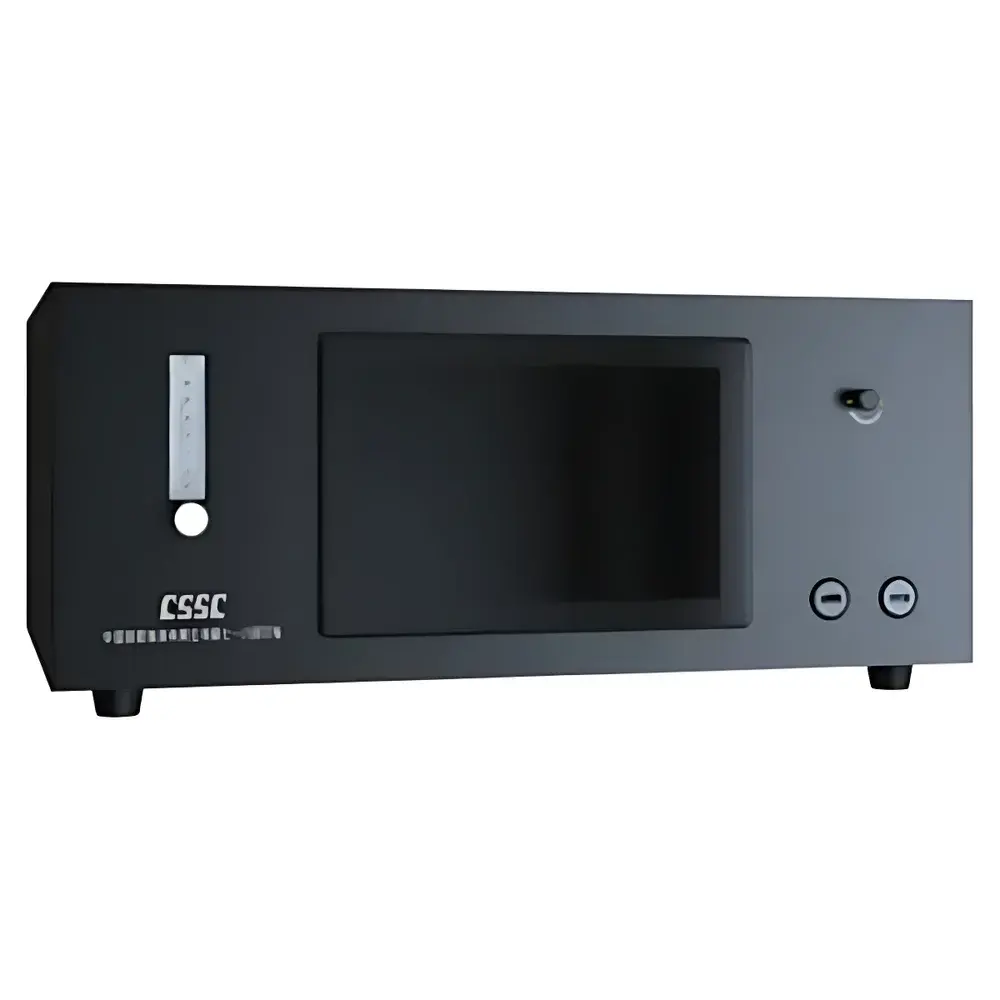
PERIC PR-LR Battery Thermal Runaway Laser Raman Analyzer
| Brand | PERIC |
|---|---|
| Origin | Hebei, China |
| Manufacturer Type | Manufacturer |
| Region | Domestic (China) |
| Model | PR-LR |
| Pricing | Upon Request |
| Gas Detection Range | N₂, O₂, H₂, CH₄, CO, CO₂, C₂H₆, C₂H₄, C₂H₂, C₃H₈, C₃H₆, C₄H₁₀, NO, NO₂, SO₂, H₂S |
| Accuracy | ≤±1% FS for components >1% full scale |
| Resolution | ≤0.01% (for >1% FS) |
| Analysis Time | 10–30 s (adjustable) |
| Laser Wavelength | 532 nm |
| Laser Linewidth | ≤0.1 nm |
| Spectral Range | 0–4200 cm⁻¹ |
| Spectral Resolution | 5 cm⁻¹ |
| Power Supply | 220 VAC, 50 Hz |
| Max. Power Consumption | ≤300 W |
| Operating Temperature | 10–35 °C |
Overview
The PERIC PR-LR Battery Thermal Runaway Laser Raman Analyzer is a purpose-built, benchtop Raman spectroscopic system engineered for real-time, non-destructive, multi-component gas analysis during lithium-ion battery thermal runaway events. It operates on the principle of inelastic light scattering—where monochromatic 532 nm laser excitation induces vibrational mode-specific Raman shifts in gaseous molecules—enabling unambiguous identification and quantification without chemical derivatization or separation. Unlike conventional electrochemical or infrared-based gas sensors, this analyzer leverages high-fidelity Raman spectral fingerprints across a broad 0–4200 cm⁻¹ range with 5 cm⁻¹ resolution to resolve overlapping peaks from complex gas mixtures generated during battery failure. The system integrates directly with explosion-proof test chambers and controlled heating stages, allowing synchronized acquisition of gas evolution kinetics throughout initiation, propagation, and venting phases of thermal runaway—supporting root-cause failure analysis, safety protocol validation, and cell chemistry benchmarking under standardized abuse conditions.
Key Features
- Simultaneous detection and quantification of up to 16 critical off-gas species—including H₂, CO, CO₂, CH₄, C₂H₄, C₂H₂, C₃H₆, NO, NO₂, SO₂, and H₂S—without cross-interference or calibration drift.
- Optimized optical path design with narrow-linewidth (≤0.1 nm) 532 nm solid-state laser source and thermally stabilized spectrometer, ensuring long-term signal reproducibility and minimal fluorescence background.
- Integrated gas conditioning module featuring particulate filtration, mass flow control (MFC), and pressure regulation to deliver stable, representative sample streams to the measurement cell.
- Adjustable spectral acquisition time (10–30 s) enabling trade-off between temporal resolution and signal-to-noise ratio—critical for capturing transient gas release profiles during rapid exothermic events.
- Ruggedized industrial enclosure rated for continuous operation in laboratory environments (10–35 °C), with EMI-shielded electronics and fail-safe interlocks compatible with battery abuse test infrastructure.
Sample Compatibility & Compliance
The PR-LR analyzer interfaces seamlessly with standard battery safety test platforms, including UL 1642/UL 2580-compliant thermal abuse chambers and ISO 12405-4-defined cycling enclosures. Its sampling interface supports direct coupling to sealed gas collection manifolds or heated transfer lines (up to 150 °C), minimizing condensation and adsorption losses for polar or reactive species (e.g., NO₂, SO₂, H₂S). All gas-handling wetted materials comply with ASTM D6299 guidelines for inertness and low outgassing. While the instrument itself does not carry CE or UKCA marking, its hardware architecture and firmware design support integration into GLP/GMP-regulated workflows, including audit-ready metadata logging and user-access controls aligned with FDA 21 CFR Part 11 principles.
Software & Data Management
The proprietary RamanGas™ software suite provides real-time spectral acquisition, multivariate curve fitting (using constrained least-squares algorithms), and dynamic concentration tracking with automated baseline correction and cosmic-ray rejection. Each measurement session exports timestamped .csv and .spc files containing raw spectra, fitted peak areas, calculated concentrations, and system diagnostic logs. Batch processing tools enable retrospective analysis across multiple thermal runaway replicates, supporting statistical comparison of gas evolution onset temperatures, peak rates, and cumulative yields. Data export formats are compatible with MATLAB, Python (via SciPy/Pandas), and commercial LIMS platforms. Optional API access allows integration with battery cyclers (e.g., Arbin, BioLogic) for closed-loop trigger-based acquisition synchronized to voltage/temperature thresholds.
Applications
- Quantitative profiling of gas generation pathways during thermal runaway in NMC, LFP, LCO, and solid-state battery cells.
- Evaluation of electrolyte additive efficacy by correlating suppressed H₂ or CO evolution with improved thermal stability.
- In situ monitoring of gaseous byproducts during controlled overcharge, overdischarge, or external short-circuit tests.
- Validation of vent filter performance and gas scrubber efficiency in battery module-level safety systems.
- Supporting development of physics-informed thermal runaway models by providing experimentally derived species-specific kinetic data.
FAQ
Does the PR-LR require calibration gases for routine operation?
No—Raman spectroscopy is an absolute intensity-based technique; quantitative analysis relies on pre-characterized molecular cross-sections and internal reference standards (e.g., N₂ or CO₂), eliminating the need for daily span gas calibration.
Can it detect trace fluorinated compounds (e.g., HF, PF₅) relevant to LiPF₆ decomposition?
HF exhibits weak Raman activity and is not reliably resolved at ambient pressure using 532 nm excitation; detection of PF₅ and other fluorinated species is limited by low scattering cross-section and spectral overlap—complementary FTIR or SIFT-MS is recommended for those analytes.
Is the system compatible with vacuum or pressurized sampling environments?
Yes—the gas inlet accepts pressures from 50 kPa to 300 kPa (absolute); optional vacuum-compatible versions with differential pumping stages are available upon request.
What spectral libraries are included with the instrument?
The factory-installed library contains high-resolution reference spectra for all 16 target gases, acquired under identical optical and pressure conditions; users may add custom spectra validated per ASTM E1840 protocols.
How is laser safety managed during operation?
The 532 nm laser is fully enclosed within an interlocked optical housing meeting Class 1 IEC 60825-1 requirements; no alignment or user-accessible optics are present during normal operation.
Related Products




