
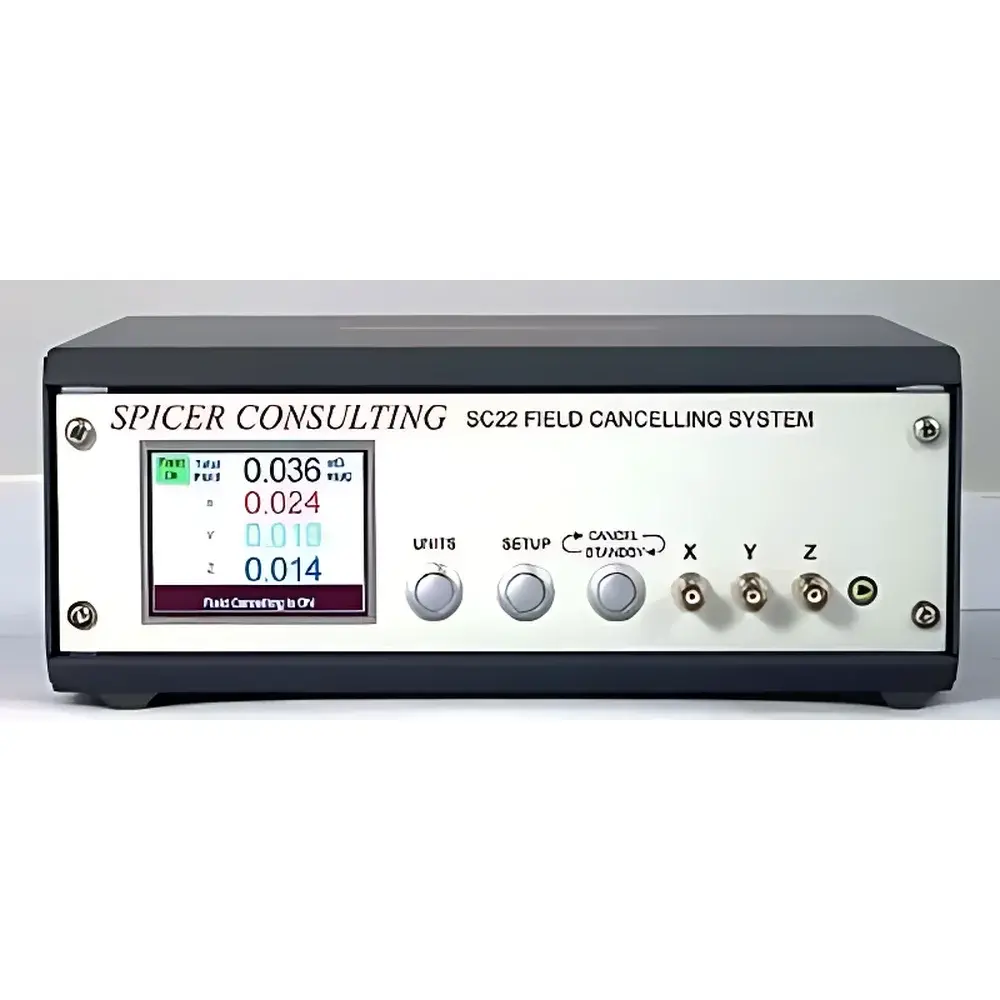
SC22 Active Magnetic Field Cancellation System (0.5 Hz – 5 kHz)
| Origin | UK |
|---|---|
| Manufacturer Type | Authorized Distributor |
| Origin Category | Imported |
| Model | SC22 |
| Frequency Range | 0.5 Hz – 5 kHz |
| Maximum Compensatable AC Field | ±30 mG (±3.0 µT) peak-to-peak |
| Field Step Response Time | <100 µs |
| Sensor Sensitivity | <1 nT/√Hz (typ.) |
| Axis Configuration | Full 3-axis (X, Y, Z) vector compensation |
| Interface | USB 2.0 for real-time monitoring and configuration |
| Dual-Sensor Support | Yes |
| Power Supply | 100–240 VAC, 50/60 Hz |
| Compliance | CE, RoHS, IEC 61326-1 (EMC for laboratory equipment) |
Overview
The SC22 Active Magnetic Field Cancellation System is an engineered solution for ultra-stable magnetic environments required by high-resolution electron-optical instruments—including transmission electron microscopes (TEM), scanning electron microscopes (SEM), electron beam lithography (EBL) systems, and atomic resolution scanning probe platforms. Operating on the principle of real-time feedback-driven active cancellation, the SC22 continuously measures ambient AC magnetic field components in three orthogonal axes using high-bandwidth, low-noise fluxgate magnetometers. The system’s digital controller computes instantaneous counter-field waveforms and drives orthogonal Helmholtz-type compensation coils to generate equal-magnitude, phase-inverted magnetic fields—thereby nullifying dynamic interference across its specified bandwidth (0.5 Hz to 5 kHz). This closed-loop architecture ensures sub-microsecond temporal fidelity and enables sustained spatial field uniformity within critical instrument chambers, directly restoring electron beam stability, imaging contrast, and positional accuracy compromised by environmental AC field perturbations.
Key Features
- Real-time, closed-loop 3-axis AC magnetic field cancellation with <100 µs step response time
- Compensation bandwidth spanning 0.5 Hz to 5 kHz—fully covering power-line harmonics (50/60 Hz), switching power supply noise (kHz-range), and low-frequency geomagnetic fluctuations
- Peak-to-peak compensation capability up to ±30 mG (±3.0 µT) per axis, scalable via coil configuration
- Dual-sensor input support for differential measurement—essential for TEM column isolation or high-dynamic-range environments with localized field transients
- Integrated high-sensitivity fluxgate sensors with intrinsic noise floor <1 nT/√Hz (typ.), enabling detection of sub-nanotesla field variations
- Intuitive web-based and USB-connected GUI for system calibration, real-time field visualization, logging, and adaptive gain tuning
- Rugged, modular mechanical design compatible with standard TEM/SEM facility layouts; coil sets mount externally without chamber modification
Sample Compatibility & Compliance
The SC22 is designed for integration into controlled laboratory environments housing sensitive electron-beam instrumentation. It imposes no physical contact with the sample or specimen chamber and introduces no electromagnetic emissions that interfere with detector electronics or signal acquisition hardware. All electronic modules comply with IEC 61326-1 for EMC immunity and emissions in laboratory-use measurement equipment. The system supports GLP-aligned operational documentation: full audit trails of compensation parameters, sensor calibration timestamps, and real-time field logs are exportable in CSV format. While not a radiation-emitting device, it falls under the regulatory scope of electromagnetic compatibility directives (2014/30/EU) and conforms to RoHS 2011/65/EU material restrictions. No ionizing radiation is generated or measured; its function is strictly passive field mitigation—not radiation detection.
Software & Data Management
The SC22 is managed via a cross-platform software suite accessible through USB 2.0 or local Ethernet. The interface provides live vector-field magnitude and spectral decomposition (FFT) displays for each axis, enabling rapid diagnosis of dominant interference sources (e.g., HVAC transformers, elevators, or nearby RF equipment). Users may define custom frequency-weighted compensation profiles, schedule automatic daily calibration routines, and set threshold-triggered alerts for field excursions exceeding user-defined limits. All operational data—including raw sensor outputs, applied compensation currents, and system health metrics—are timestamped and stored locally with optional networked backup. Audit-ready logs satisfy requirements for ISO/IEC 17025-accredited laboratories and FDA 21 CFR Part 11-compliant environments when paired with validated user access controls and electronic signature modules (available as optional add-on).
Applications
- Stabilization of TEM/STEM columns against urban AC magnetic noise, enabling atomic-resolution imaging at 0.05 nm and below
- Mitigation of 50/60 Hz and harmonic interference in electron beam writers used for sub-10 nm photomask fabrication
- Reduction of image drift and focus instability in cryo-EM workflows operating under low-dose conditions
- Supporting ultra-low-field NMR pre-polarization setups where stray fields degrade spin coherence times
- Enabling quantitative electron holography by suppressing phase-wrapping artifacts induced by field gradients
- Facility-wide deployment in nanofabrication cleanrooms where multiple e-beam tools share common infrastructure
FAQ
Does the SC22 measure DC or static magnetic fields?
No. The SC22 is optimized exclusively for AC magnetic field cancellation between 0.5 Hz and 5 kHz. Static (DC) or slowly varying (<0.1 Hz) fields require separate passive shielding (e.g., mu-metal enclosures) or DC-active systems.
Can the SC22 be integrated with existing facility power conditioning systems?
Yes. It operates independently of power quality infrastructure and complements UPS-backed or filtered AC supplies. Its low-power coil drivers draw <15 W typical and do not interact with upstream voltage regulation.
Is remote monitoring supported over LAN or industrial protocols?
Standard USB and TCP/IP (via optional Ethernet adapter) are supported. Modbus TCP and OPC UA integration are available under custom engineering services for centralized facility monitoring platforms.
What maintenance or recalibration intervals are recommended?
Annual verification using traceable field standards (e.g., NIST-traceable coil calibrators) is recommended. Sensor drift is monitored autonomously; system self-tests run at startup and report deviations beyond ±2% full-scale.
Related Products







