
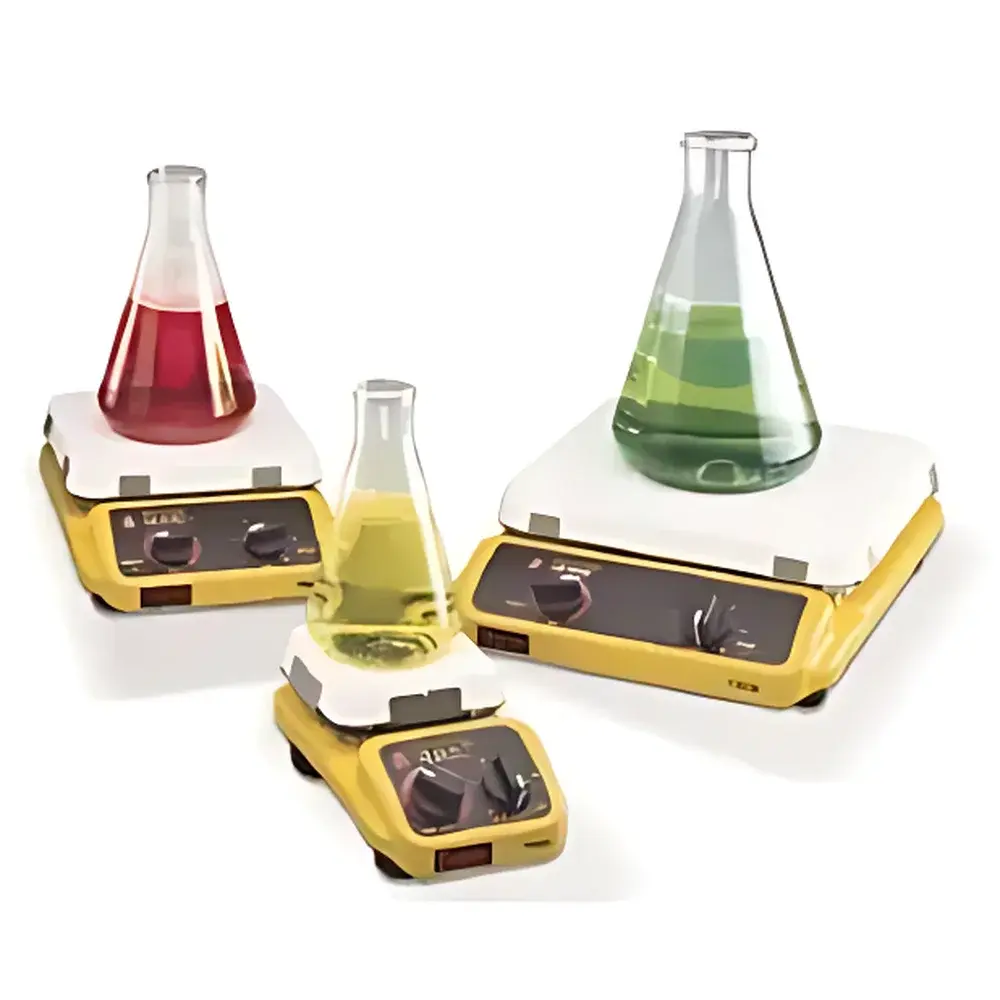
Thermo Scientific Cimarec+ Series Hotplate Stirrers
| Brand | Thermo Fisher |
|---|---|
| Origin | Shanghai, China |
| Manufacturer | Thermo Fisher Scientific |
| Product Type | Magnetic Hotplate Stirrer |
| Model | Cimarec+ |
| Stirring Capacity | 1 L / 4 L / 6 L |
| Speed Range | 50–1500 rpm |
| Temperature Range | 30–300°C / 400°C / 540°C |
| Heating Surface Options | Ceramic or Aluminum |
| Display | LED with Independent Temperature & Speed Readouts |
| Safety Features | HOT TOP Visual Alert (activated >50°C), Over-Temperature Protection, Raised Front Panel Design, Optional PT100 Temperature Probe & Splash Guard |
Overview
The Thermo Scientific Cimarec+ Series Hotplate Stirrers integrate precise magnetic stirring with robust, programmable heating in a single compact platform engineered for routine and demanding laboratory applications. These instruments operate on the principle of rotating magnetic fields generated beneath a thermally conductive surface to drive PTFE- or glass-coated stir bars immersed in liquid samples. The system couples electromagnetic torque transmission with resistive heating elements—either embedded in a high-purity ceramic plate (for chemical inertness and thermal stability) or an anodized aluminum plate (for rapid thermal response)—to deliver simultaneous temperature control and mechanical mixing. Designed for use in chemistry, pharmaceutical development, materials synthesis, and quality control laboratories, the Cimarec+ series supports reproducible reaction kinetics, dissolution testing, buffer preparation, and sample homogenization under controlled thermal conditions. Its modular architecture accommodates variable vessel geometries and volumes, making it suitable for both benchtop-scale experiments and process validation workflows compliant with GLP and GMP requirements.
Key Features
- StirTrac™ intelligent stirring algorithm ensures consistent low-speed torque delivery (down to 50 rpm) without stalling, even with high-viscosity or dense suspensions.
- HOT TOP visual alert system illuminates when surface temperature exceeds 50°C—providing immediate tactile and optical feedback to prevent accidental contact burns.
- Independent dual-parameter control: real-time adjustment of stirring speed (50–1500 rpm) and surface temperature (30–300°C standard; optional 400°C or 540°C variants) with 1°C resolution.
- Raised front panel design physically isolates controls from spill risk, enhancing long-term operational reliability in wet-lab environments.
- LED display provides simultaneous, high-contrast readouts of setpoint and actual values for both temperature and rotational speed.
- Over-temperature protection circuitry automatically deactivates heating if internal sensor thresholds are exceeded—meeting IEC 61010-1 safety standards for laboratory equipment.
- Selectable heating surfaces: chemically resistant ceramic (ideal for aggressive solvents and alkaline media) or fast-response aluminum (optimized for rapid ramp-and-hold protocols).
Sample Compatibility & Compliance
The Cimarec+ accommodates vessels ranging from small test tubes (with mini stir bars) up to 6 L round-bottom flasks or beakers, supporting standard borosilicate glass, stainless steel, and PTFE-lined containers. Its magnetic coupling efficiency remains stable across common labware diameters (Ø60–180 mm), and optional extended-length stir bars enable effective mixing in tall-form vessels. All models comply with CE marking requirements and conform to ISO/IEC 17025-relevant environmental monitoring practices. When used with traceable PT100 probes (sold separately), the system supports temperature validation per ASTM E2251 and USP , enabling documented thermal uniformity mapping for audit readiness.
Software & Data Management
While the Cimarec+ operates as a standalone analog-digital hybrid instrument, its front-panel interface is designed for seamless integration into validated workflows. Optional RS232 or USB connectivity (via accessory module) enables remote parameter logging and basic script-based control through third-party LabVIEW or Python-driven automation frameworks. All temperature and speed settings are retained after power cycling, and the device maintains non-volatile memory for up to 10 user-defined protocols. For regulated environments, the unit supports manual audit trail documentation; full 21 CFR Part 11 compliance requires external data acquisition software and electronic signature infrastructure.
Applications
- Controlled heating and agitation during organic synthesis, polymerization, and catalyst activation studies.
- Dissolution testing of solid dosage forms under USP Apparatus II conditions.
- Buffer and reagent preparation requiring precise thermal equilibration and homogeneity.
- Cell culture media warming and pH adjustment prior to sterile filtration.
- Environmental sample digestion (e.g., EPA Method 3050B) using closed-vessel acid heating protocols.
- Calibration of viscosity standards at defined shear rates and temperatures.
FAQ
What is the maximum recommended vessel diameter for optimal magnetic coupling?
For reliable stirring performance across the full speed range, vessels with diameters between 60 mm and 150 mm are recommended. Larger diameters (>150 mm) may require high-torque stir bars and reduced speed settings.
Can the Cimarec+ be used in fume hoods without performance degradation?
Yes—the unit’s sealed electronics and low airflow-dependent thermal design ensure stable operation in ventilated enclosures, though ambient temperature fluctuations may affect surface temperature accuracy by ±2°C.
Is the aluminum heating plate compatible with hydrofluoric acid exposure?
No—aluminum is not resistant to HF. Use only the ceramic plate variant for applications involving fluorinated acids or strong alkalis.
Does the device support external temperature feedback control?
Yes—when paired with an optional PT100 probe connected via the rear port, the unit can regulate surface temperature based on solution temperature rather than plate temperature.
How often should the magnetic drive mechanism be serviced?
Under normal use, no scheduled maintenance is required; however, annual inspection of the stir bar alignment and bearing integrity is recommended for continuous 24/7 operation environments.



