
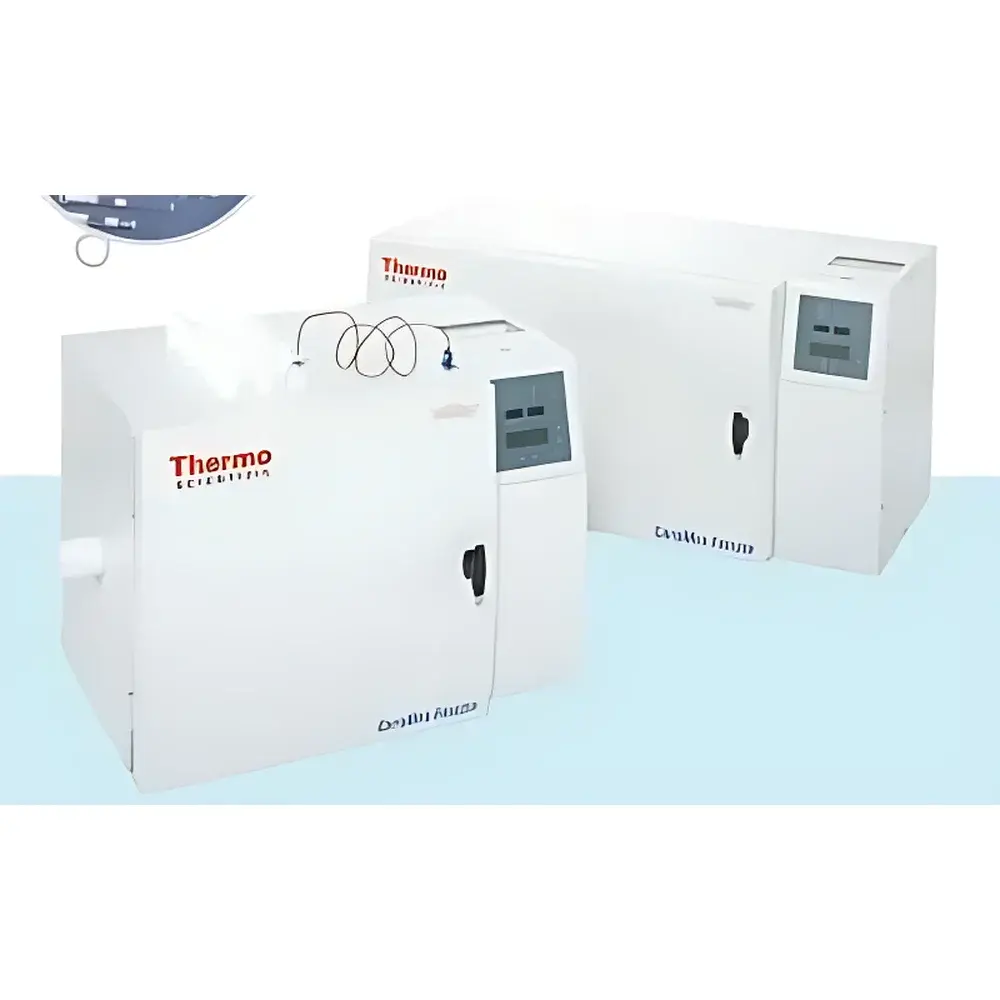
Thermo Fisher CryoMed Controlled-Rate Freezer Series 7451/7453/7455/7457/7459
| Brand | Thermo Fisher |
|---|---|
| Origin | USA |
| Manufacturer | Thermo Fisher Scientific |
| Product Type | Imported Controlled-Rate Freezer |
| Model Numbers | 7451, 7453, 7455, 7457, 7459 |
| Certifications | UL, CSA, CE Mark |
| Cooling Rate | 0.1–99.9 °C/min |
| Heating Rate | 0.1–10.0 °C/min |
| Temperature Uniformity | < ±2.0 °C |
| Controller | Microprocessor-based |
| Control Mode | Sample- or Chamber-sensing |
| Display | 4×20 LCD |
| Preset Programs | 6 |
| User-Programmable Protocols | 10 |
| Insulation | In-situ foamed polyurethane |
| Valve System | Dual solenoid valves |
| Cooling Medium | Liquid nitrogen (LN₂) |
| Chamber Volumes | 17.0 L (0.6 cu ft), 34.0 L (1.2 cu ft), 48.1 L (1.7 cu ft) |
| IVF-Specific Models | FDA-cleared for human assisted reproductive technology applications |
Overview
The Thermo Fisher CryoMed Controlled-Rate Freezer Series (Models 7451, 7453, 7455, 7457, and 7459) is a family of microprocessor-controlled, liquid nitrogen–based cryopreservation systems engineered for precise, reproducible, and GxP-compliant cell and tissue freezing. Based on the fundamental principle of controlled-rate freezing—where biological samples are cooled at defined, programmable rates to minimize intracellular ice formation and osmotic shock—the CryoMed platform delivers thermodynamic stability across diverse biospecimen classes. These instruments are validated for use in clinical biobanking, hematopoietic stem cell processing, cord blood banking, IVF laboratories, and preclinical research settings where regulatory traceability and thermal fidelity are non-negotiable. Each model integrates a patented liquid nitrogen injection ring (U.S. Patent No. 6,044,648), dual-solenoid valve architecture, and in-situ foamed polyurethane insulation to ensure uniform thermal gradients, low acoustic emissions (<55 dBA), and long-term mechanical reliability.
Key Features
- Patented concentric liquid nitrogen injection ring enabling uniform vapor-phase cooling and eliminating localized thermal spikes
- Dual independent solenoid valves for high-resolution control of LN₂ flow—supporting both rapid quenching and ultra-slow ramping (0.1–99.9 °C/min)
- In-situ foamed polyurethane insulation (≥150 mm thickness) minimizing heat leak and maximizing energy efficiency during extended hold cycles
- Microprocessor-based controller with real-time sample- or chamber-temperature feedback loop; selectable sensor input mode ensures protocol alignment with ISO 20387:2018 biobanking requirements
- 4×20-character backlit LCD interface with continuous temperature logging, password-protected parameter editing, and audit-trail-capable event logging
- Onboard programming capacity: six factory-default protocols (e.g., standard lymphocyte freeze, bone marrow slow-cool, IVF oocyte vitrification prep) plus ten fully customizable user-defined programs
- Optional Windows PC connectivity via RS-232 or USB-to-serial interface—enabling remote operation, automated report generation (PDF/CSV), and integration into LIMS or ELN environments
Sample Compatibility & Compliance
The CryoMed 745x series accommodates vials (2 mL, 5 mL, 25 mL), cryobags (up to 250 mL), multi-well plates (96- and 384-well), and custom fixtures for tissue strips or ovarian cortex specimens. All IVF-dedicated variants (7453-IVF, 7457-IVF) are cleared under FDA 510(k) K082900 for use in human assisted reproductive technology—including embryo, oocyte, and sperm cryopreservation per ASRM and ESHRE guidelines. The system complies with IEC 61010-1 (safety), ISO 13485:2016 (medical device QMS), and supports 21 CFR Part 11 compliance when operated with validated software configurations. Temperature uniformity (<±2.0 °C across full chamber volume) and rate accuracy (±0.2 °C/min over full range) are verified per ASTM F1980-22 Annex A2 for cryopreservation equipment qualification.
Software & Data Management
Thermo Fisher’s CryoMed Control Software (v5.2+) provides a validated, Windows-native interface for protocol authoring, execution monitoring, and post-run analysis. Features include time-temperature curve overlay (with delta-T comparison between runs), automatic calibration certificate generation, and export of raw data with timestamps, setpoints, actual temperatures, valve states, and alarm logs. All data files are digitally signed and timestamped to satisfy GLP/GMP audit requirements. The system maintains an immutable electronic log of all user actions—including login/logout events, program edits, and emergency aborts—with configurable retention policies aligned with institutional data governance policies.
Applications
- Clinical-scale cryopreservation of hematopoietic stem cells (HSCs), peripheral blood mononuclear cells (PBMCs), and mesenchymal stromal cells (MSCs)
- Regulatory-grade freezing of cord blood units per AABB and FACT-Net standards
- IVF laboratory workflows including oocyte, zygote, and blastocyst cryopreservation under CAP/CLIA-accredited conditions
- Biobank operations requiring ISO 20387:2018-compliant specimen integrity management
- Preclinical toxicology studies involving serial tissue banking with longitudinal thermal history tracking
- Plant germplasm and animal gamete preservation in agricultural research facilities
FAQ
What validation documentation is provided with the CryoMed 745x series?
Each unit ships with a Factory Acceptance Test (FAT) report, IQ/OQ documentation templates aligned with ISO/IEC 17025, and a Certificate of Conformance to UL/CSA/CE safety standards.
Can the CryoMed be integrated into a centralized laboratory automation network?
Yes—via Modbus RTU over RS-485 or optional Ethernet/IP module, enabling status polling, alarm forwarding, and protocol triggering from central SCADA or MES platforms.
Is LN₂ consumption monitored and reported?
The system logs cumulative LN₂ usage per cycle (in liters) and calculates average consumption per freeze run; this metric is exportable for cost accounting and sustainability reporting.
How does the dual-valve design improve process robustness?
Independent coarse and fine LN₂ valves enable stable low-rate cooling (e.g., 0.1 °C/min for sensitive primary neurons) while maintaining rapid response during mid-cycle rate transitions—reducing overshoot and improving inter-run repeatability.
Are firmware updates provided, and how are they deployed?
Thermo Fisher releases validated firmware patches quarterly; updates are applied via USB drive using cryptographically signed update packages to preserve system integrity and regulatory compliance.



