
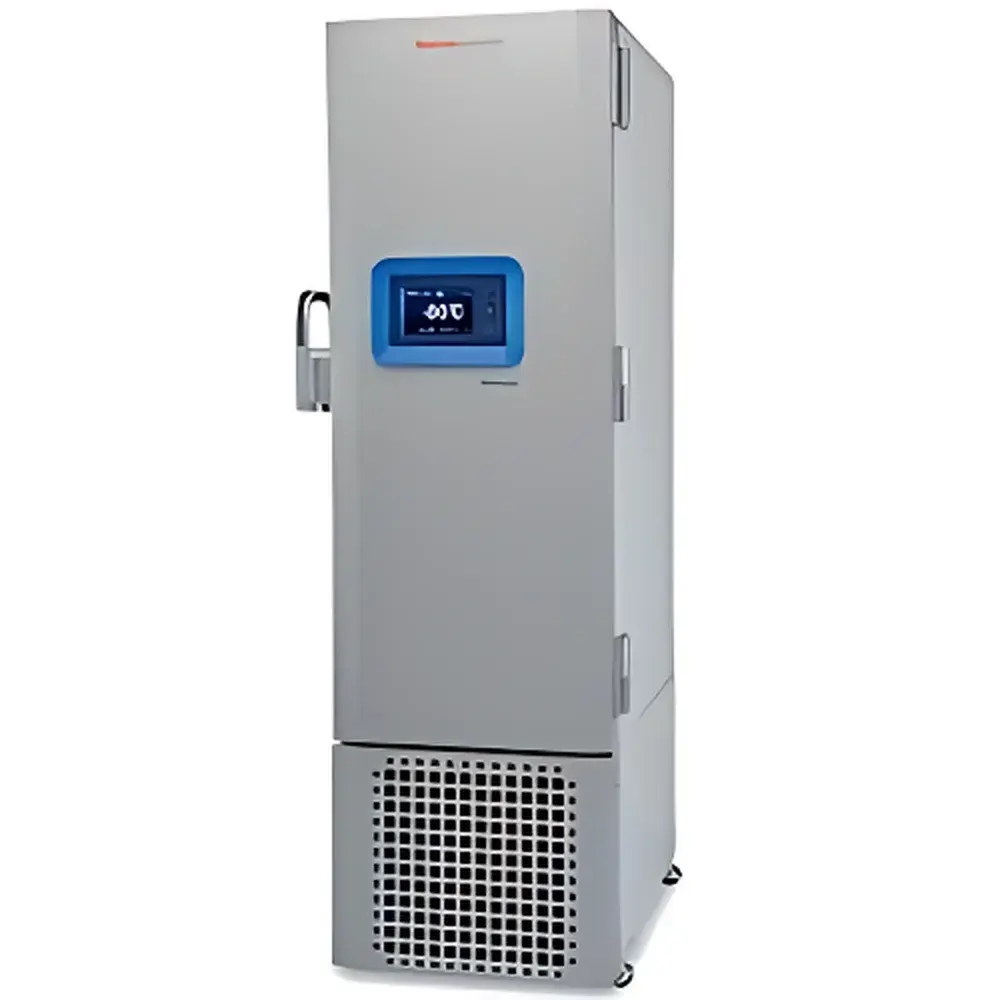
Thermo Scientific TLE Series Ultra-Low Temperature Freezers
| Brand | Thermo Fisher Scientific |
|---|---|
| Origin | USA |
| Manufacturer | Thermo Fisher Scientific |
| Product Type | Imported |
| Models | TLE1, TLE2, TLE3, TLE4, TLE5, TLE60086V, TLEA, TLED |
| Voltage/Frequency | 230 V / 50 Hz |
| Current Rating / Circuit Breaker | 5.3–6.1 A / 16.0 A |
| Internal Volume | 422–816 L |
| External Dimensions (H×W×D) | 198.1 × (58.4–111.3) × 95.5 cm |
| Net Weight | 257–322 kg |
| Temperature Range | –50 °C to –86 °C |
| Recovery Time (to –75 °C after door opening) | ≤16 min |
| Holdover Time (to < –50 °C, no load, power off) | ≥282 min |
| Energy Consumption | 9.1 kWh/day |
| Refrigerants | R170 (ethane) and R290 (propane) |
| Insulation | Water-blown polyurethane foam |
| Noise Level | ≤50 dB(A) |
| Shelf Load Capacity | 57–110 kg |
| 2-inch Box Capacity | 300–600 boxes |
| Compliance | SNAP-approved, EU F-Gas Regulation compliant, ISO 13485-manufactured |
Overview
The Thermo Scientific™ TLE Series Ultra-Low Temperature (ULT) Freezers are engineered for mission-critical biosample preservation in academic research laboratories, biobanks, clinical diagnostics facilities, and pharmaceutical development environments. Operating across a stable temperature range of –50 °C to –86 °C, these freezers employ dual-stage cascade refrigeration with natural hydrocarbon refrigerants (R170 and R290) to achieve high thermal stability and rapid temperature recovery—critical for minimizing thermal stress on sensitive biological materials such as primary cells, stem cell lines, plasma, DNA/RNA extracts, and cryopreserved tissues. Unlike conventional ULT systems relying on high-global-warming-potential (GWP) fluorocarbons, the TLE platform complies with U.S. EPA SNAP program requirements and the EU F-Gas Regulation (EU No. 517/2014), reflecting a design philosophy that integrates sample integrity, regulatory readiness, and environmental stewardship without compromise.
Key Features
- Hydrocarbon-based refrigeration system: Uses R170 (ethane) and R290 (propane) — zero ozone depletion potential (ODP), negligible GWP (<10), and non-toxic under normal operating conditions.
- Energy-efficient architecture: Consumes only 9.1 kWh per day (TLE30086V model), representing ~25% lower energy demand versus legacy ULT freezers using R404A or R507.
- Rapid thermal recovery: Restores internal setpoint of –75 °C within ≤16 minutes following a standard 30-second door opening event — validated per ICH Q5C and ISO 20417 guidance for cold chain continuity.
- Extended holdover performance: Maintains internal temperature below –50 °C for ≥282 minutes during unplanned power interruption (no-load condition), supporting GLP-compliant emergency response protocols.
- Uniform temperature distribution: Achieves ±2.5 °C uniformity across all shelf positions (per ASTM F745-22 Annex A2 mapping protocol), ensuring consistent cryostability for heterogeneous sample inventories.
- Low acoustic signature: Operates at ≤50 dB(A) — comparable to domestic refrigerator noise levels — suitable for open-plan laboratory environments and proximity to sensitive instrumentation.
- Water-blown polyurethane insulation: Eliminates halogenated blowing agents; supports VOC-free manufacturing and aligns with LEED-certified lab facility requirements.
Sample Compatibility & Compliance
The TLE Series accommodates standardized cryogenic storage configurations including 2-inch (50.8 mm) format冻存盒 (cryoboxes), rack-mounted vials, and cassette-based formats used in large-scale biorepositories. Internal chamber geometry is optimized for airflow uniformity and minimizes thermal stratification, enabling reliable long-term storage of primary human specimens under ISO 20387:2018 (Biobanking) and CAP-accredited workflows. All models are manufactured under ISO 13485:2016 quality management systems and support audit-ready documentation packages required for FDA 21 CFR Part 11 compliance when integrated with Thermo Fisher’s SampleManager LIMS or third-party ELN platforms. The use of SNAP- and F-Gas-compliant refrigerants ensures seamless import eligibility into North America, the European Union, and APAC markets with evolving environmental legislation.
Software & Data Management
Each TLE freezer includes an embedded microprocessor controller with real-time logging of chamber temperature, compressor status, door-open events, alarm history, and ambient conditions. Data is stored locally for ≥30 days (circular buffer) and exportable via USB interface in CSV format for integration into institutional data governance frameworks. Optional Ethernet connectivity enables remote monitoring through Thermo Fisher’s Connect Platform — delivering configurable email/SMS alerts, trend visualization, and secure access control aligned with NIST SP 800-53 Rev. 5 security baselines. Audit trails comply with ALCOA+ principles (Attributable, Legible, Contemporaneous, Original, Accurate, Complete, Consistent, Enduring, Available), supporting inspection readiness for FDA, EMA, and MHRA audits.
Applications
- Long-term archiving of clinical trial biospecimens under ICH E6(R3) Good Clinical Practice guidelines
- Cryopreservation of induced pluripotent stem cells (iPSCs) and organoid cultures requiring strict thermal fidelity
- Storage of reference standards and calibration materials in QC/QA laboratories accredited to ISO/IEC 17025
- Biobank infrastructure supporting NIH Common Fund initiatives and GA4GH-compliant data-sharing consortia
- Support of mRNA vaccine development pipelines where ultra-low temperature stability directly impacts antigen integrity
FAQ
What refrigerants are used in the TLE Series, and why are they environmentally preferable?
The TLE Series uses R170 (ethane) and R290 (propane) — naturally occurring hydrocarbons with zero ODP and GWP values of 4 and 3, respectively. These replace high-GWP synthetic refrigerants (e.g., R404A, GWP = 3922), aligning with global phase-down mandates.
How is temperature uniformity validated across the chamber?
Temperature mapping is performed per ASTM F745-22 using ≥15 calibrated thermistors placed on each shelf and in corner zones. Uniformity is reported as maximum deviation from setpoint across all measurement points.
Does the TLE Series support 21 CFR Part 11 compliance?
Yes — when paired with Thermo Fisher’s Connect Platform and configured with electronic signatures, role-based access, and immutable audit trails, the system meets core technical requirements for electronic records and signatures.
What is the expected service life and maintenance interval?
Designed for >15 years of continuous operation, with recommended preventive maintenance every 12 months by Thermo Fisher Field Service Engineers trained to ISO/IEC 17020 standards.
Can the TLE freezer be installed in rooms with limited HVAC capacity?
Yes — due to low heat rejection (~1.2 kW peak) and absence of condenser water loops, the TLE Series reduces HVAC cooling load by up to 35% compared to R404A-based ULT systems, facilitating deployment in retrofit lab spaces.
Related Products




