
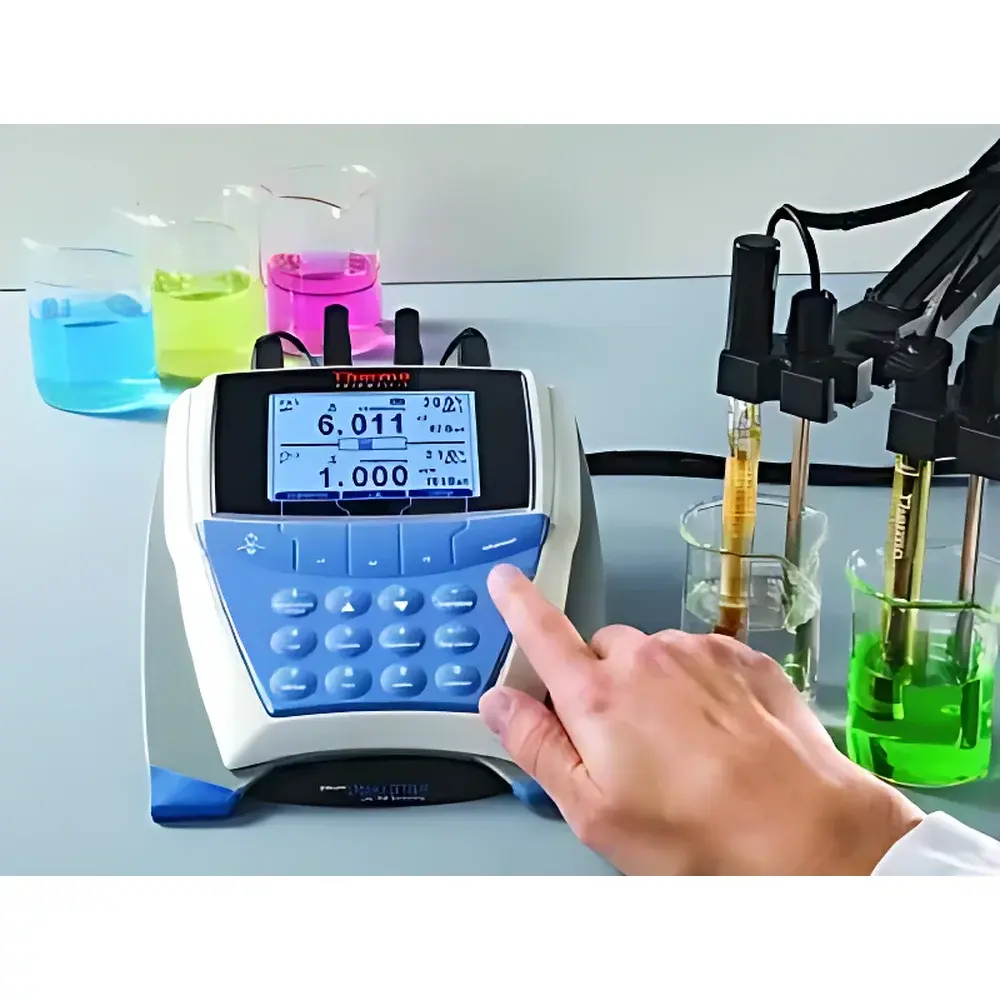
Thermo Fisher Orion Dual Star D10P-35 Bromide Ion Analyzer
| Brand | Thermo Fisher |
|---|---|
| Origin | USA |
| Manufacturer | Thermo Fisher Scientific |
| Product Type | Imported Instrument |
| Model | D10P-35 |
| Price | Upon Request |
| Electrode | 9635BNWP Bromide Composite Electrode |
| Bromide Range | 0.2–79,900 ppm |
| pH Range | 0–14 |
| Temperature Range | 0–80 °C |
| Repeatability | ±2% |
| Electrode Dimensions | 110 mm length, 13 mm body diameter, 16 mm cap diameter, 1 m cable |
| Meter Resolution | 1–3 significant digits (ion mode) |
| Accuracy | ±0.001 pH |
| Calibration Points | 2–6 (ion), 1–6 (pH) |
| Method Storage | 20 methods |
| Data Storage | 1,000 records with timestamp |
| GLP Compliance | Yes (audit trail, password protection, user-defined methods) |
| Connectivity | Dual RS232, optional USB |
| IP Rating | IP54 |
| Certifications | CE, CSA, UL, TÜV, FCC Class A |
Overview
The Thermo Fisher Orion Dual Star D10P-35 Bromide Ion Analyzer is a dual-channel benchtop ion concentration and pH meter engineered for high-reproducibility potentiometric measurements of bromide (Br⁻) in aqueous environmental, industrial, and regulatory-compliant water quality applications. It operates on the principle of selective potentiometry using an ion-selective electrode (ISE)—specifically the 9635BNWP bromide composite electrode—which generates a Nernstian potential response proportional to the logarithm of bromide activity in solution. Coupled with integrated automatic temperature compensation (ATC) and rigorous GLP-aligned data handling, the system delivers traceable, auditable results suitable for compliance with EPA Method 300.0, ISO 10304-1 (determination of anions by ion chromatography—where ISE serves as a field-screening or verification tool), and ASTM D6508 (standard test method for determination of bromide in water by potentiometric titration or ISE). The analyzer is optimized for routine analysis of drinking water, wastewater effluents, cooling tower water, seawater dilutions, and brominated disinfection byproduct monitoring.
Key Features
- Dual-channel architecture with independent BNC inputs, reference electrode ports, and MiniDIN ATC interfaces—enabling simultaneous measurement of bromide concentration and pH (or ORP) from a single sample aliquot.
- 9635BNWP bromide-selective composite electrode featuring a solid-state polymeric membrane with optimized selectivity over common interferents including chloride (Cl⁻), nitrate (NO₃⁻), and sulfate (SO₄²⁻), validated per IUPAC selectivity coefficient methodology.
- Advanced calibration flexibility: supports 2–6 point bracketing calibrations, single/dual known addition/subtraction methods, and automated blank subtraction—critical for low-level bromide quantification in high-ionic-strength matrices.
- Full GLP functionality including user-accessible audit trails, method-specific password protection, electronic signature support, and timestamped data logging compliant with FDA 21 CFR Part 11 requirements when paired with Orion Star™ Com software.
- Graphical calibration curve display with residual error reporting, real-time slope monitoring (mV/decade), and automatic detection of non-Nernstian behavior during calibration.
- Robust hardware design: IP54-rated enclosure, dual power options (4×AA alkaline or universal AC adapter), and operational stability across 5–45 °C ambient conditions with ≤85% non-condensing humidity.
Sample Compatibility & Compliance
The D10P-35 is validated for direct potentiometric analysis of aqueous samples within pH 0–14 and temperature 0–80 °C. It accommodates turbid, colored, or mildly suspended samples when used with appropriate ionic strength adjustment (e.g., 940011 ISA) and electrode maintenance protocols. Sample types include raw and treated drinking water, surface water, groundwater, wastewater influent/effluent, brackish water, and process streams containing brominated biocides (e.g., DBNPA, bromochlorodimethylhydantoin). All measurements adhere to standard practices outlined in APHA Standard Methods 4500-Br⁻ B and ISO/IEC 17025-accredited laboratories’ internal validation protocols. The instrument’s firmware and data structure support full traceability for ISO/IEC 17025, USP , and EU Annex 11 compliance frameworks.
Software & Data Management
Data acquisition, method configuration, and report generation are supported via Orion Star™ Com PC software (Windows-compatible), which enables bidirectional RS232 communication, secure export to CSV/PDF formats, and integration into LIMS environments. The onboard memory stores up to 1,000 measurement records—including ion concentration (ppm, mg/L, M, %), mV potential, temperature, date/time stamp, operator ID, and calibration metadata. All stored entries are immutable post-acquisition unless explicitly overwritten under administrator privilege. Firmware updates are performed via USB interface using Thermo Fisher’s certified update packages, ensuring continued alignment with evolving regulatory firmware validation expectations.
Applications
- Regulatory monitoring of bromide in source water prior to ozonation/chlorination (to assess potential bromate formation risk).
- Verification of bromide removal efficiency in ion exchange or reverse osmosis treatment systems.
- Quality control of brominated flame retardants (BFRs) in industrial wastewater discharge.
- Process control of bromine-based cooling water biocides in HVAC and power generation facilities.
- Environmental fate studies tracking bromide transport in soil leachate and sediment pore water.
- Educational laboratory instruction in analytical chemistry, environmental engineering, and electroanalytical methods.
FAQ
What is the minimum detectable bromide concentration using the 9635BNWP electrode?
The practical lower limit of quantitation (LLOQ) is approximately 0.2 ppm Br⁻ under optimized conditions (i.e., with ISA addition, proper electrode conditioning, and stable temperature control).
Can the D10P-35 measure bromide in seawater without dilution?
Direct measurement is not recommended due to extreme ionic strength and chloride interference; a 1:100 dilution with deionized water and appropriate ISA correction is required for reliable results.
Is the 9635BNWP electrode compatible with other Orion meters?
Yes—it is fully compatible with all Orion Star™ A-Series, Versa Star™, and Dual Star™ platforms supporting BNC-input ISE modules.
How often should the 9635BNWP electrode be recalibrated?
Calibration frequency follows risk-based assessment per ISO/IEC 17025: typically before each analytical batch, after electrode cleaning or storage, and following any significant matrix change.
Does the system support automatic sample changers?
Yes—the D10P-35 supports integration with Orion Auto-Mate™ or third-party autosamplers via TTL-triggered RS232 handshake protocol for unattended multi-sample analysis.







