
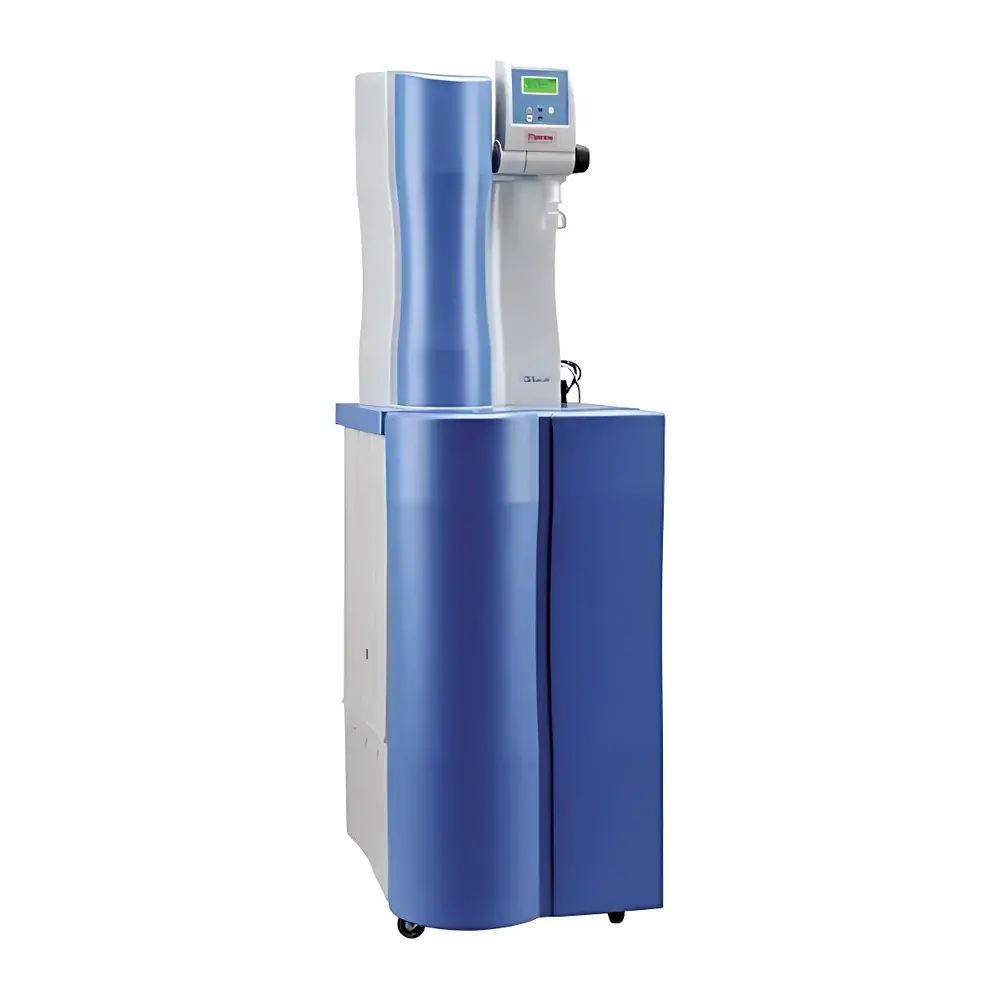
Thermo Fisher LabTower EDI Ultra-Pure Water System
| Brand | Thermo Fisher |
|---|---|
| Origin | Germany |
| Manufacturer | Thermo Fisher Scientific |
| Product Type | Imported Ultra-Pure Water System |
| Model | LabTower EDI |
| Pure Water Grade | ASTM Type I |
| Resistivity | 18.2 MΩ·cm |
| TOC | 1–5 ppb |
| Microbial Content | < 1 CFU/mL |
| Endotoxin | < 0.001 EU/mL |
| Particles (>0.1 µm) | < 1 particle/mL |
| Flow Rate Options | 15 L/h or 30 L/h |
| Integrated Storage Tank | 100 L PE tank with recirculation loop and sterile air filter |
| UV Option | Available |
| CO₂ Absorber | Optional |
| Compliance | ASTM D1193, ISO 3696, USP <645>, GLP-ready, FDA 21 CFR Part 11–compatible data logging |
Overview
The Thermo Fisher LabTower EDI Ultra-Pure Water System is an integrated, dual-grade laboratory water purification platform engineered for precision-critical applications in analytical chemistry, molecular biology, cell culture, and pharmaceutical R&D. It employs a multi-stage purification architecture combining reverse osmosis (RO), electrodeionization (EDI), and final polishing via mixed-bed ion exchange resin—ensuring continuous production of both ASTM Type I ultra-pure water (resistivity ≥18.2 MΩ·cm at 25 °C) and ASTM Type II high-purity water (10–15 MΩ·cm). Unlike conventional single-output systems, the LabTower EDI integrates a 100 L polyethylene storage tank with active recirculation, enabling stable Type II water supply for autoclaves, glassware washers, and feedwater to secondary purification units—while maintaining on-demand Type I water delivery at ≤1.5 L/min with real-time quality verification at the point-of-use.
Key Features
- Two-tier water production: Simultaneous generation of ASTM Type I (≤5 ppb TOC, <1 CFU/mL, <0.001 EU/mL) and Type II (10–15 MΩ·cm) water from a single footprint.
- Compact vertical design (450 × 580 × 1500 mm) with castor-mounted base—optimized for floor-standing deployment without occupying bench space.
- Integrated 100 L PE storage tank featuring conical bottom for complete drainage, sterile 0.2 µm air filter, overflow protection, and optional CO₂ absorber to suppress atmospheric carbon ingress and maintain low TOC stability.
- Intelligent microprocessor control with password-protected interface, real-time parameter monitoring (resistivity, TOC, flow, tank level, UV intensity), and automatic error logging for up to 28 days.
- Compliance-enabling architecture: Built-in temperature-compensated conductivity measurement per USP ; RS232 serial interface with configurable transmission intervals for secure audit-trail data export to LIMS or validated printers; GLP/GMP-ready operational logs support FDA 21 CFR Part 11 compliance when paired with appropriate IT infrastructure.
- Dual flow-rate configurations: LabTower EDI 15 (15 L/h RO output) and LabTower EDI 30 (30 L/h RO output), each supporting scalable demand without sacrificing purity consistency.
Sample Compatibility & Compliance
The LabTower EDI is validated for use with municipal tap water meeting specified inlet criteria: feed conductivity ≤1500 µS/cm, SDI ≤3, pH 4–11, temperature 2–35 °C, and pressure 2–6 bar. Its purified output meets or exceeds requirements for ISO 3696 Grade 1, ASTM D1193 Type I & II, CLSI EP21-A, and USP for conductometric water quality assessment. The system’s RNase (<0.003 ng/mL) and DNase (<0.4 pg/µL) specifications render it suitable for sensitive nucleic acid workflows—including qPCR, NGS library prep, and CRISPR applications—without requiring additional downstream filtration. All wetted materials comply with USP Class VI biocompatibility standards; the 100 L tank and recirculation loop are designed for routine sanitization using validated thermal or chemical protocols.
Software & Data Management
The LabTower EDI controller provides embedded data management capabilities including time-stamped event logging (alarms, maintenance alerts, parameter deviations), user-access-level authentication, and customizable tank fill thresholds. Measurement data—including resistivity, TOC, UV lamp status, and flow rate—is timestamped and exportable via RS232 to external PCs or thermal printers. When integrated into a validated laboratory environment, the system supports electronic signature capture, audit trail review, and periodic backup—fulfilling core elements of FDA 21 CFR Part 11 for electronic records and signatures. Optional IQ/OQ documentation packages (Cat. No. 50133916) are available to accelerate installation qualification and operational qualification under GxP frameworks.
Applications
- HPLC, LC-MS, and ICP-MS mobile phase and blank preparation where trace metal contamination and organic interference must be minimized.
- Cell culture media formulation and buffer preparation requiring endotoxin-free, nuclease-free water.
- Atomic absorption spectroscopy (AAS) and graphite furnace analysis demanding ultra-low background conductivity and particulate counts.
- Pharmaceutical QC testing per USP monographs, including water-for-injection (WFI) feedstock preparation and dissolution media.
- Calibration of clinical analyzers and reference material dilution in accredited medical laboratories.
FAQ
What inlet water quality is required for optimal LabTower EDI performance?
Municipal tap water with conductivity ≤1500 µS/cm, silt density index (SDI) ≤3, pH 4–11, temperature 2–35 °C, and pressure 2–6 bar. Pre-treatment (e.g., softening, 5 µm filtration) is recommended where hardness or particulate load exceeds local utility specifications.
Can the system be validated for GMP environments?
Yes—optional IQ/OQ documentation (Cat. No. 50133916) and configurable data logging support validation under EU Annex 11 and FDA 21 CFR Part 11 when deployed with compliant network infrastructure and procedural controls.
How frequently must consumables be replaced?
RO membranes require replacement every 2–3 years depending on feed water quality; EDI stacks are designed for >5 years of service life; polishing cartridges (0.2 µm final filter, UV lamp, mixed-bed resin) follow usage-based schedules—typically 6–12 months—and are monitored via system alerts.
Is remote monitoring supported?
Native RS232 enables local serial connection to PCs or printers; Ethernet or Wi-Fi integration requires third-party gateway hardware and custom middleware—not provided by Thermo Fisher.
Does the system include built-in TOC monitoring?
TOC is measured offline using optional external analyzers; the LabTower EDI reports resistivity, temperature, flow, and UV intensity in real time—but does not incorporate an integrated online TOC sensor.



