
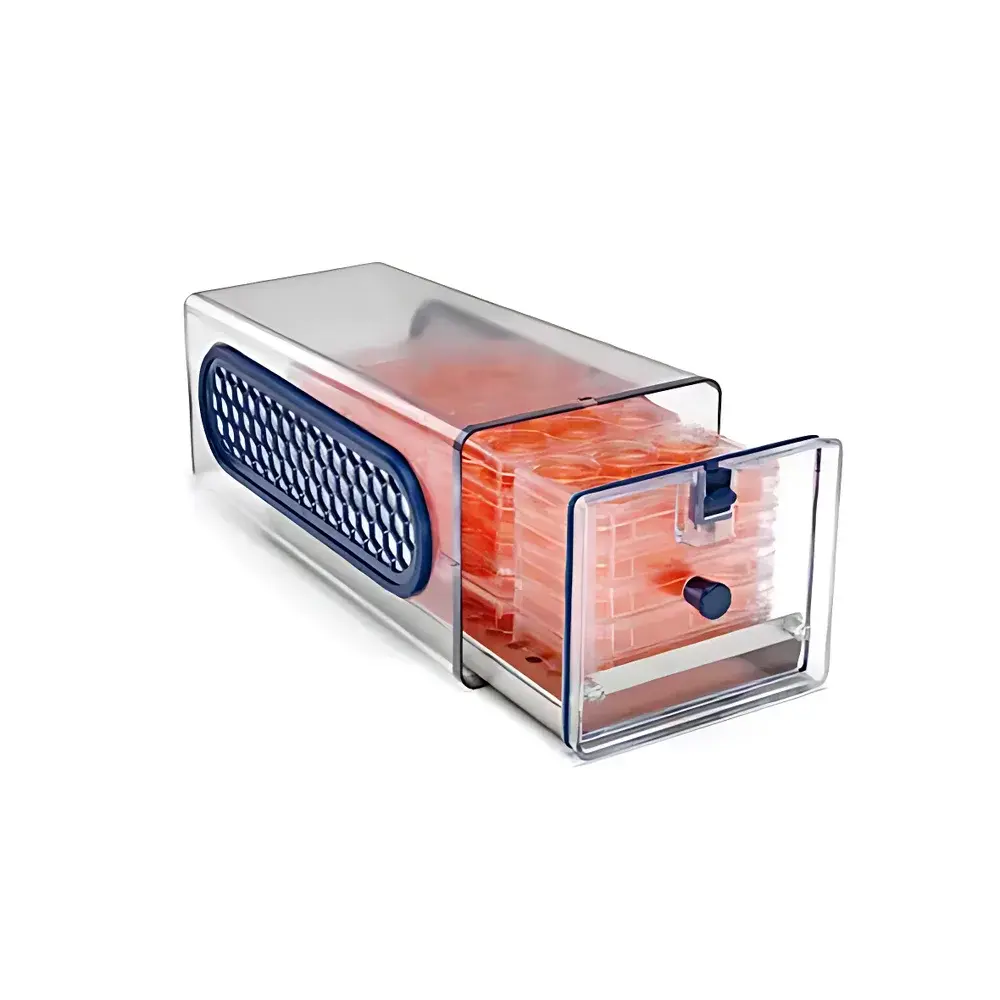
Thermo Scientific Heracell VIOS 160i & Steri-cycle i160 Carbon Dioxide Incubator
| Brand | Thermo Fisher Scientific |
|---|---|
| Origin | USA |
| Manufacturer | Yes |
| Import Status | Imported |
| Model | Heracell VIOS 160i / Steri-cycle i160 |
| Temperature Range & Accuracy | 3–55 °C |
| Temperature Uniformity | ±0.2 °C |
| Humidity Range & Accuracy | 20–95 % RH |
| Chamber Capacity | 165 L |
| Sterilization Method | 180 °C Dry-Heat |
| Air Filtration | ISO Class 5 HEPA |
| CO₂ Control | IR-based, with iCAN intelligent logging system |
| Cell Compartmentalization | Cell Locker™ modular chamber system |
| Airflow Technology | THRIVE™ rapid-recovery laminar airflow |
Overview
The Thermo Scientific Heracell VIOS 160i and Steri-cycle i160 are high-performance, 165 L capacity carbon dioxide incubators engineered for rigorous cell culture applications in academic, clinical, and pharmaceutical laboratories. These instruments implement a dual-chamber architecture based on the patented Cell Locker™ compartmentalization system—dividing the main incubation volume into six independently sealed, gasketed sub-compartments. This design fundamentally alters environmental stability dynamics by minimizing cross-compartment gas exchange during frequent door openings, thereby preserving CO₂ concentration, temperature, and humidity integrity across all zones. The core measurement principle relies on infrared (IR180) CO₂ sensing, enabling real-time, drift-free monitoring without sensor recalibration over extended operational cycles. Integrated THRIVE™ laminar airflow technology ensures full chamber re-equilibration of all critical parameters—including temperature, CO₂, and relative humidity—within ≤10 minutes following a standard 30-second door opening event. This performance is validated per ISO 14644-1 Class 5 cleanroom air quality standards via an enhanced HEPA filtration system delivering ≥99.995% particle removal at 0.3 µm.
Key Features
- Cell Locker™ modular chamber system: Six independent, gasket-sealed compartments with individual access doors to prevent cross-contamination and support user-defined workflow segregation.
- THRIVE™ rapid-recovery airflow: Optimized laminar circulation path reduces thermal and gaseous perturbation; achieves full parameter recovery (±0.2 °C, ±0.1% CO₂, ±3% RH) within 10 minutes post-door-open event.
- IR180 infrared CO₂ sensor: Factory-calibrated, non-consumable, and compatible with in-situ dry-heat sterilization cycles at 180 °C—ensuring long-term measurement stability and eliminating routine recalibration.
- 180 °C dry-heat sterilization cycle: Fully validated by independent third-party certification (e.g., TÜV or NSF); includes automated leak-test verification and thermal mapping compliance reporting.
- iCAN intelligent logging operating system: Compliant with FDA 21 CFR Part 11 requirements for electronic records and signatures; supports audit trail, user-level access control, and encrypted data export (CSV/PDF).
- Cold-spot condensate management: Integrated reservoir-based drainage system captures excess moisture at low-temperature zones, enabling stable 95% RH operation without internal condensation on shelves or optics.
Sample Compatibility & Compliance
The Heracell VIOS 160i and Steri-cycle i160 support cultivation of sensitive primary cells, human stem cells, co-cultures, and low-passage cell lines requiring stringent environmental fidelity. Each Cell Locker™ compartment maintains independent environmental setpoints (temperature, CO₂, humidity), allowing concurrent multi-condition experiments under identical macro-environmental conditions. The system complies with ISO 13485:2016 for medical device manufacturing environments and supports GLP/GMP documentation workflows through iCAN’s configurable alarm logging, deviation tracking, and electronic signature capabilities. All sterilization protocols adhere to ISO 14644-1 (Class 5), while temperature uniformity validation follows ASTM E145-21 Annex A3 guidelines using 27-point, triplicate probe mapping.
Software & Data Management
The iCAN operating system provides bilingual interface support (English/Chinese), though English is default for regulatory submissions. It features real-time graphical trend visualization for up to four parameters simultaneously (T, CO₂, RH, O₂ if equipped with tri-gas module), with configurable alarm thresholds and email/SNMP alerting. Data integrity is enforced via role-based permissions (admin, operator, reviewer), immutable audit trails, and automatic backup to external USB or network drives. Exported logs include timestamped metadata, calibration history, sterilization cycle certificates, and user action logs—all structured to meet FDA 21 CFR Part 11 and EU Annex 11 requirements for computerized system validation.
Applications
- Stem cell expansion under defined hypoxic or normoxic conditions (with optional O₂ module)
- Primary neuronal or epithelial cell culture requiring minimal environmental fluctuation
- High-throughput assay development where multiple users share a single incubator unit
- GMP-compliant production of therapeutic cell products (e.g., CAR-T, MSCs)
- Long-term organoid maintenance requiring sustained 95% RH and zero condensation
- Regulatory submission studies requiring ALCOA+ data integrity principles (Attributable, Legible, Contemporaneous, Original, Accurate, Complete, Consistent, Enduring, Available)
FAQ
How does the Cell Locker™ system improve contamination control compared to conventional CO₂ incubators?
The Cell Locker™ physically isolates cultures into six hermetically sealed compartments, eliminating airborne pathogen transfer between users or experiments—unlike shared-chamber designs relying solely on HEPA filtration.
Is the 180 °C dry-heat sterilization cycle validated for regulatory submissions?
Yes—third-party validation reports (TÜV SÜD or equivalent) are available upon request and include thermal mapping, biological indicator challenge testing, and cycle reproducibility data compliant with ISO 14644-2.
Can humidity be maintained at 95% RH without condensation forming on optical components or culture vessels?
Yes—the cold-spot condensate capture system actively redirects excess moisture to an internal reservoir, preventing surface condensation even during prolonged high-humidity operation.
Does the iCAN system support electronic signatures for 21 CFR Part 11 compliance?
Yes—iCAN implements digital signature authentication, biometric or token-based login options, and immutable audit trails with time-stamped user actions and system events.
What is the expected service life of the IR180 CO₂ sensor?
The IR180 sensor has no consumable elements and is rated for ≥10 years of continuous operation under standard laboratory conditions, with no field recalibration required.
Related Products



