
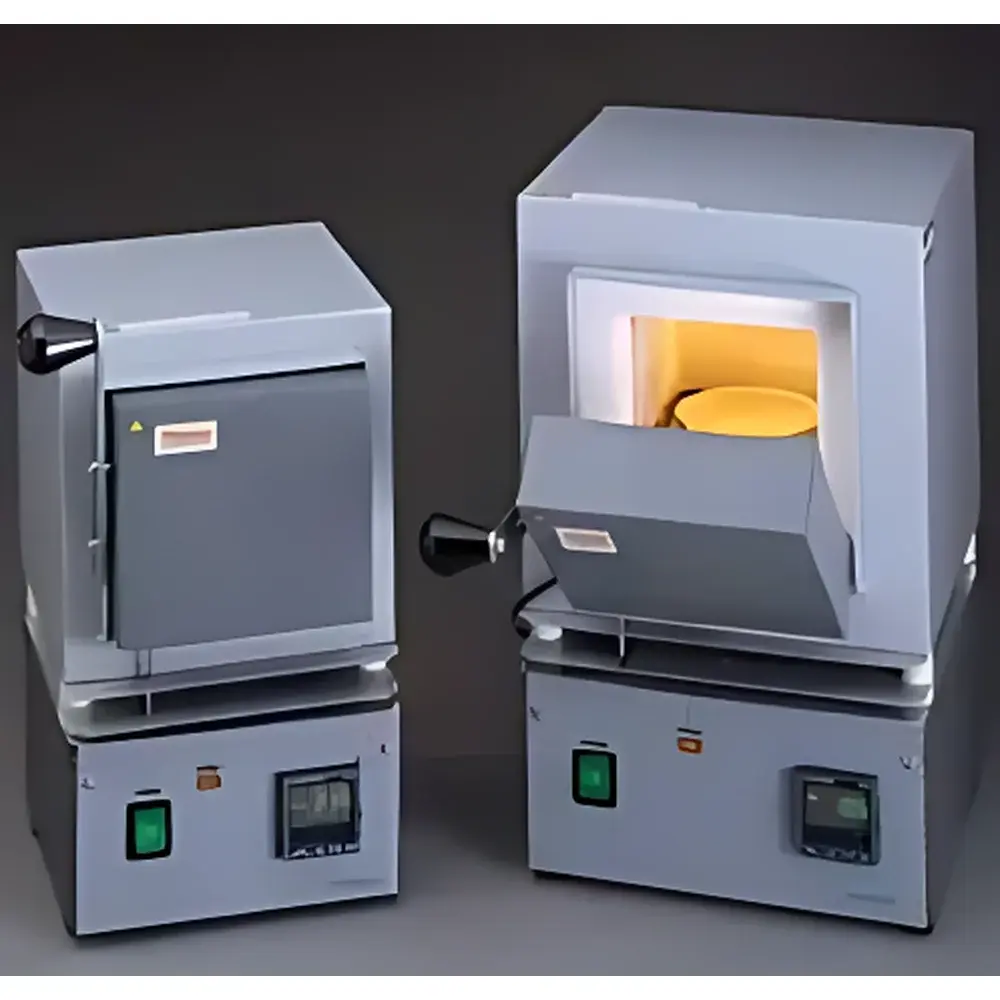
Thermo Fisher FB 1300 & FB 1400 Benchtop Muffle Furnaces
| Brand | Thermo Fisher |
|---|---|
| Origin | USA |
| Manufacturer | Thermo Fisher Scientific |
| Product Type | Benchtop Box-Type Muffle Furnace |
| Models | FB 1300 / FB 1400 |
| Max Temperature | 1100°C |
| Temperature Uniformity (at 1000°C) | ±7.8°C (FB 1300) / ±5.0°C (FB 1400) |
| Temperature Stability (at 1000°C) | ±0.3°C (FB 1300) / ±0.5°C (FB 1400) |
| Control System | Digital Single-Setpoint (Class A1) |
| Heating Method | Resistive Wire (Ni-Cr Alloy) |
| Chamber Dimensions (W×H×D, mm) | 103×98×130 (FB 1300) / 127×108×152 (FB 1400) |
| External Dimensions (W×H×D, mm) | 230×360×216 / 330* (FB 1300, door open) / 250×370×282 / 400* (FB 1400, door open) |
| Chamber Volume | 1.3 L (FB 1300) / 2.1 L (FB 1400) |
| Power Rating | 1060 W |
| Input Voltage/Frequency | 240 V, 50/60 Hz |
| Current Draw | 4.4 A (FB 1300) / 6.3 A (FB 1400) |
| Ramp Rate to Max Temp | 6–12°C/min |
| Thermal Insulation | High-Density Ceramic Fiber |
| Safety Features | Door-Interlocked Power Cut-off, Thermocouple Fault Protection, Rear 9.5-mm Process Port |
| Net Weight | 9 kg (FB 1300) / 12.7 kg (FB 1400) |
Overview
The Thermo Fisher FB 1300 and FB 1400 are compact, benchtop muffle furnaces engineered for precision thermal processing in research laboratories, quality control environments, and small-scale production settings. Designed around a robust box-type architecture with full ceramic fiber insulation, these furnaces operate on the principle of radiant heat transfer within an electrically isolated chamber—ensuring minimal thermal mass and rapid thermal response. Unlike traditional brick-lined kilns, the high-purity alumina-silica ceramic fiber lining provides superior thermal efficiency, enabling fast heating (6–12°C/min to 1100°C) and accelerated cooling without compromising structural integrity or temperature stability. The furnace chamber is fully enclosed and gas-tight, isolating samples from combustion byproducts and external atmosphere—making it suitable for ashing, calcination, heat treatment, and controlled oxidation/reduction studies where ambient contamination must be eliminated.
Key Features
- Two chamber volumes: 1.3 L (FB 1300) and 2.1 L (FB 1400), optimized for flexibility across sample throughput requirements
- Dual-zone resistive heating elements—strategically mounted on top and both side walls—to ensure uniform thermal distribution and minimize axial and radial gradients
- Downward-opening hinged door functions as a stable sample-loading platform and integrates a mechanical safety interlock that de-energizes all heating circuits immediately upon opening
- Digital Class A1 single-setpoint controller with dual-display capability (simultaneous readout of setpoint and actual temperature) and intuitive push-button interface
- Integrated thermocouple fault detection circuitry that automatically disables power to heating elements if sensor signal loss or out-of-range deviation exceeds defined thresholds
- Rear-mounted 9.5-mm diameter process port for integration with external thermocouples, data loggers, or atmosphere control systems (e.g., inert gas purging)
- Ceramic fiber insulation rated for continuous operation up to 1100°C, offering low thermal conductivity (< 0.08 W/m·K at 800°C) and negligible stored heat
Sample Compatibility & Compliance
These furnaces accommodate standard crucibles (alumina, porcelain, platinum, and silicon carbide), quartz boats, and custom fixtures up to maximum dimensions of 100 × 95 × 125 mm (FB 1300) or 120 × 100 × 145 mm (FB 1400). The muffle design eliminates direct flame contact and ensures consistent exposure to convective-radiative heating—critical for ASTM E1529 (fire-test-response standards), ISO 1171 (ash content determination), and USP <231> heavy metals testing protocols. All electrical components comply with IEC 61010-1:2010 for laboratory equipment safety. The digital controller supports audit-ready operation logs when paired with optional RS-232/USB data export modules—facilitating GLP/GMP-aligned recordkeeping per FDA 21 CFR Part 11 requirements when used with validated software platforms.
Software & Data Management
While the base A1 controller operates independently without software dependency, both models support optional firmware upgrades and external data acquisition via analog voltage output (0–10 V) corresponding to real-time temperature. When connected to a PC using Thermo Fisher’s optional LabConnect™ interface module (sold separately), users gain access to time-stamped temperature profiles, ramp-hold-soak programming, and event-triggered alerts—including overtemperature events, door-open status, and thermocouple failure. Exported CSV files are compatible with common statistical analysis tools (e.g., JMP, Minitab) and LIMS integration frameworks. Firmware updates maintain backward compatibility and include enhanced calibration traceability features aligned with ISO/IEC 17025 metrological requirements.
Applications
- Ash content analysis per AOAC 942.05, ASTM D2974, and EPA Method 1695
- Calcination of catalyst precursors, metal oxides, and battery cathode materials
- Residue-on-ignition (ROI) testing in pharmaceutical excipient qualification
- Thermal gravimetric pre-conditioning prior to TGA or DSC analysis
- Heat treatment of small metallurgical specimens and dental alloys
- Pre-drying and conditioning of reference standards and calibration weights
FAQ
What is the recommended maintenance interval for the ceramic fiber insulation?
Ceramic fiber linings require no scheduled replacement under normal operating conditions; however, visual inspection every 6 months is advised for signs of cracking, delamination, or surface erosion—particularly after repeated thermal cycling above 900°C.
Can these furnaces be operated under inert or reducing atmospheres?
Yes—via the rear 9.5-mm process port, users may introduce N₂, Ar, or forming gas (5% H₂/95% N₂); however, prolonged use under reducing conditions requires optional quartz tube liner kits to prevent heater degradation.
Is the temperature uniformity specification validated per any recognized standard?
Uniformity values (±7.8°C and ±5.0°C at 1000°C) were measured per ASTM E220-19 Annex A3 using a 9-point thermocouple mapping grid across the usable chamber volume.
Does the controller support multi-step programmable ramps?
The standard A1 controller supports only single-setpoint operation; programmable ramp/soak functionality requires upgrade to the optional A2 controller module (part number FB-A2-UPG).
What is the typical service life of the Ni-Cr heating elements?
Under continuous operation at ≤1000°C with proper thermal cycling practices, heating elements typically exceed 5,000 hours of service life before resistance drift exceeds ±5% of nominal value.



