
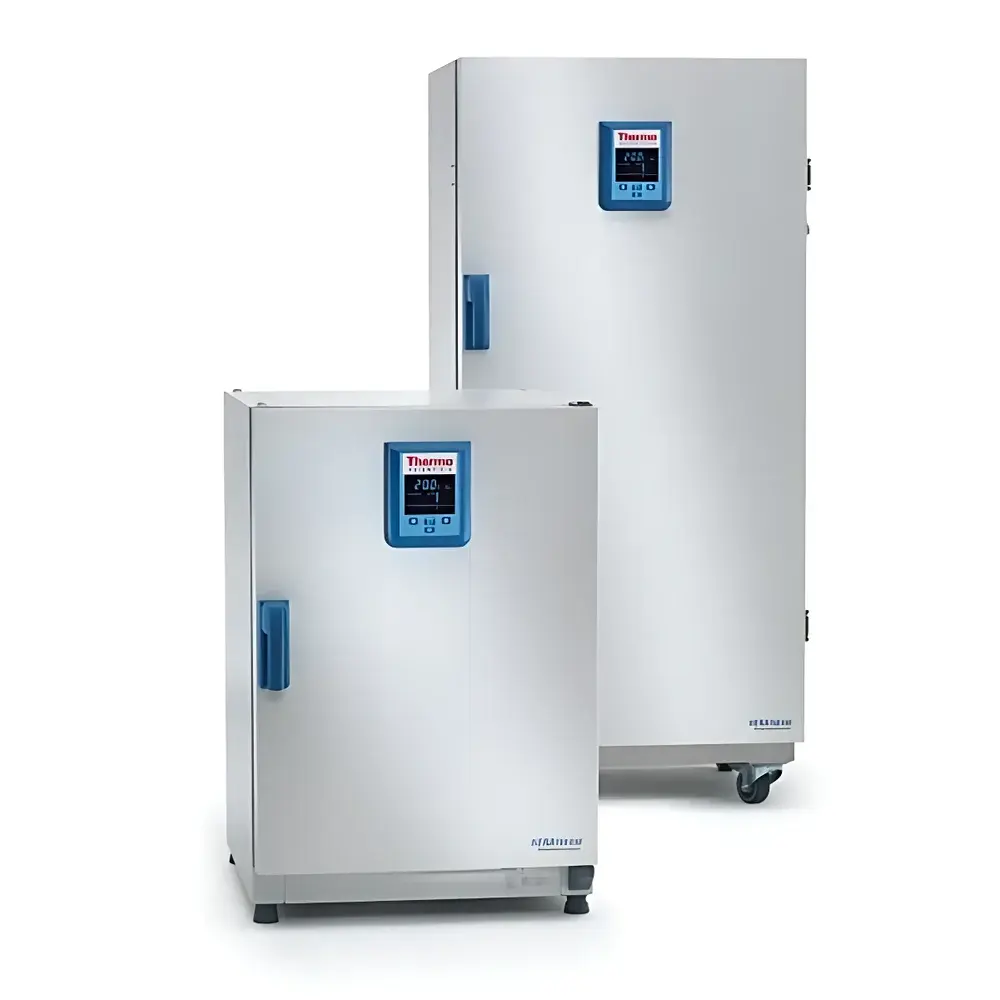
Thermo Fisher Heratherm™ IMP400 Low-Temperature Biochemical Incubator
| Brand | Thermo Fisher |
|---|---|
| Origin | Germany |
| Manufacturer | Thermo Fisher Scientific |
| Type | Imported Equipment |
| Model | IMP400 |
| Temperature Range | 5–70°C |
| Capacity | 178 L (benchtop) / 381 L (floor-standing with casters) |
| Temperature Uniformity | ±0.3°C at 20°C |
| Temperature Stability | ±0.1°C at 20°C |
| Power Consumption | 80 Wh/h (benchtop) / 150 Wh/h (floor-standing) |
| Insulation | CFC-free & HFC-free polyurethane foam |
| Door Heating | Intelligent energy-controlled glass door heating |
| Programming | Up to 10 programs, each with 10 steps (ramp, soak, cool-down) |
| Safety Class | Class 2.0 per DIN 12880 |
| Chamber Material | Stainless steel 1.4301 (ASTM 304), radius-cornered interior |
| Access Port | Standard Ø42 mm (1.65 in) for data monitoring probes |
Overview
The Thermo Fisher Heratherm™ IMP400 Low-Temperature Biochemical Incubator is a precision-engineered environmental chamber designed for consistent, reliable temperature control across life science laboratories, quality control units, and regulated bioprocessing environments. Utilizing a high-efficiency compressor-based cooling system combined with intelligent dual-mode (heating/cooling) thermal regulation, the IMP400 maintains stable setpoints from +5°C to +70°C—enabling applications ranging from low-temperature enzyme storage and microbial culture maintenance to accelerated stability testing and biochemical reaction incubation. Its thermally optimized chamber architecture—featuring CFC-free and HFC-free rigid polyurethane insulation (≥80 mm thickness) and an actively heated double-glazed inner door—minimizes thermal bridging and eliminates condensation even under high-humidity, sub-ambient conditions. All performance specifications—including temperature uniformity of ±0.3°C at 20°C and stability of ±0.1°C at 20°C—are validated per DIN 12880:2015, ensuring metrological traceability and compliance with ISO/IEC 17025-aligned laboratory practices.
Key Features
- Two scalable configurations: 178 L benchtop (6.3 cu.ft.) and 381 L floor-standing (13.5 cu.ft.) with ergonomic casters and leveling feet
- Dual-zone thermal management: independent compressor cooling and PID-controlled resistive heating deliver rapid recovery (<15 min after 30-sec door opening at 37°C)
- Energy-optimized operation: consumes only 80 Wh/h (benchtop) or 150 Wh/h (floor-standing) at 20°C—approximately 1/6 the energy demand of conventional compressor incubators
- Intelligent door heating system prevents internal condensation without compromising chamber humidity integrity
- Class 2.0 overtemperature protection per DIN 12880, with independent mechanical backup thermostat and configurable alarm thresholds
- Radius-cornered stainless steel 1.4301 (ASTM 304) interior, seamless welds, and removable perforated shelves for autoclave-compatible cleaning
- Standard 42 mm (1.65 in) access port with silicone gasket for integration of external sensors (e.g., CO₂, O₂, RH, or data loggers)
Sample Compatibility & Compliance
The IMP400 supports a broad range of biological and chemical sample formats—including Petri dishes, multiwell plates, flasks, tubes, and custom vessels—without compromising thermal fidelity. Its uniform airflow design (non-turbulent, rear-wall convection) avoids shear stress on sensitive cell cultures. The unit complies with DIN 12880:2015 for incubator classification and meets essential requirements of IEC 61010-1 (Safety of Laboratory Equipment). Optional validation documentation packages support IQ/OQ protocols aligned with GLP, GMP, and FDA 21 CFR Part 11 expectations. Internal chamber geometry and material selection (electropolished stainless steel, no crevices or polymer coatings) ensure compatibility with alcohol-based disinfectants and routine decontamination cycles.
Software & Data Management
The IMP400 features an intuitive 4.3-inch capacitive touchscreen interface supporting multilevel user access (operator, supervisor, administrator). Programmable logic includes ramp-soak-cool profiles (up to 10 programs × 10 steps), weekly/daily scheduling, and real-time deviation logging. All parameter changes, alarm events, and door openings are timestamped and stored locally for ≥30 days. The standard RS485 interface enables Modbus RTU integration into centralized building management systems (BMS) or LIMS platforms. Optional Ethernet module adds HTTP/HTTPS remote monitoring, TLS 1.2-secured firmware updates, and audit-trail-enabled event export compliant with ALCOA+ data integrity principles.
Applications
- Long-term storage and maintenance of mesophilic and psychrotrophic microorganisms (e.g., E. coli, Bacillus, lactic acid bacteria)
- Enzyme activity assays requiring precise thermal control between 5°C and 45°C
- Stability studies per ICH Q1A(R3) guidelines for pharmaceutical intermediates and excipients
- Seed culture expansion and inoculum preparation in biomanufacturing workflows
- Environmental simulation for material degradation testing (e.g., polymer hydrolysis, coating adhesion)
- Controlled-temperature hybridization and blotting procedures in molecular biology labs
FAQ
What is the minimum operating temperature, and can it maintain 5°C reliably under load?
Yes—the IMP400 achieves and sustains +5°C continuously with ≤±0.3°C spatial uniformity, verified under full-load conditions (10× standard shelf configuration) per DIN 12880 Annex B.
Is the chamber suitable for use with volatile organic solvents?
No—this model is not explosion-proof. For solvent-based applications, consult the Heratherm™ GR series with ATEX-certified variants.
Can the access port accommodate a Pt100 probe with cable strain relief?
Yes—the Ø42 mm port accepts standard industrial probes up to 6 mm diameter; optional gland fittings (order code IMP-PORT-GASKET-KIT) provide IP54-rated sealing.
Does the incubator support 21 CFR Part 11-compliant electronic records?
The base unit provides audit-trail-capable logging; full Part 11 compliance requires optional Thermo Fisher Connect™ software with role-based e-signature and electronic record archiving.
What maintenance intervals are recommended for optimal performance?
Compressor oil and refrigerant levels require verification every 24 months by certified service personnel; door gasket integrity and sensor calibration should be checked semiannually per laboratory SOPs.




