
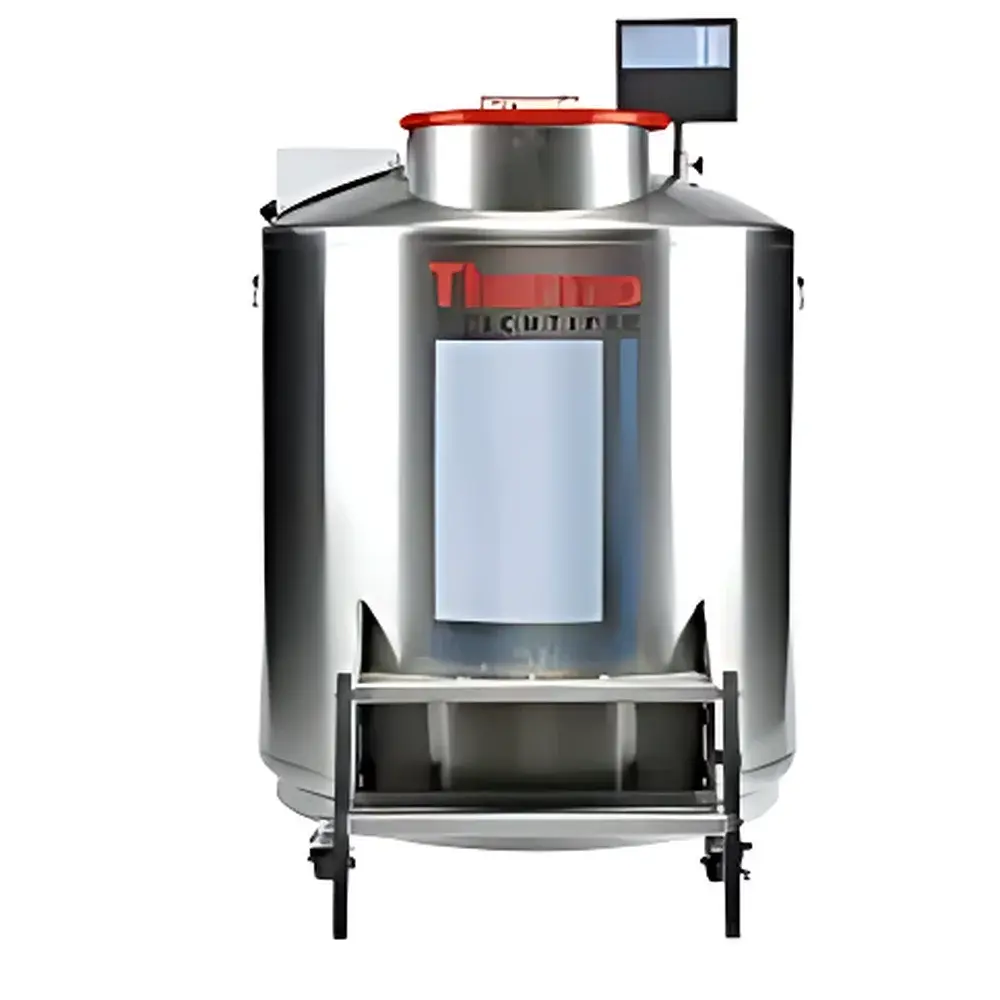
Thermo Fisher CryoExtra™ CE8140 Vapor-Phase Liquid Nitrogen Storage System
| Brand | Thermo Fisher |
|---|---|
| Origin | Imported |
| Manufacturer Type | Original Equipment Manufacturer (OEM) |
| Model | CE8140 |
| Supply Pressure Requirement | 22 psi low-pressure liquid nitrogen source (sold separately) |
| Dimensions (H) | CE8140-20/40: 77 in (1956 mm) |
| CE8140-80 | 88 in (2235 mm) |
| CE8140-94 | 93 in (2362 mm) |
| Temperature Uniformity | ±0.5 °C across storage chamber (vapor-phase mode) |
| Display | Backlit LCD with real-time temperature and liquid nitrogen level readout |
| Safety | Lockable lid, microprocessor-based level monitoring with audible/visual alarms |
| Accessories Interface | Compatible with 0.5″ 45° flare inlet fitting and 6 ft (1.8 m) stainless steel flexible LN₂ supply hose |
Overview
The Thermo Fisher CryoExtra™ CE8140 is a high-integrity vapor-phase liquid nitrogen (LN₂) storage system engineered for long-term, ultra-low-temperature preservation of sensitive biological specimens—including primary cells, stem cell lines, embryos, oocytes, and genomic samples—at temperatures consistently below −150 °C. Unlike traditional liquid-phase immersion systems, the CE8140 maintains samples exclusively in the cold vapor phase above the LN₂ reservoir, eliminating direct contact with liquid cryogen and thereby minimizing cross-contamination risk, thermal shock during retrieval, and sample loss due to accidental submersion or boil-off-induced exposure. Its thermally optimized vacuum-insulated stainless steel chamber delivers exceptional temperature stability and spatial uniformity (±0.5 °C across the full storage volume), validated under continuous operation at ambient conditions ranging from 15–30 °C. Designed for GLP-compliant and ISO 13485-aligned laboratory environments, the CE8140 supports traceable, auditable cryopreservation workflows through integrated microprocessor-based monitoring and configurable alarm thresholds.
Key Features
- Vapor-phase storage architecture ensures sample integrity without direct LN₂ immersion—critical for regulatory-grade biobanking and clinical-grade cell therapy material handling.
- Intelligent microprocessor control system continuously monitors LN₂ level and internal chamber temperature, triggering dual-stage audible and visual alarms upon deviation from user-defined setpoints.
- Backlit LCD interface displays real-time temperature (°C), LN₂ level (% full), system status, and alarm history—enabling rapid operational assessment without opening the chamber.
- Lockable stainless steel lid with tamper-evident mechanism complies with institutional biosafety and access-control policies; optional integration with facility access management systems via dry-contact relay output.
- Ergonomic design includes foldable aluminum step platform (load-rated to 150 kg), recessed handle zones, and intuitive functional zoning for glove-compatible operation—even with cryogenic PPE.
- Modular accessory compatibility: accepts standardized vertical and horizontal cryobox racks (Nunc™, Corning®, Thermo Scientific™ formats), automated lifters, and barcode-scannable frame mounts—supporting scalable inventory expansion.
Sample Compatibility & Compliance
The CE8140 accommodates standard ANSI/SLAS-compliant cryovials (0.5–5.0 mL), cryoboxes (10×10, 20×20 configurations), and custom-fit specimen frames. All internal surfaces are electropolished 316L stainless steel, certified non-pyrogenic and compliant with USP endotoxin limits. The system meets IEC 61010-1 safety requirements for laboratory equipment and conforms to ISO 14644-1 Class 5 cleanroom-compatible installation protocols when placed in controlled environments. For FDA-regulated applications, the CE8140 supports 21 CFR Part 11-compliant electronic record generation when paired with Thermo Fisher’s SampleManager LIMS or third-party validated data acquisition software (audit trail, user authentication, and electronic signature modules required separately).
Software & Data Management
While the CE8140 operates as a standalone unit, its RS-485 serial port and optional Ethernet module enable seamless integration into centralized environmental monitoring networks (e.g., SensiNet, TempTale® Web, or LabVantage). Logged parameters—including temperature min/max/avg, LN₂ consumption rate (calculated from level delta over time), and alarm event timestamps—are exportable in CSV or XML format. Firmware updates are performed via secure USB interface with SHA-256 signature verification. Data retention spans ≥30 days onboard; extended logging requires external SCADA or LIMS linkage. Audit trail functionality satisfies GLP Annex 11 and GMP Annex 11 documentation requirements when deployed with validated software layers.
Applications
- Long-term archival of human biospecimens in biorepositories accredited to ISBER Best Practices or CAP Biorepository standards.
- Cryopreservation of induced pluripotent stem cells (iPSCs) and mesenchymal stromal cells (MSCs) under cGMP conditions for regenerative medicine manufacturing.
- Storage of clinical trial reference standards, comparator biologics, and potency assay controls requiring strict thermal history documentation.
- Support of single-cell genomics workflows where RNA integrity (RIN > 8.5) must be preserved across multi-year storage intervals.
- Backup storage for critical master cell banks (MCBs) and working cell banks (WCBs) per ICH Q5D guidance.
FAQ
What LN₂ supply infrastructure is required?
A dedicated low-pressure (22 psi) liquid nitrogen dewar with 0.5″ 45° flare outlet and 6 ft stainless steel flexible hose is mandatory. Bulk tank systems must include pressure-reducing regulators and particulate filtration (≤5 µm).
Can the CE8140 operate in liquid-phase mode?
No—it is engineered exclusively for vapor-phase storage. Direct liquid immersion compromises temperature uniformity, increases contamination risk, and voids warranty.
Is remote monitoring supported out of the box?
Basic local alarms and display are standard; Ethernet or cellular telemetry modules are optional accessories requiring separate configuration and validation.
How often does the system require preventive maintenance?
Annual inspection of vacuum integrity (via helium leak testing), sensor calibration verification, and gasket replacement per Thermo Fisher Service Bulletin SB-CE8140-REV3.
Are rack configurations validated for specific cell types?
Rack geometry and thermal mass distribution are validated for uniform cooling rates per ISO 20362-3; cell-type-specific recovery viability data must be generated internally per your SOPs.




