
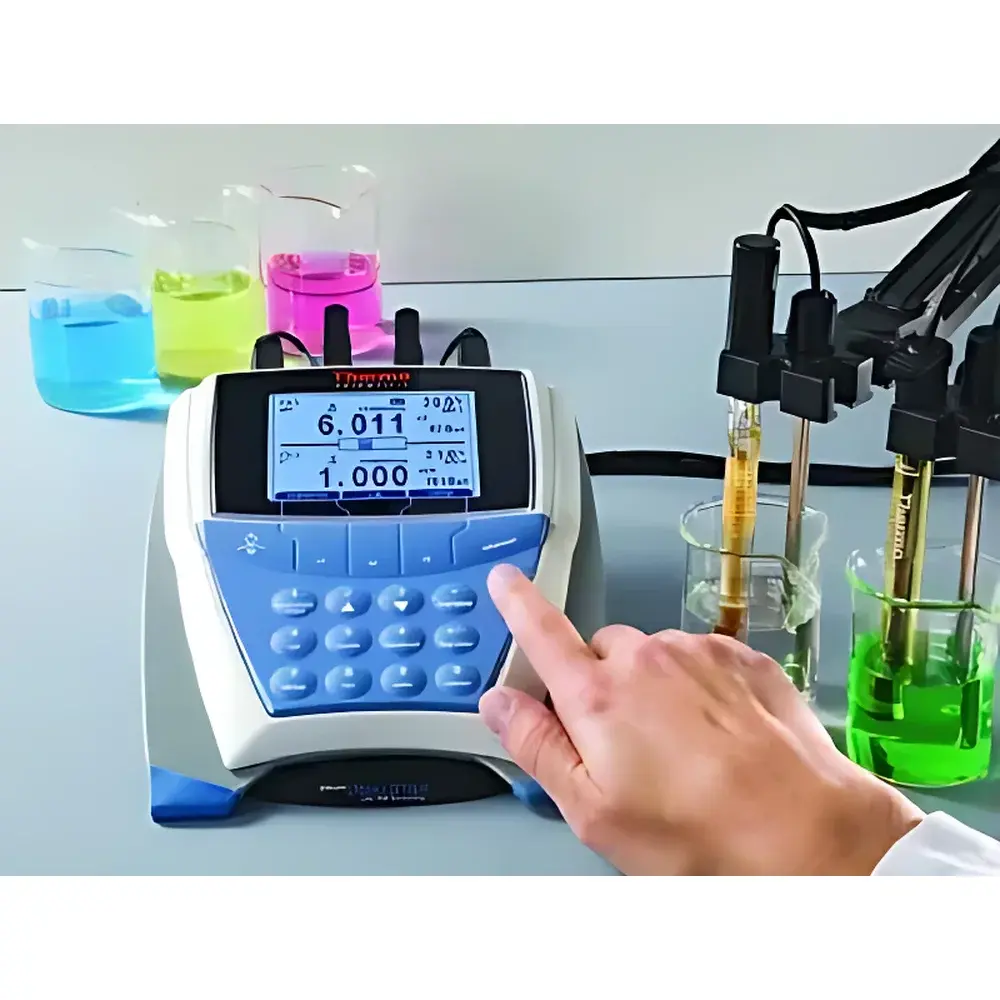
Thermo Fisher Orion Dual Star D10P-32 Hardness Analyzer
| Brand | Thermo Fisher |
|---|---|
| Origin | USA |
| Manufacturer | Thermo Fisher Scientific |
| Product Type | Imported Instrument |
| Model | D10P-32 |
| Pricing | Upon Request |
| Electrode System | 9332BNWP Hardness Half-Cell Electrode + 900100 Single-Junction Reference Electrode |
| Measurement Principle | Potentiometric Ion-Selective Electrode (ISE) Detection of Ca²⁺ and Mg²⁺ |
| pH Range | 7–10 |
| Temperature Range | 0–40 °C |
| Repeatability | ±4% |
| Ion Concentration Range | 6 × 10⁻⁶ M to 1 M (as CaCO₃ equivalent) |
| pH Range (Meter) | −2.000 to 19.999 |
| ORP Range | ±1999.9 mV |
| Temperature Accuracy | ±0.1 °C |
| Data Storage | 1000 entries with timestamp |
| GLP Compliance | Yes (audit trail, password protection, method locking) |
| Connectivity | RS232 and optional USB |
| Enclosure Rating | IP54 |
| Certifications | CE, CSA, UL, TÜV, FCC Class A |
Overview
The Thermo Fisher Orion Dual Star D10P-32 Hardness Analyzer is a dual-channel, potentiometric ion concentration meter engineered for precise, trace-level quantification of total water hardness—expressed as calcium carbonate (CaCO₃) equivalence—via selective detection of Ca²⁺ and Mg²⁺ ions in aqueous samples. Unlike colorimetric or titrimetric methods, this system employs a robust ISE-based electrochemical measurement principle grounded in the Nernst equation, enabling direct, interference-resilient analysis without reagent consumption or sample digestion. The instrument integrates the 9332BNWP hardness half-cell electrode—a solid-state, lead-free sensor with optimized membrane composition for enhanced selectivity toward divalent cations—and the 900100 single-junction reference electrode to form a stable, low-drift measuring cell. Designed specifically for environmental laboratories, municipal water treatment facilities, and industrial process control, the D10P-32 delivers reproducible results across raw surface water, potable water, boiler feedwater, and wastewater effluents within its validated operational pH range (7–10) and temperature envelope (0–40 °C).
Key Features
- Dual-channel architecture with independent BNC inputs, reference electrode ports, and ATC (Automatic Temperature Compensation) MiniDIN interfaces—enabling concurrent measurement of hardness and pH, ORP, or a second ion parameter (e.g., Cl⁻, F⁻, NO₃⁻) without hardware switching.
- Advanced ISE methodology support: single- and double-standard addition/subtraction modes, blank auto-calibration, and user-defined ion activity corrections for complex matrices containing high ionic strength or chelating agents.
- High-resolution display showing real-time ion name, concentration (in ppm, mg/L, M, or %), mV potential, and temperature—simultaneously per channel.
- GLP-compliant data governance: password-protected method configuration, per-method access control, full audit trail logging (including calibration events, operator ID, and timestamp), and 1000-point internal storage with date/time stamping.
- Graphical calibration curve visualization on LCD screen—including slope, intercept, R², and electrode response deviation alerts—to facilitate rapid performance verification and troubleshooting.
- RS232 bidirectional communication with PC software (Orion Star™ Com) for automated report generation, method export/import, and firmware updates; USB adapter optional for legacy system integration.
- Rugged IP54-rated enclosure suitable for benchtop use in regulated environments; certified to CE, UL, CSA, TÜV, and FCC Class A standards.
Sample Compatibility & Compliance
The D10P-32 is validated for use with clarified, low-turbidity aqueous samples meeting ASTM D1126 (Standard Test Method for Hardness in Water) and ISO 6059 (Water quality — Determination of calcium and magnesium — EDTA titrimetric method, used for comparative validation). While optimized for drinking water and treated effluents, it accommodates moderately complex matrices when paired with appropriate sample conditioning (e.g., pH adjustment to 8.5–9.5 using ammonia buffer, filtration to <5 µm). The 9332BNWP electrode exhibits minimal interference from Na⁺, K⁺, and common anions below 0.1 M; however, elevated levels of Al³⁺, Fe³⁺, or phosphate require pre-treatment per EPA Method 130.1 guidelines. All measurements adhere to GLP and GMP documentation requirements, with full traceability aligned with FDA 21 CFR Part 11 for electronic records where configured with secure user authentication and audit-enabled software.
Software & Data Management
Data acquisition and reporting are managed via Orion Star Com PC software, which supports CSV/Excel export, customizable report templates (including lab header, analyst signature field, and QC flagging), and batch calibration file management. Each stored reading includes embedded metadata: channel ID, electrode serial number (if registered), temperature-compensated mV value, calculated concentration, method version, and operator login ID. Firmware updates preserve calibration history and user-defined methods. For networked labs, optional Orion StarLink™ middleware enables integration with LIMS platforms via HL7 or ASTM E1384 protocols—supporting automatic ingestion of hardness values into QA/QC dashboards and regulatory submission workflows.
Applications
- Regulatory compliance monitoring for EPA Clean Water Act (CWA) discharge permits and Safe Drinking Water Act (SDWA) maximum contaminant level (MCL) verification.
- Boiler and cooling tower water treatment optimization—tracking scaling potential through real-time Ca²⁺/Mg²⁺ ratio analysis.
- Wastewater reclamation facility effluent characterization prior to reuse applications (e.g., irrigation, industrial makeup water).
- Pharmaceutical water system qualification (Purified Water, Water for Injection) per USP and EU Annex 1 requirements.
- Educational laboratory instruction in analytical chemistry, emphasizing ISE theory, calibration strategy, and matrix effect mitigation.
FAQ
What is the recommended calibration frequency for routine hardness testing?
Calibration should be performed daily for high-precision applications or before each analytical batch; at minimum, a two-point calibration using 10 ppm and 100 ppm CaCO₃ standards is required per ASTM D1126 Section 8.3.
Can the 9332BNWP electrode be used outside the specified pH 7–10 range?
Operation below pH 7 risks hydrogen ion interference and reduced sensitivity; above pH 10, precipitation of Ca(OH)₂ or Mg(OH)₂ may foul the sensing membrane—buffering to pH 8.5–9.5 is strongly advised.
Is the D10P-32 compliant with ISO/IEC 17025 requirements for accredited testing laboratories?
Yes—when operated with documented SOPs, calibrated traceable standards (NIST-traceable CaCO₃ solutions), and enabled GLP features (audit trail, electronic signatures), it satisfies Clause 6.4.10 (equipment verification) and Clause 7.7 (result reporting) of ISO/IEC 17025:2017.
How does temperature compensation function during hardness measurement?
The integrated 927007MD thermistor probe provides continuous ATC; the meter applies a Nernstian temperature coefficient (−0.198 mV/°C per decade change in [Ca²⁺]) to correct raw mV output in real time, ensuring concentration accuracy across 0–40 °C.
What maintenance is required for long-term electrode stability?
The 9332BNWP electrode requires periodic rehydration (24 h in 100 ppm CaCO₃), cleaning with dilute HNO₃ (0.1 M) for inorganic deposits, and replacement of the 900100 reference electrolyte every 3 months or after 500 measurements—per Thermo Fisher Technical Bulletin TB-9332-01.







