
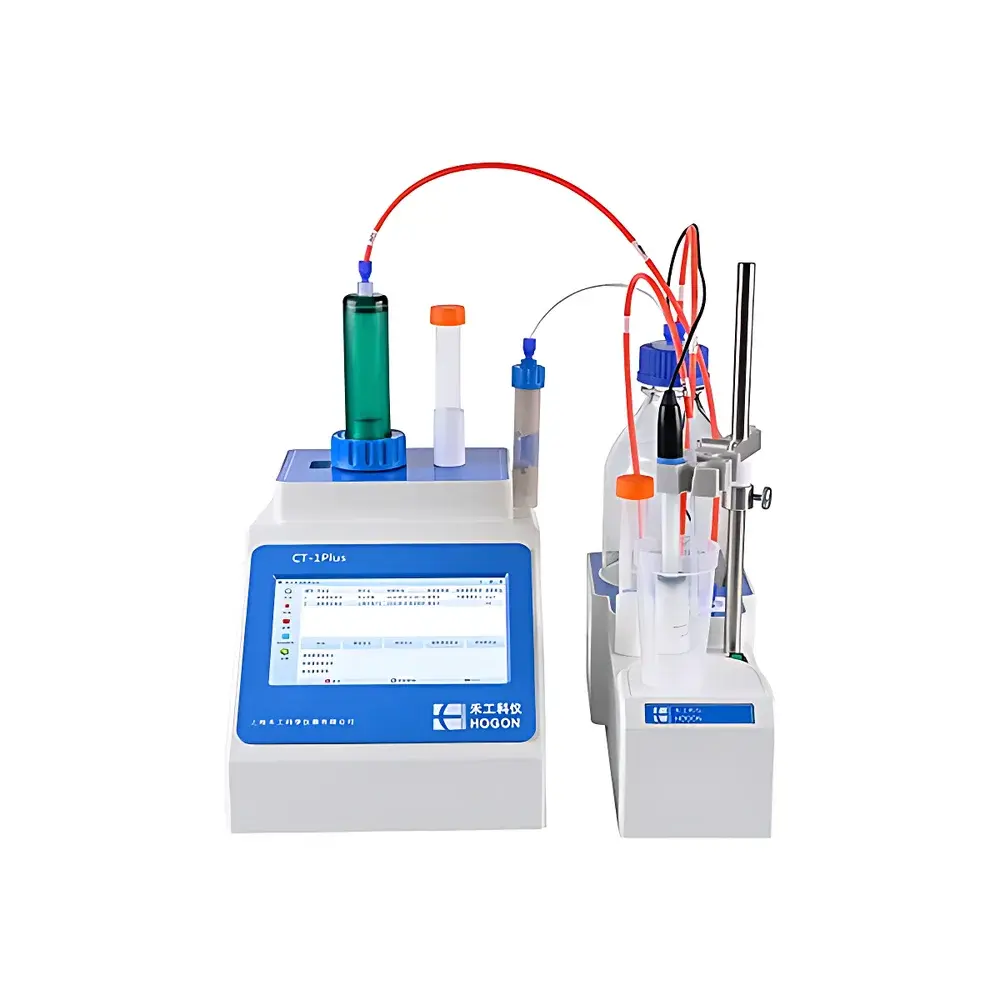
HOGON CT-1PLUS Color-Integrated Automatic Potentiometric Titrator
| Brand | HOGON |
|---|---|
| Origin | Shanghai, China |
| Manufacturer Type | Direct Manufacturer |
| Instrument Type | General-Purpose Potentiometric Titrator |
| Application Scope | Universal |
| pH Measurement Range | 1–14 |
| Potential Display Accuracy | ±0.2 mV |
| Potential Resolution | 0.1 mV (within ±2000 mV range) |
| Burette Precision | 0.001 mL (20 mL standard burette) |
| Burette Resolution | 0.0005 mL (10 mL optional burette) |
Overview
The HOGON CT-1PLUS Color-Integrated Automatic Potentiometric Titrator is a dual-mode analytical instrument engineered for precision endpoint detection in volumetric titration. It combines classical potentiometric measurement—based on Nernstian potential response of ion-selective or redox electrodes—with an integrated computer vision-based color detection module. This hybrid architecture enables reliable endpoint determination for reactions where conventional potentiometric signals are weak, noisy, or absent—particularly in acid-base, redox, and complexometric titrations involving chromogenic indicators (e.g., phenolphthalein, methyl orange, starch-iodine). The system operates under controlled electrochemical principles: electrode potential is continuously monitored vs. a reference electrode (e.g., Ag/AgCl), while the color module captures real-time RGB intensity dynamics across the visible spectrum (400–700 nm) to quantify hue, saturation, and luminance shifts. Designed for routine QC laboratories and R&D environments, the CT-1PLUS complies with fundamental metrological requirements outlined in ISO 8655-3 (burette accuracy), ASTM E2081 (titration method validation), and supports GLP-aligned documentation workflows.
Key Features
- Dual-endpoint detection capability: Simultaneous or independent operation of potentiometric and colorimetric modes—eliminating reliance on subjective visual endpoint judgment.
- High-fidelity color sensing module: Equipped with a 5-megapixel industrial CMOS camera, programmable LED illumination array (6500 K correlated color temperature, ±2% uniformity), and motorized rotational stage enabling multi-angle solution imaging at 0.5° angular resolution.
- Precision fluid handling: Standard 20 mL glass burette with PTFE piston and ceramic seal; volumetric accuracy certified to ±0.001 mL per delivery (ISO 8655-3 Class A); optional 10 mL high-resolution burette (±0.0005 mL resolution).
- Electrochemical measurement engine: High-impedance (>1013 Ω) input amplifier, 24-bit ADC, and automatic electrode calibration routines for pH and redox electrodes.
- Modular hardware design: Tool-free access to burette, electrode holder, stirrer, and color module components—facilitating cleaning, maintenance, and validation traceability.
- Compliance-ready architecture: Supports audit trails, user-level access control, electronic signatures, and data export in CSV and PDF formats—aligned with FDA 21 CFR Part 11 foundational expectations for regulated environments.
Sample Compatibility & Compliance
The CT-1PLUS accommodates aqueous and moderately polar non-aqueous samples (e.g., ethanol/water mixtures, glacial acetic acid) in standard 100–250 mL titration beakers. Compatible electrodes include combination pH electrodes (glass membrane), silver/silver chloride reference electrodes, platinum redox electrodes, and ion-selective electrodes (e.g., fluoride, chloride). The color module is validated for common indicator systems: phenolphthalein (pH 8.2–10.0), bromothymol blue (pH 6.0–7.6), and starch-iodine (λmax ≈ 580 nm). Instrument performance meets ISO/IEC 17025:2017 clause 6.4.3 (equipment verification) and supports method validation per ICH Q2(R2) guidelines. All firmware and software modules undergo annual functional verification per internal SOP-QC-017.
Software & Data Management
The proprietary TitraSoft v3.2 software provides intuitive workflow-driven operation: method setup (titrant concentration, indicator type, equivalence point algorithm), real-time dual-channel plotting (mV vs. volume + ΔRGB vs. volume), and automated report generation with embedded metadata (operator ID, timestamp, environmental conditions, calibration history). Raw sensor data—including full-frame image sequences (JPEG 2000 compression) and synchronized potential logs—are stored in encrypted SQLite databases with SHA-256 hash integrity verification. Export options include CSV (for LIMS integration), PDF/A-1b (archival compliance), and XML (for ELN synchronization). Audit trail records all parameter changes, result modifications, and user logins with immutable timestamps—fully traceable for internal audits or regulatory inspection.
Applications
- Food & Beverage QC: Automated determination of total acidity in vinegar (AOAC 975.34), peroxide value in edible oils (AOCS Cd 8-53), and free fatty acids in dairy products—replacing manual back-titration with objective color thresholding.
- Pharmaceutical Analysis: Quantification of ascorbic acid (USP 351), chlorhexidine gluconate (EP 2.2.43), and iodine value in excipients—leveraging sharp starch-iodine color transitions for enhanced specificity.
- Chemical Manufacturing: Chloride ion analysis in cement extracts (ASTM C114), acid number in polyester resins (ASTM D974), and hydroxyl value in polyols (ASTM D4294)—where electrode fouling or low ionic strength compromises potentiometric reliability.
- Academic Research: Teaching laboratories use the CT-1PLUS to demonstrate endpoint detection theory across multiple transduction mechanisms—supporting curriculum alignment with ACS Guidelines for Bachelor’s Degree Programs.
FAQ
Does the CT-1PLUS require specialized training to operate?
No. The touchscreen interface follows ISO 9241-110 usability principles, with guided method wizards and context-sensitive help. Basic operation can be mastered in under 30 minutes; advanced method development requires familiarity with titration fundamentals.
Can the color module be used independently of potentiometric measurement?
Yes. Users may configure standalone color titration mode—ideal for teaching labs or applications where no suitable ion-selective electrode exists.
How is photometric stability ensured during long-duration titrations?
The LED illumination system includes active thermal regulation and real-time luminance feedback control, maintaining intensity drift below ±0.5% over 4-hour continuous operation.
Is third-party software integration supported?
Yes. OPC UA and RESTful API interfaces enable bidirectional communication with LIMS (e.g., LabWare, Thermo Fisher SampleManager) and MES platforms.
What maintenance intervals are recommended for the color module?
Camera lens and cuvette window cleaning after every 50 titrations; full optical recalibration annually or after mechanical shock—performed via built-in NIST-traceable color reference tile (CIE LAB coordinates certified).





