
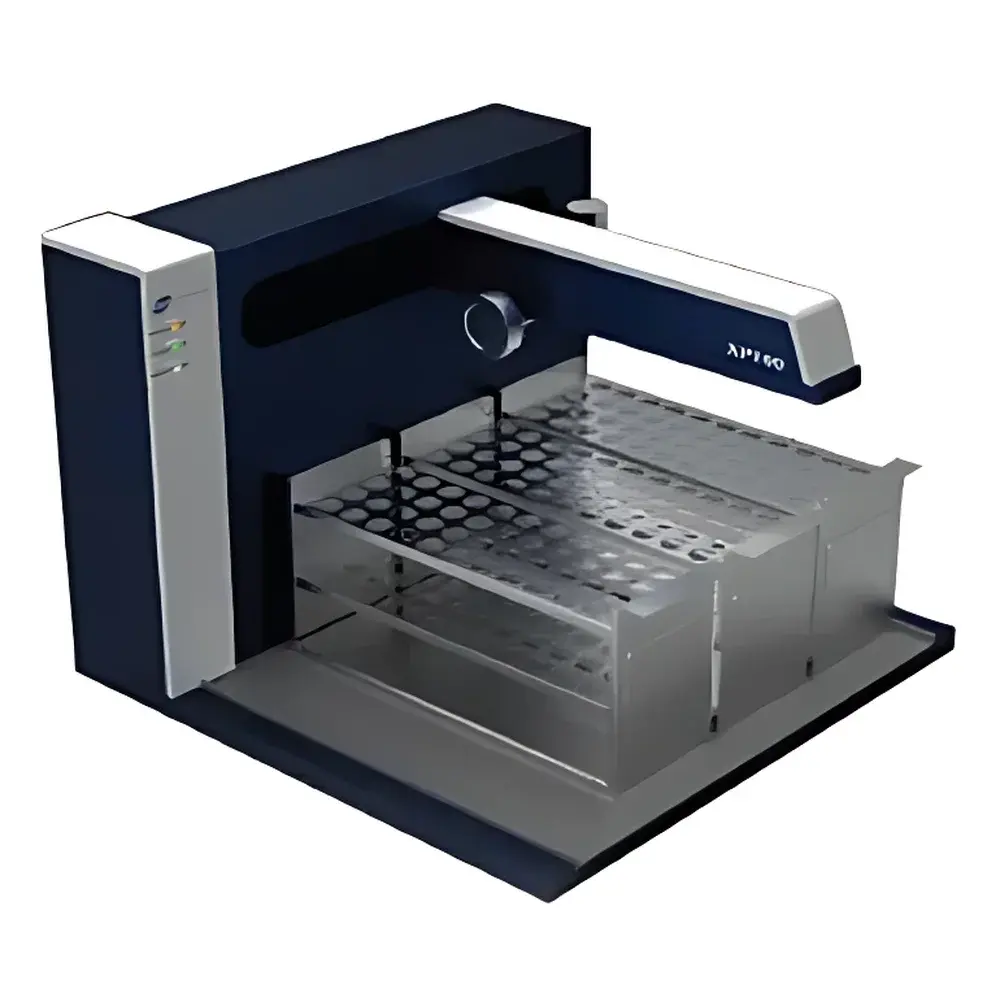
Agela FLEXA HP 100 Modular Preparative Liquid Chromatography System
| Brand | Agela |
|---|---|
| Origin | Tianjin, China |
| Manufacturer Type | Authorized Distributor |
| Product Category | Domestic |
| Model | FLEXA HP 100 |
| Application Level | Laboratory-Scale |
| Instrument Type | High-Pressure Preparative LC System |
| Flow Rate Range | 1–100 mL/min |
| Flow Accuracy | ±1% |
| Flow Precision (RSD) | ≤1% |
| Maximum Pressure | 20–30 MPa |
| Wavelength Range (UV-Vis Detector) | 190–800 nm |
| Wavelength Reproducibility | ±1 nm |
| Baseline Noise (UV-Vis, 254 nm, 1 s) | < ±2.5 × 10⁻⁵ AU |
| Data Acquisition Rate | Up to 20 Hz |
| Detector Options | UV-Vis, ELSD, RI |
| Fraction Collection Modes | Time-based, Peak-triggered, Threshold-based, User-defined Coordinates |
| Communication Interface | RS-232, Optional Ethernet/USB |
Overview
The Agela FLEXA HP 100 is a modular, high-pressure preparative liquid chromatography (Prep LC) system engineered for laboratory-scale purification of organic compounds, natural products, peptides, and small-molecule pharmaceuticals. Built upon a robust, open-architecture platform, it implements classical high-performance liquid chromatography (HPLC) separation principles—employing gradient or isocratic elution under controlled pressure, flow, and detection conditions—to deliver reproducible fractionation with scalable throughput. Unlike monolithic benchtop systems, the FLEXA HP 100 decouples core functional modules—pump, detector(s), fraction collector, and control unit—enabling users to configure, validate, and expand the system in alignment with evolving method development, regulatory compliance, and analytical scope requirements. Its design adheres to fundamental chromatographic performance criteria defined in ISO 17025 and ASTM D7091, supporting method transfer from analytical to preparative scale while maintaining traceable calibration and operational integrity.
Key Features
- Modular Architecture: Independent pump, detector, and fraction collector modules communicate via standardized RS-232 protocol; optional Ethernet/USB interfaces support integration into centralized lab networks and LIMS environments.
- High-Pressure Gradient Pump: Dual-piston reciprocating design with cam-profile flow pulsation compensation; floating plunger assembly and chemically resistant seals ensure compatibility with both reversed-phase (e.g., acetonitrile/water) and normal-phase (e.g., hexane/ethyl acetate) mobile phases up to 30 MPa.
- Multi-Detector Flexibility: Standard UV-Vis detector features dual-wavelength simultaneous monitoring (e.g., 214 nm + 254 nm) for co-elution assessment; optional ELSD (evaporative light scattering) and RI (refractive index) detectors provide universal, non-destructive detection for non-chromophoric analytes without UV absorbance.
- XY-Axis Fraction Collector: Motorized two-dimensional stage with programmable coordinate mapping; accommodates conical flasks, round-bottom flasks, test tubes, and custom vial racks via adjustable tray geometry and multi-channel valve switching between collection and waste lines.
- Control & Calibration Integrity: Multi-point flow calibration curves across full 1–100 mL/min range; wavelength accuracy verified per NIST-traceable standards; baseline noise and drift specifications comply with USP <621> chromatographic system suitability criteria.
Sample Compatibility & Compliance
The FLEXA HP 100 supports purification of thermally stable and moderately labile compounds across molecular weights ranging from ~100 Da to >2,000 Da. Column compatibility spans standard stainless-steel or PEEK-packed columns (10–50 mm ID, 100–500 mm length) using silica, C18, amino, cyano, or diol stationary phases. All wetted materials—including ELSD nebulizer tubing, RI flow cell, and pump fluid path—are constructed from inert, low-adsorption components (e.g., PTFE, sapphire, fused silica) to minimize analyte loss or degradation. The system meets essential design elements referenced in FDA 21 CFR Part 11 for electronic records and signatures when operated with validated software configurations, and supports GLP/GMP-aligned audit trails through timestamped event logging and user-access controls.
Software & Data Management
Agela’s FLEXA Control Suite provides a Windows-based interface for method building, real-time chromatogram visualization, peak integration, and fraction triggering logic. It enables automated sequence execution, retention time locking, and export of raw data in ASCII or .CDF formats compatible with third-party processing tools (e.g., Chromeleon, Empower). Audit trail functionality logs all parameter changes, user logins, and fraction collection events with immutable timestamps—critical for regulatory submissions. Data backups are configurable to network drives or NAS devices, and system validation documentation (IQ/OQ protocols) is available upon request to support laboratory accreditation workflows.
Applications
- Purification of synthetic intermediates and final APIs during medicinal chemistry campaigns
- Isolation of bioactive constituents from plant extracts and fermentation broths
- Desalting and buffer exchange of peptides prior to MS analysis
- Chiral separations using polysaccharide-based preparative columns
- Scale-up support for process analytical technology (PAT) development under ICH Q5 and Q8 guidelines
FAQ
Can the FLEXA HP 100 be integrated with mass spectrometry for real-time fraction characterization?
Yes—its analog output ports and TTL-compatible trigger signals enable synchronization with external mass spectrometers, including Advion expression® CMS and similar single-quadrupole instruments, for post-run or parallel fraction identification.
Does the system support method transfer from analytical HPLC methods?
Yes—flow rate, gradient slope, and column dimensions can be scaled using established linear velocity and retention time preservation rules (e.g., constant k′, proportional flow adjustment); Agela provides method translation templates and application notes.
Is remote monitoring or unattended overnight operation supported?
The system supports scheduled start/stop functions, email alerts on completion or error conditions, and secure remote desktop access via IT-approved VPN infrastructure when deployed on isolated lab subnets.
What maintenance intervals are recommended for pump seals and detector lamps?
Pump seals require inspection every 500 hours of operation or after 100 solvent changes; UV lamp lifetime is rated at ≥2,000 hours under typical usage, with automatic intensity diagnostics embedded in the control software.
Are IQ/OQ documents and calibration certificates provided with shipment?
Factory-installed calibration reports are included; site-specific IQ/OQ protocols and certified reference standards (e.g., caffeine for UV response, sucrose for RI linearity) are available as optional add-ons aligned with ISO/IEC 17025 laboratory practices.







