
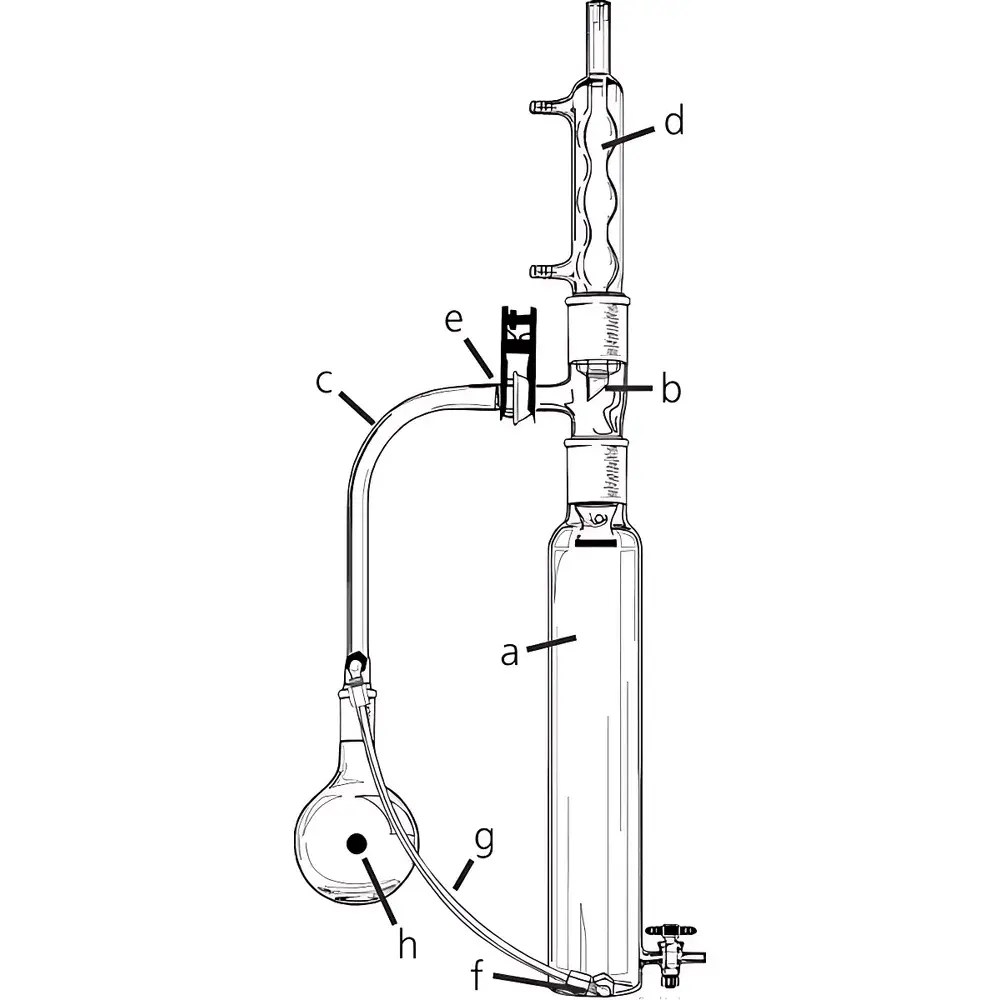
Supelco Liquid-Liquid Extraction Apparatus Kit
| Brand | Supelco |
|---|---|
| Origin | USA |
| Manufacturer Type | Authorized Distributor |
| Import Status | Imported |
| Model | Supelco |
| Pricing | Upon Request |
Overview
The Supelco Liquid-Liquid Extraction Apparatus Kit is a precision-engineered benchtop system designed for quantitative, reproducible liquid-liquid extraction (LLE) of organic analytes from aqueous matrices—particularly suited for sample preparation prior to GC, HPLC, or GC-MS analysis. Based on the fundamental principle of differential solubility, this apparatus facilitates partitioning of target compounds between two immiscible phases (e.g., water and dichloromethane or chloroform), leveraging density-driven phase separation and gravity-assisted drainage. Unlike manual separatory funnel techniques, this glass-and-PTFE modular system enables continuous, controlled, and contamination-free extraction of up to 1 L aqueous samples—minimizing operator variability, solvent loss, and emulsion formation. Its design conforms to classical LLE methodology as described in EPA Method 505, ASTM D3789, and ISO 11348, supporting validated workflows in environmental, food safety, and pharmaceutical QC laboratories.
Key Features
- Chemically inert construction: All wetted components—including extraction chamber, fritted drip spout union, side-arm elbow, condenser, and PTFE tubing—are fabricated from borosilicate glass (Duran®/Pyrex® grade) or high-purity PTFE, ensuring zero leaching, minimal adsorption, and compatibility with aggressive solvents (e.g., CH₂Cl₂, CHCl₃, ethyl acetate, hexane).
- Modular, standardized ground-glass joint assembly: Equipped with ball-and-socket clamp (No. 35) and PTFE-lined elbow unions for leak-tight, repeatable connections; joints comply with ISO 3806 and DIN 12250 specifications.
- Integrated reflux-capable condenser: Enables solvent recovery during extended extractions, reducing volatile organic compound (VOC) emissions and improving method economy and safety.
- Gravity-driven phase separation architecture: Eliminates need for centrifugation or vacuum assistance—reducing mechanical complexity and enhancing operational robustness in regulated environments.
- Scalable configuration: Designed for 1 L aqueous feed volume; compatible with standard 500 mL jacketed extraction flasks and 1000 mL round-bottom receiving flasks (not included).
Sample Compatibility & Compliance
This apparatus supports extraction of polar and nonpolar organic contaminants—including pesticides, PAHs, PCBs, phenols, pharmaceutical residues, and fat-soluble vitamins—from drinking water, wastewater, milk, juice, tissue homogenates, and soil leachates. It meets material compatibility requirements for USP (Extraction Procedures), FDA 21 CFR Part 11–compliant data integrity when paired with validated digital logging systems, and GLP/GMP traceability standards when used within documented SOPs. All glassware is autoclavable (121 °C, 20 min), and PTFE components withstand repeated cleaning with acetone, methanol, and dilute NaOH without degradation.
Software & Data Management
As a standalone passive extraction platform, the apparatus does not incorporate embedded electronics or firmware. However, it integrates seamlessly into digital laboratory ecosystems: extraction time, solvent volume, temperature, and phase separation endpoints can be recorded via LIMS or ELN platforms (e.g., LabWare, Benchling, or Veeva Vault). When used in conjunction with automated fraction collectors or balance-integrated workflows, full audit trails—including user ID, timestamp, and environmental conditions—can be generated to satisfy FDA 21 CFR Part 11 electronic record requirements. Calibration verification is performed using certified reference materials (CRMs) per ISO/IEC 17025 guidelines.
Applications
- Environmental testing: Extraction of organochlorine pesticides from surface water per EPA Method 508.1.
- Food safety: Isolation of mycotoxins (e.g., aflatoxin B1) from cereal extracts prior to LC-MS/MS quantification.
- Pharmaceutical development: Recovery of lipophilic drug candidates from simulated gastric fluid for dissolution profiling.
- Fat analysis support: Preparatory cleanup step preceding Soxhlet or acid hydrolysis-based fat determination (e.g., AOAC 991.36).
- Nuclear chemistry: Separation of actinide complexes from acidic aqueous streams using tributyl phosphate (TBP)-based solvents.
FAQ
Is this apparatus suitable for regulatory-compliant testing?
Yes—when operated within validated SOPs and paired with calibrated ancillary equipment (e.g., Class A volumetric glassware, NIST-traceable thermometers), it fulfills method requirements for EPA, ISO, and AOAC official methods.
What additional equipment is required for operation?
A water-cooled condenser supply, variable-voltage heating mantle (with rheostat), 500 mL jacketed extraction flask, 1000 mL round-bottom receiver, tripod stand, iron ring clamp, silicone/PVC tubing, and Class A graduated cylinders (100 mL and 1000 mL) are necessary but not included.
Can the system handle viscous or emulsion-prone samples?
For highly viscous or surfactant-laden matrices, pre-filtration or salting-out (e.g., NaCl saturation) is recommended prior to loading; optional glass frits (porosity G3) may be installed at the drip spout to enhance coalescence.
Are replacement parts available?
Yes—Supelco supplies genuine spare components including PTFE tubing (ID 4 mm), fritted glass unions (24/40 joint), and condensers (500 mm length), all with batch-specific CoA documentation.



