
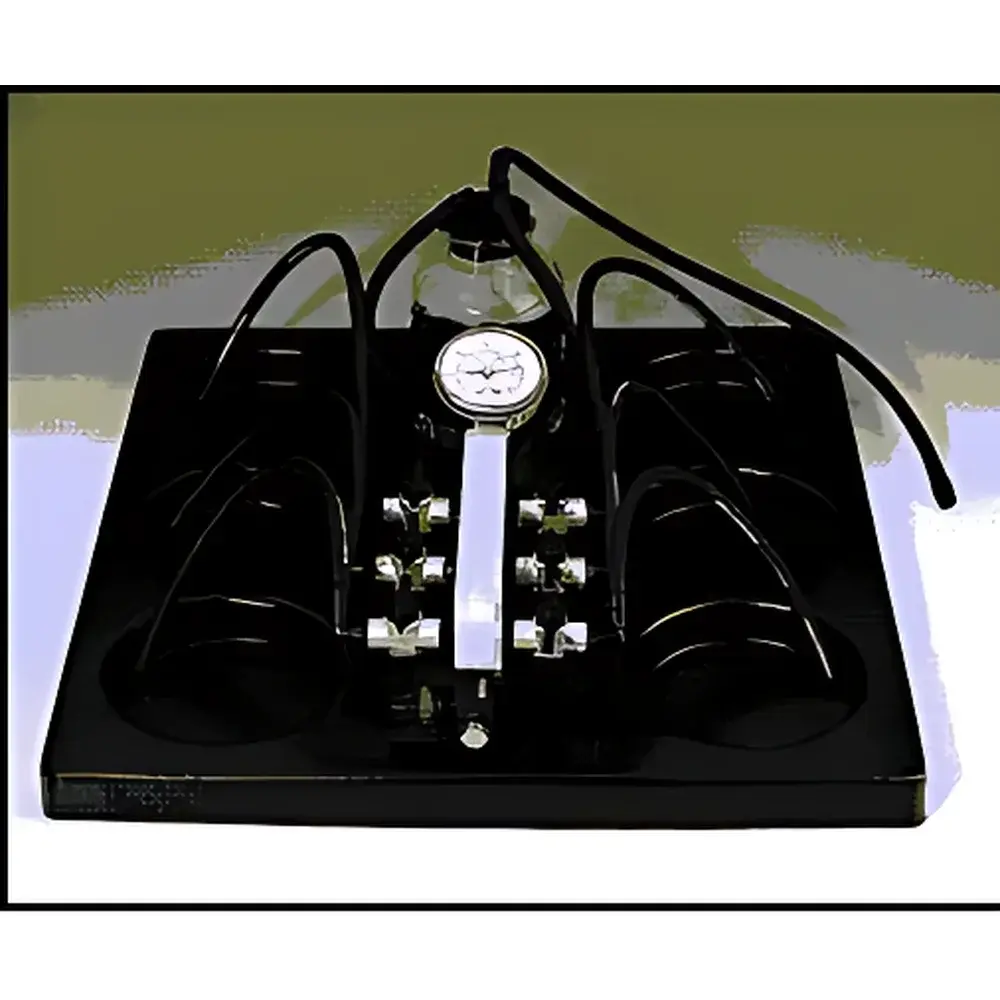
Supelco ENVI-Disk Solid Phase Extraction System
| Brand | Supelco |
|---|---|
| Origin | USA |
| Model | ENVI-Disk |
| Type | Disk-Based Solid Phase Extraction (SPE) System |
| Disk Options | ENVI-8 (C8-bonded, 24 mm), ENVI-18 (C18-bonded, 24 mm), 47 mm & 90 mm formats available |
| Vacuum Source Compatibility | GAST 74329 (imported) or domestic portable vacuum pump |
| Accessories | PTFE spiral clamp (ID 47 mm), PTFE edge gasket, 1 L conical flask (40/35 joint), 25 × 250 mm collection tubes, TF-lined vacuum buffer bottle |
| Compliance | Designed for EPA Methods 508.1, 525.3, 625.1 |
Overview
The Supelco ENVI-Disk Solid Phase Extraction System is a disk-based sample preparation platform engineered for high-volume, high-particulate aqueous matrix processing. Unlike conventional cartridge-based SPE—where analytes pass through a narrow-diameter packed bed with long flow paths—the ENVI-Disk system utilizes flat, porous polymeric or silica-based disks with large surface area and short diffusion pathways. This architecture enables rapid, unimpeded passage of turbid, suspended-solid-laden water samples (e.g., wastewater, surface water, groundwater) without channeling or bed clogging. The system operates under controlled vacuum pressure to drive sample loading, washing, and elution steps in accordance with standardized environmental analytical protocols. Its design adheres to the fundamental principles of adsorption chromatography, where analyte retention is governed by hydrophobic, ion-exchange, or mixed-mode interactions between the disk sorbent and target compounds—including polycyclic aromatic hydrocarbons (PAHs), polychlorinated biphenyls (PCBs), organochlorine pesticides, herbicides, and phthalate esters.
Key Features
- Large-diameter disk geometry (24 mm, 47 mm, and 90 mm formats) ensures low backpressure and resistance to particulate fouling during high-volume sample processing (up to 10 L per disk).
- ENVI-8 (octyl-bonded) and ENVI-18 (octadecyl-bonded) disks provide reproducible reversed-phase retention for nonpolar and moderately polar organic contaminants.
- Modular stainless-steel and PTFE-compatible hardware—including spiral clamps, conical flasks (1 L, 40/35 standard taper), and collection tubes (25 × 250 mm)—ensures chemical inertness and compatibility with aggressive organic eluents (e.g., methanol, acetone, ethyl acetate).
- Vacuum-driven operation supports precise flow rate control via adjustable regulator; compatible with both imported GAST 74329 diaphragm vacuum pumps and validated domestic portable units.
- Integrated TF-lined vacuum buffer bottle prevents pump contamination and safeguards against accidental solvent aspiration during high-flow elution steps.
- System components are designed for full traceability and audit readiness in regulated laboratories—each disk lot is certified with certificate of analysis (CoA) and batch-specific performance data.
Sample Compatibility & Compliance
The ENVI-Disk system is validated for use with raw and filtered aqueous matrices containing suspended solids up to 500 mg/L. It meets method requirements for U.S. EPA SW-846 Methods 508.1 (Organochlorine Pesticides and PCBs), 525.3 (Purgeable and Semivolatile Organic Compounds), and 625.1 (Base/Neutral and Acid Organics). It also aligns with ASTM D7066 (Standard Practice for Extraction of Organic Compounds from Water Using Solid-Phase Extraction Disks) and ISO 17993 (Water quality — Determination of selected organic compounds using solid-phase extraction and gas chromatography–mass spectrometry). All hardware components comply with GLP documentation standards, and disk packaging includes lot-specific QC testing reports supporting method validation and regulatory submission.
Software & Data Management
While the ENVI-Disk system is manually operated, its workflow integrates seamlessly into LIMS- and ELN-supported environments. Each disk lot number is scannable and traceable via Supelco’s online CoA portal, providing immediate access to retention capacity, breakthrough volume, and recovery efficiency data for targeted analytes. Laboratories implementing 21 CFR Part 11 compliance may document all procedural steps—including vacuum pressure settings, eluent volumes, and collection tube labeling—in electronic lab notebooks with time-stamped, user-authenticated entries. Optional SOP templates and method verification checklists are available through Supelco’s Technical Support Portal.
Applications
- Environmental monitoring: Extraction of PAHs, PCBs, chlorpyrifos, atrazine, and di(2-ethylhexyl) phthalate (DEHP) from drinking water, wastewater effluents, and sediment porewater.
- Regulatory compliance testing: Preparation of samples for GC-MS, LC-MS/MS, and HPLC-UV analysis per EPA, APHA, and ISO standard methods.
- Method development labs: Rapid screening of sorbent selectivity across disk chemistries (C8, C18, Florisil, NH₂) under variable pH and ionic strength conditions.
- High-throughput laboratories: Parallel processing of ≥12 samples using multi-port vacuum manifolds and standardized disk holders.
FAQ
What is the maximum recommended sample volume for a 47 mm ENVI-18 disk?
For optimal recovery and minimal breakthrough, the recommended loading volume is 1–5 L for clean water matrices; up to 2 L is advised for turbid or high-dissolved-organic-carbon (DOC) samples.
Can ENVI-Disk systems be used for biological or soil leachate extracts?
Yes—provided samples are pre-filtered (≤0.45 µm) or centrifuged to remove coarse particulates; method optimization is required for complex matrices due to potential matrix-induced suppression or enhancement effects.
Is the vacuum buffer bottle autoclavable?
No—the TF-lined buffer bottle is not designed for steam sterilization; it is intended for single-use or repeated solvent-rinsed reuse under ambient conditions.
Are ENVI-Disk products compliant with EU REACH and RoHS directives?
Yes—Supelco certifies all ENVI-Disk sorbents and associated hardware as REACH SVHC-free and RoHS-compliant; full declarations are available upon request.
How frequently should the PTFE spiral clamp gasket be replaced?
Under routine use with organic solvents, inspect gaskets after every 50 extractions; replace if compression set, cracking, or visible solvent swelling is observed to maintain vacuum integrity.



