
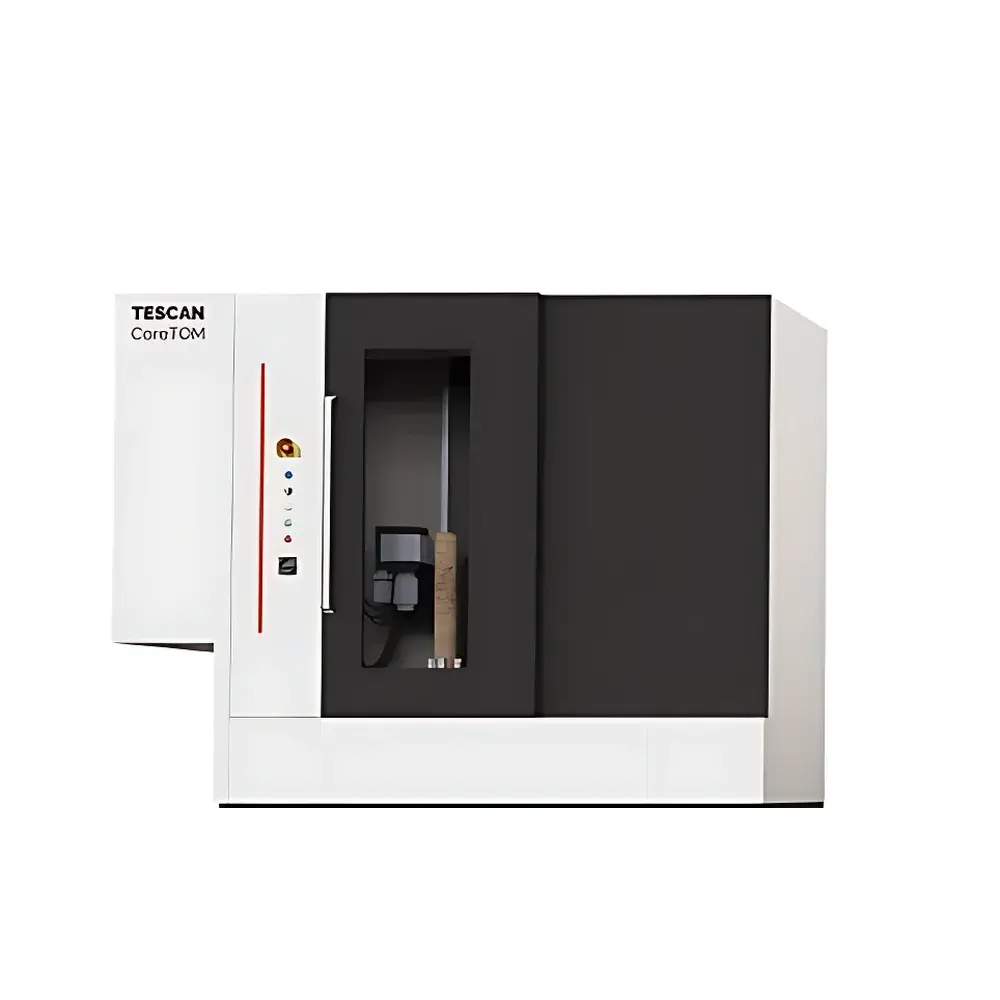
TESCAN CoreTOM Multi-Resolution 3D X-ray Microtomography System
| Brand | TESCAN |
|---|---|
| Origin | Belgium |
| Manufacturer Type | Original Equipment Manufacturer (OEM) |
| Origin Category | Imported |
| Model | CoreTOM |
| Pricing | Available upon Request |
Overview
The TESCAN CoreTOM is a laboratory-based, multi-resolution 3D X-ray microtomography system engineered specifically for geoscience applications. It bridges the performance gap between clinical-scale X-ray imaging and high-resolution X-ray microscopy by integrating dual-domain optical and geometric design principles. Based on cone-beam computed tomography (CBCT) with filtered back-projection and iterative reconstruction algorithms, the CoreTOM delivers isotropic voxel resolutions down to <3 µm while maintaining full-field-of-view capability for specimens up to 1000 mm in length. This enables seamless transition from macro-scale structural analysis — such as stratigraphic layering, fracture networks, and lithological heterogeneity across intact core samples — to micro-scale pore architecture, grain boundary morphology, and mineral phase distribution within millimeter-sized plugs or cuttings. Its modular mechanical architecture supports both static high-fidelity scanning and time-resolved dynamic acquisition, making it suitable for static characterization as well as in situ/operando experiments under controlled fluid flow, pressure, or thermal conditions.
Key Features
- Multi-scale imaging capability: Simultaneous support for whole-core scanning (up to 1000 mm length) and sub-3 µm resolution imaging of small-diameter core plugs or particulate samples
- High-power microfocus X-ray source: Optimized for enhanced photon flux and beam stability, enabling rapid data acquisition with temporal resolution <10 seconds per full 3D volume
- Large-area, high-DQE flat-panel detector: Engineered for superior signal-to-noise ratio (SNR) across varying sample densities and thicknesses, including highly attenuating rock matrices
- Real-time region-of-interest (ROI) navigation: Integrated overview-to-detail workflow allows direct selection and zooming into areas of interest directly from low-resolution scout scans, preserving context while maximizing local resolution
- In situ experimental integration: Dedicated mechanical interface for custom environmental stages, including fluid injection manifolds, load frames, and sensor feedthroughs; compatible with 4D acquisition protocols for time-lapse volumetric monitoring
- Ruggedized gantry design: Precision-aligned rotational stage and linear translation system ensure long-term mechanical stability and repeatability across thousands of scan cycles
Sample Compatibility & Compliance
The CoreTOM accommodates cylindrical and irregular geological specimens ranging from fine-grained sedimentary cuttings (<1 mm) to full-diameter hydrocarbon reservoir cores (up to Ø150 mm × 1000 mm). Sample mounting fixtures are designed for minimal artifact introduction and maximum positional reproducibility. The system complies with IEC 61000-6-3 (EMC emission standards) and IEC 61000-6-2 (immunity requirements), and meets CE marking directives for laboratory X-ray equipment. While not classified as medical devices, its reconstruction pipelines adhere to ISO 12799:2021 (X-ray computed tomography — Vocabulary and definitions) and support traceable calibration workflows aligned with ASTM E1441 (Standard Practice for Computed Tomography (CT) Imaging). Data provenance and audit trails can be configured to meet GLP-compliant documentation requirements.
Software & Data Management
Acquila is a GPU-accelerated, modular software platform developed exclusively for TESCAN micro-CT systems. It provides unified control over acquisition, real-time reconstruction, and post-processing workflows. Key modules include: Acquila Scan (automated protocol definition and hardware synchronization), Acquila Recon (CPU/GPU hybrid iterative and analytical reconstruction with ring artifact suppression and beam hardening correction), and Acquila Analyze (quantitative morphometry, phase segmentation, porosity/permeability modeling, and export to industry-standard formats including DICOM, TIFF stack, and HDF5). Acquila supports scripting via Python API for batch processing and integration with external simulation tools (e.g., OpenPNM, GeoDict). All user actions, parameter changes, and reconstruction logs are timestamped and stored in an embedded SQLite database to satisfy 21 CFR Part 11–aligned electronic record integrity requirements.
Applications
- Petroleum reservoir characterization: Pore-network extraction, capillary pressure curve derivation, and digital rock physics simulations using native-resolution 3D volumes
- Mining and metallurgy: Ore texture analysis, gangue-mineral spatial association mapping, and leaching front progression tracking under reactive flow conditions
- Environmental geochemistry: Clay swelling behavior, contaminant transport pathways in fractured media, and biofilm-mineral interaction studies
- Geomaterial mechanics: In situ triaxial compression testing with concurrent 4D microstructural evolution monitoring
- Planetary analog research: Regolith compaction dynamics, impact cratering simulation, and volatile migration in icy matrix composites
FAQ
What is the minimum achievable voxel size on the CoreTOM system?
The system achieves isotropic voxel sizes down to 2.8 µm under optimal geometric magnification and exposure conditions for small-diameter samples.
Can the CoreTOM perform time-resolved (4D) imaging during fluid injection experiments?
Yes — the integrated in situ stage interface, synchronized acquisition engine, and Acquila’s 4D reconstruction pipeline support dynamic volumetric imaging at sub-minute temporal resolution.
Is Acquila software compatible with third-party reconstruction or analysis tools?
Yes — Acquila exports fully calibrated 3D volumes in standard formats (e.g., TIFF stack, NRRD, HDF5) and provides a documented Python API for custom algorithm integration.
Does the system support automated batch scanning of multiple core plugs?
Yes — Acquila Scan includes configurable sample carousel control and auto-alignment routines for unattended sequential scanning of standardized plug sets.
How is radiation safety managed during operation?
The CoreTOM is fully shielded with lead-equivalent housing and interlocked access doors compliant with EU Directive 2013/59/Euratom; no external shielding or dedicated vault required for standard lab installation.
Related Products



